
 Credits: PetiteProf79 | CC BY-SA 4.0 InternationalLooking back over the past weeks, I would not say that my course on giftedness and 2e profiles fundamentally changed how I understand giftedness. I was already skeptical of attempts to reduce ability to an IQ score, high grades, or unusually fast performance. What changed was the precision of that skepticism. Learning more about twice-exceptionality, or 2e, made it increasingly difficult to treat observable performance as a reliable proxy for ability, support needs, or intellectual level.
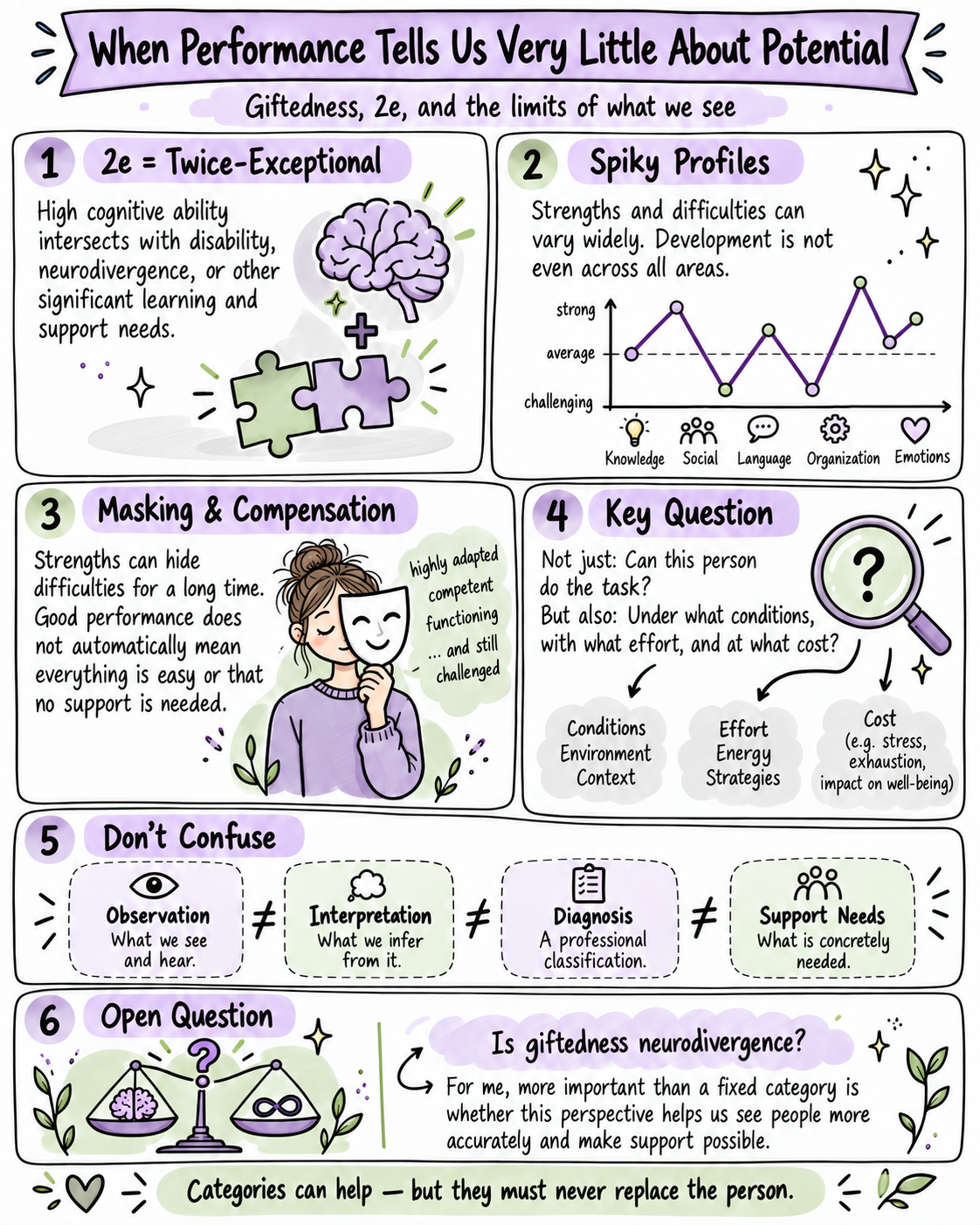
In 2e, high cognitive ability coexists with disability, neurodivergence, or other substantial learning and support needs. Even that description can be misleading when it suggests two neatly separable characteristics. In real lives, these experiences interact. A learner may use cognitive strengths to compensate for years. They may teach themselves content, develop elaborate strategies, invest extraordinary amounts of time, or use strong verbal abilities to conceal difficulties elsewhere. The reverse can happen as well: barriers, inaccessible environments, or overload may prevent high ability from becoming visible at all. What others see may look remarkably average while concealing a highly uneven profile.
This is why the idea of a spiky profile became particularly important to me during the course. It disrupts the expectation that development should be reasonably consistent across domains. A learner can engage with highly complex ideas and struggle with a task that appears simple. Someone may focus intensely for hours in one context and find it nearly impossible to initiate work in another. Strong verbal reasoning can coexist with executive functioning difficulties; heightened sensitivity can sit alongside remarkable analytical ability. These combinations appear contradictory only when consistency is treated as the norm. They make much more sense once variability becomes an expected part of human learning.
When compensation looks like competence
I kept returning to the role of masking and compensation. A system that tends to provide support once difficulty has become sufficiently visible will inevitably overlook people who are able to conceal that difficulty for a long time. Success can paradoxically become one of the reasons support is withheld. The relevant question is no longer simply whether someone can complete a task. We also need to ask under what conditions they are doing so, how much effort it requires, and what the longer-term cost may be.
For twice-exceptional learners in particular, adequate performance tells us very little about whether the environment is actually a good fit. Compensation may work for years and become unsustainable as demands increase. Anxiety, exhaustion, avoidance, or withdrawal may then appear to be a new problem even though they are connected to a much longer history of invisible effort. This also changed how I think about assessment and diagnosis. An observation, our interpretation of that observation, a diagnosis, and an identified support need belong to different levels of reasoning. When they collapse into one another, misinterpretation becomes very easy.
The same caution applies to characteristics that can appear across giftedness, ADHD, autism, and other forms of neurodivergence. Intense interests, hyperfocus, sensory differences, asynchronous development, or particular social experiences cannot reliably be assigned to a category through a checklist. Our work on misdiagnosis therefore did not leave me with a better list for telling people apart. It left me more cautious about the assumption that complex human beings can be classified reliably from isolated observable traits.
Is giftedness a form of neurodivergence?
One question remains intentionally unresolved for me: How should giftedness relate to neurodivergence? There are meaningful reasons to consider giftedness within a broader neurodiversity framework, especially when that allows experiences to become visible that disappear in a purely achievement-oriented view. Asynchronous development, unusual intensity, a substantially different pace of learning, or the experience of rarely finding intellectual peers can shape a person’s relationship with their environment in profound ways.
At the same time, I do not want to equate giftedness with disability or assign a neurodivergent identity to people who would not use that language for themselves. At this point, I find the framing most useful when it changes the questions we ask rather than when it attempts to settle a classification. When giftedness is treated exclusively as an advantage, underchallenge, isolation, and hidden support needs can disappear from view. Pathologizing giftedness creates a different kind of distortion. A neurodiversity perspective can help resist both simplifications.
That may be one of the most important ideas I am taking from this course. Categories can create access to understanding and support. They can also obscure. What matters is whether they help us perceive a person more accurately, or whether at some point we begin to replace the person with the category.
Further Reading
- Baum, Susan M., Robin M. Schader & Steven V. Owen (2017): To Be Gifted & Learning Disabled: Strength-Based Strategies for Helping Twice-Exceptional Students with LD, ADHD, ASD, and More. Azbuki Journals
- Foley-Nicpon, Megan, Susan G. Assouline & Nicholas Colangelo (2013): “Twice-Exceptional Learners: Who Needs to Know What?” Gifted Child Quarterly, 57(3), 169–180. GSD Journal
- Trail, Beverly A. (2011): Twice-Exceptional Gifted Children: Understanding, Teaching, and Counseling Gifted Students. ResearchGate
- Webb, James T. et al. (2016): Misdiagnosis and Dual Diagnoses of Gifted Children and Adults, 2nd ed.
Bildquellen
- Giftedness 1: PetiteProf79 | CC BY-SA 4.0 International
- Neurodiversity: PetiteProf79 | CC BY-SA 4.0 International