
 I have been working with learning environments, the future of learning, and the question of what conditions help people learn well for many years. Universal Design for Learning and neurodiversity are much more recent frameworks for me. I have only been engaging with them more deeply over the past few months. What I discovered fairly quickly was that many things I had been doing for years, based on my pedagogical beliefs and the way I think about learning, aligned surprisingly well with these approaches. The terminology and models were new to me; many of the underlying ideas were not.
When I started my current course on Individual Learning Needs, my perspective shifted again. For the first time, I began looking more closely at the nervous system and sensory processing. Questions I had previously approached mainly through the design of learning environments suddenly became very personal.
I started paying closer attention to myself. I realized that I already knew quite a lot about the conditions that work for me, although I had never connected these observations in this way. I have known for a long time that I work well when I can decide when and how to do something. I organize my tasks, often set my own deadlines, and make intensive use of periods when I can focus particularly well.
Autonomy, focus, and social energy
At the same time, I am very capable of being flexible. Ten years of teaching trained me to change plans within seconds when a situation required it. What I understand more clearly now is that being able to adapt says very little about what that adaptation costs my nervous system. If I am deeply focused and something interrupts me, I can respond without any problem. Afterwards, however, I may be much more restless. I notice this especially when I feel that I have been pulled away from something that was meaningful and important at that moment.
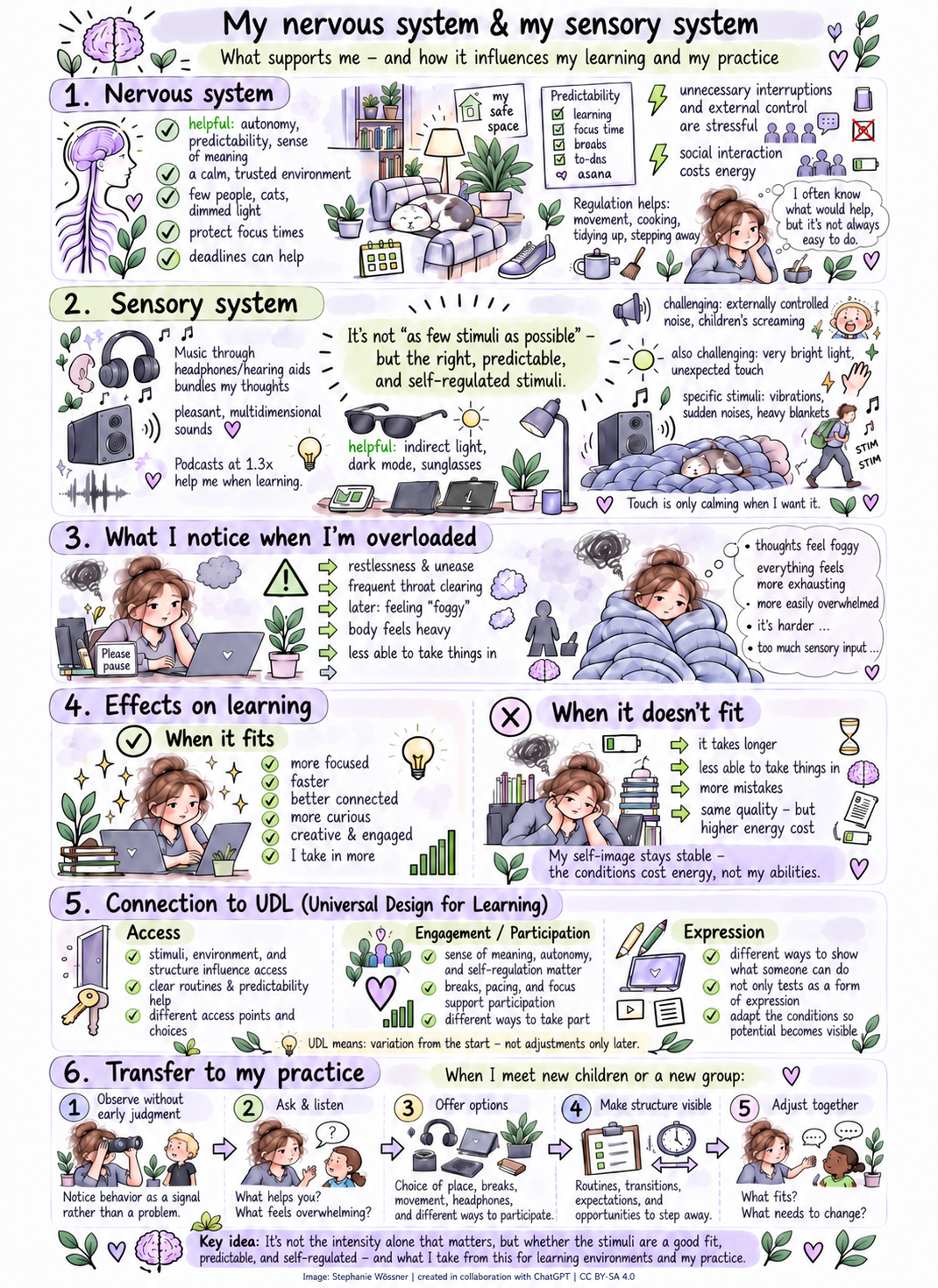
I can now describe some of the things that support my nervous system quite specifically. I like having few people around me, my cats somewhere nearby, a familiar environment, quiet, and light that is not too bright. Autonomy matters a great deal. I have worked in a largely self-directed way for years and have gradually created many conditions that suit me well. I can decide when I need focus time, when to schedule appointments, and how to structure my day. I probably underestimated for a long time how much this autonomy supports me simply because it has become normal in my everyday life.
Social interaction is similarly complex. I enjoy working with people, talking to them, and engaging with them. I also seem to take in a great deal of what is happening socially and emotionally, and that can cost me a lot of energy. When I worked in school, I was surrounded by hundreds of students every day. Only after leaving that environment did I realize how exhausting this must have been for me. Today, an intense day with many interactions can still leave me tired for several days. A crowded subway or a large anonymous city does not have the same effect. The number of people seems to matter less than actually engaging with them and processing everything that comes with that interaction.
Which sensory input works – and when?
My sensory processing cannot really be summarized as simply needing less stimulation either. I actually enjoy some quite intense sensory input. I usually walk faster than other people and rarely enjoy strolling unless I am deliberately wandering through a city. I like heavy blankets. Music streamed directly through my hearing aids or headphones can help bundle my thoughts. My mind often feels a little like having a hundred browser tabs open with music playing somewhere in the background. Certain multidimensional sounds can quiet that internal noise surprisingly quickly. I often prefer podcasts at around 1.3 times normal speed because I find it easier to concentrate. Bass that I can physically feel, vibration, and engine sounds can also be very pleasant.
Other sensory input affects me very differently. A neighbor sawing for hours can make it almost impossible for me to concentrate. I find children screaming particularly exhausting. I do not like very bright light, which is one reason why my apartment now has many indirect, dimmable light sources and almost all my devices are set to dark mode. Touch also depends very much on whether I want it. Unexpected touch from strangers or even people I know can feel uncomfortable. Physical closeness that I choose myself feels entirely different.
What has become increasingly clear to me is that intensity alone explains very little. What often matters is whether I can predict a stimulus, whether it fits the situation for me, and how much control I have over it. Strong bass can be calming, while a quieter sound that I cannot control can be extremely distracting. This makes sensory processing feel much less linear than I initially assumed. My own Sensory Profile does not show one simple pattern either. I show greater sensitivity and actively avoid some types of sensory input, while deliberately seeking other forms of intense stimulation. There are also some aspects of low registration. Once I look at the actual situations behind these scores, that combination no longer feels contradictory.
When the body notices first
The course has also made me pay more attention to how overload shows up in my own nervous system. Here, too, I have started interpreting familiar experiences differently. I often become restless and impatient first. Sometimes I start clearing my throat much more frequently. When the exhaustion becomes stronger, my state changes. I can feel as though I am wrapped in cotton wool. My body feels heavy, I take in less information, and thinking requires more effort.
Interestingly, I usually know what would help: moving, getting on the treadmill for a while, playing with my cats, cooking, tidying up, doing something completely unrelated to work. Yet I often remain at my desk because I can see everything that still needs to be done. This is where I see one of my personal learning goals. I am already fairly good at noticing the signals. Acting on them early enough is another matter.
What conditions do to learning
The effects on my learning and work are quite noticeable. When the conditions fit, I can be very fast. I connect information across different areas, develop new ideas, and often become more curious the longer I learn. It reminds me of opening an encyclopedia to look up one unfamiliar word, finding another interesting term, and eventually ending up somewhere completely different. Those are often the phases in which my best ideas emerge. I can be highly creative and passionate and take in a great deal of information.
When the conditions do not fit, those abilities do not disappear. Everything simply requires more time and energy. I take in less, I am more likely to overlook a small careless mistake, and maintaining the same quality becomes more demanding. My perception of myself does not change because of this. I know what I can do. What frustrates me are conditions that unnecessarily consume capacity.
Another layer to UDL
This has also added another layer to how I understand Universal Design for Learning. When I started looking more closely at UDL a few months ago, I realized that many of its basic ideas were already part of the learning environments I had been designing: different ways of accessing something, choices, different forms of participation, and different ways of making learning visible.
Thinking about the nervous system and sensory processing adds something that can easily remain unnoticed. Access is also affected by how a room sounds, how bright it is, whether movement is possible, how much social interaction is built into a situation, or whether people can step away for a while. Engagement is connected to autonomy, meaning, pace, and regulation. And when a large part of someone’s capacity is already being used to process sensory or social demands, that inevitably affects what they are able to show in that moment.
Reading behavior as information
This insight also changes how I think about neurodiversity-affirming practice. When I meet a new group in the future, I want to become slower to explain behavior and more willing to treat it as information first. A child who keeps getting up may be communicating something about what they need. Another child may participate less because the expected form of participation is exhausting. The room may be too loud, a transition may be too unpredictable, or the social density may simply be too high at that moment. A different place, movement, headphones, a break, or knowing what will happen next may make a significant difference. I do not need to know the explanation in advance. What matters first is not turning an observation into an assumption too quickly.
For my own practice, this suggests an approach that sounds simple and is probably more demanding in reality: observe, ask, listen, and offer options. Make choices visible early. Make routines and transitions understandable. Allow movement, different places, different forms of participation, and opportunities to step away before someone has to provide a special justification for needing them. Then look together at what actually helps and what needs to change.
This also shifts the question for me. It’s not about what might be “wrong” with a child. What is important is what conditions help this particular child regulate, gain access, and show what they are capable of.
Learning environments with more room for variation
It also opens new questions for the learning environments I design. I have already reviewed the Future:Lab Stuttgart from a neurodiversity-informed and intersectional perspective, looking at the space, the concept, and the materials. Sensory needs now give me another layer to examine more closely.
Online courses raise different questions: visual load, audio and video, pace, screen time, breaks, and how much control participants have over the way they participate. Virtual learning environments interest me from the same perspective. I personally feel very comfortable in virtual spaces, while also noticing that their design strongly affects my experience. That raises questions about proximity, movement, sound, visual complexity, and individual settings that could become highly relevant when thinking about future learning environments.
My own nervous system does not provide a model for anyone else. And that would be the wrong conclusion to draw from all of this anyways. Something that regulates me may be deeply uncomfortable for another child or adult. What I find pleasantly stimulating may be far too much for someone else. What I take from this instead is a much stronger awareness of how deeply conditions can shape which abilities are actually accessible in a particular situation.
If we take that seriously, we need fewer ideas about the one optimal learning environment and more possibilities within learning environments. For me, neurodiversity-affirming design increasingly begins where difference does not first have to become visible before it is taken into account.
Bildquellen
- Neurodiversity: PetiteProf79 | CC BY-SA 4.0 International