
In the first recorded video lecture of my new training program to become a trainer in neurodiversity and inclusion with the Positive Psychology Guild in the UK, one idea stayed with me. Reece Coker was discussing the medical and social models of disability and neurodivergence and raised a difficulty that becomes increasingly apparent the more closely we look at different neurocognitive profiles: Where exactly does one end and another begin? ADHD and autism overlap in some areas, dyslexia can occur alongside other forms of neurodivergent information processing, giftedness can involve characteristics that may be interpreted very differently from the outside, and in twice-exceptionality, high cognitive ability and support needs come together in ways that resist simple categorization. Even within the same diagnosis, people may differ from one another far more than the shared label suggests. In this context, Coker introduced the idea of a Periodic Table of Neurodiversity. Not a finished theory that I could simply adopt, but more of a conceptual prompt. That was precisely what made it interesting to me.
After the lecture, I started exploring the idea further with ChatGPT. At first, it was not at all clear what such a periodic table should actually contain. Using diagnoses as individual elements seemed obvious: autism, ADHD, dyslexia, dyspraxia, Tourette syndrome, giftedness, and other categories, each in its own box. The more I thought about it, however, the less convincing that version became. It would simply have reproduced the familiar diagnostic order in a different visual form. People would still have been assigned to a box or left wondering which combination of boxes described them best. The original tension raised in the lecture would have disappeared: perhaps it is precisely the boundaries between categories that we need to examine more closely.
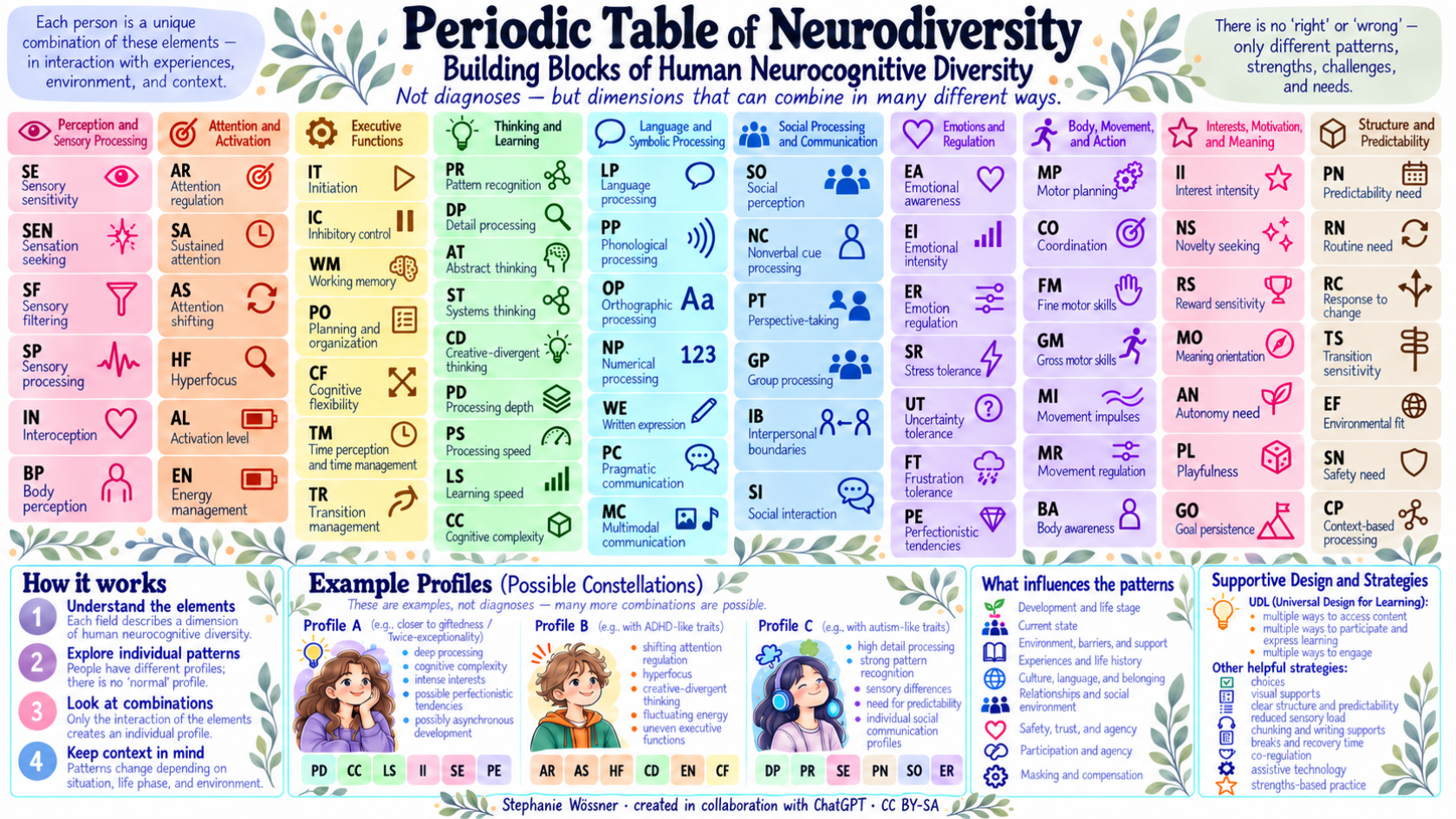 Credits: Stephanie Wössner | CC BY-SA 4.0 International
Diagnoses Matter — and Still Do Not Explain Everything
There are good reasons for diagnostic categories. I do not want to minimize that. A diagnosis can help make sense of experiences, support self-understanding, connect people with others, provide access to medical or therapeutic care, and establish eligibility for legal accommodations or other forms of support. For some people, receiving a diagnosis retrospectively changes how they understand a large part of their lives. Behavior that may have been interpreted for years as lack of effort, oversensitivity, unreliability, or personal inadequacy suddenly acquires a different context. Research and specialized care also require concepts that allow recurring patterns to be described.
And yet a tension remains. The categories we need in order to recognize certain patterns and organize support are not identical to the boundaries of human neurocognition. Attention, sensory processing, language, working memory, motor processing, emotional regulation, pattern recognition, cognitive flexibility, or the intensity of interests do not respect diagnostic boundaries. People bring different combinations and different expressions of these dimensions. Some appear across several diagnostic profiles, while others are present only in some people who share the same diagnosis. Some characteristics become visible primarily under stress; others almost disappear when the environment and its demands are a good fit. Development, experiences, current state, stress, safety, relationships, masking, and compensation add further layers. A diagnosis can therefore never fully tell us how a particular person will perceive, learn, or act in a particular situation.
From Diagnoses to Neurocognitive Constellations
This is where the periodic table became interesting to me. In our exchange, we removed diagnoses from the boxes and replaced them with dimensions of neurocognitive diversity: sensory sensitivity, sensation seeking, and sensory filtering; attention regulation, sustained attention, and hyperfocus; working memory, cognitive flexibility, and time perception; pattern recognition, processing depth, processing speed, creative and systems thinking; language processing, motor planning, emotional regulation, interest intensity, autonomy needs, and playfulness. We also included dimensions that can be relevant in the context of giftedness and twice-exceptionality, such as cognitive complexity, learning speed, intense interests, and perfectionistic tendencies. None of these concepts replaces or enables a diagnosis. What matters is the constellation.
A person may think at a highly complex level while simultaneously experiencing difficulties with planning or working memory. Someone may grasp connections extraordinarily quickly and still need considerable time for transitions. Hyperfocus does not contradict difficulties with attention regulation; the question of how voluntarily attention can be directed and disengaged changes the perspective. Sensory sensitivity can be profoundly challenging under certain conditions and barely noticeable in another environment, or it may contribute to highly differentiated perception. Perfectionism, too, cannot meaningfully be classified as an isolated strength or difficulty. It may be connected to high personal standards, sensitivity to errors, experiences, uncertainty, or a need for control. The individual elements explain little on their own. It is their interaction, their particular expression, and the context that create a profile.
A Profile Never Exists Outside Its Context
At this point, the periodic-table metaphor itself reaches a limit. Chemical elements are comparatively stable. Human neurocognition does not manifest independently of biology, situation, and life history. That is why the image needed another layer: development and life stage, current state, environment and barriers, support, experiences, culture and language, relationships, safety and belonging, masking and compensation. A profile never exists separately from these conditions. What becomes visible to others is always partly shaped by the situation. A person may possess certain capacities and temporarily have limited access to them under high stress. An environment can likewise intensify or reduce barriers. This does not change the person arbitrarily, but it changes what becomes possible.
This brings me back to the relationship between the medical and social models. The medical model directs attention more strongly toward individual characteristics and impairments, while the social model focuses on barriers and structures through which differences become disabling or are made more disabling. When thinking about neurodiversity, neither perspective is sufficient on its own. Neurocognitive differences are real. So are environments that assume particular ways of perceiving, communicating, or working and make others more difficult. What becomes interesting is the relationship between the two: Which demands meet which profile? What support is available? How much adaptation is silently expected from the individual? And who gets to decide which form of adaptation is considered self-evident? One thing remains clear: the person must remain at the center.
When Diagnosis Becomes an Entry Ticket
This also changes how we look at diagnosis. When support in our society is frequently tied to a diagnosis, the diagnosis becomes a prerequisite for access. Anyone who needs accommodations, specific assistive tools, or other forms of institutional support is often required first to prove that they belong to a recognized category. There are understandable reasons for this. Resources have to be allocated, medical interventions require professional indications, and legal entitlements need criteria. Still, we can ask what barriers we create through these arrangements. What happens to people who wait a long time for an assessment? To those whose profile appears less stereotypical? To people who need support but do not seek a diagnosis or cannot access one? And why should someone need medical legitimization for some very simple changes in the first place?
I find this question particularly relevant in education and the workplace. Many forms of supportive design do not need to be reserved exclusively for people with a diagnosis. Different ways of accessing information and expressing outcomes, clear structures, transparent expectations, visual supports, options for reducing sensory load, breaks, assistive technologies, meaningful choice, or forms of co-regulation can be available before someone has to prove why they need them. This is why Universal Design for Learning fits so well into the further development of the periodic table for me. UDL is less another category within the system than a response to the diversity it makes visible: if we start from variable profiles, we design learning environments from the outset in ways that take variation into account.
This does not mean that every form of support can be made available without limits or assessment, or that diagnosis loses its significance. A society without any form of categorical decision-making is hardly realistic, and diagnoses remain important in medical care and specialized therapeutic contexts. But the threshold can shift. Not every need has to be pathologized or diagnostically confirmed before anyone is allowed to respond to it. An inclusive society could distinguish more carefully between support for which a professional diagnosis is genuinely necessary and forms of design that can be accessible regardless of label. Diagnoses would remain important, but they would less often function as the entry ticket required for a person’s needs to be regarded as legitimate in the first place.
A Space for Thinking Rather Than a New Classification System
The Periodic Table of Neurodiversity is a visualization that can make ambiguity visible: overlaps, uneven profiles, different constellations, and the extent to which their meaning depends on context. Established diagnoses can describe particular recurring patterns within this space. That does not make them wrong or unimportant. They simply do not exhaust the full space of human neurocognitive diversity.
And perhaps this changes the question we start with. Instead of first asking which diagnosis explains a person, we might more often ask: What does this individual profile look like? What works under which conditions? Where do barriers emerge? Which forms of support actually change something? For which decisions do we need a diagnostic category, and where do we continue to require one simply because our systems have historically been organized that way?
The periodic table does not offer a finished answer. For me, that is precisely where its value lies. It emerged from an idea introduced by Reece Coker, my own continued thinking, and a collaborative process with ChatGPT. It is not an endpoint, but rather a space for thinking about a society in which human diversity does not first have to receive an official label before it can be recognized.
Bildquellen
- Periodic Table of Neurodiversity: Stephanie Wössner | CC BY-SA 4.0 International
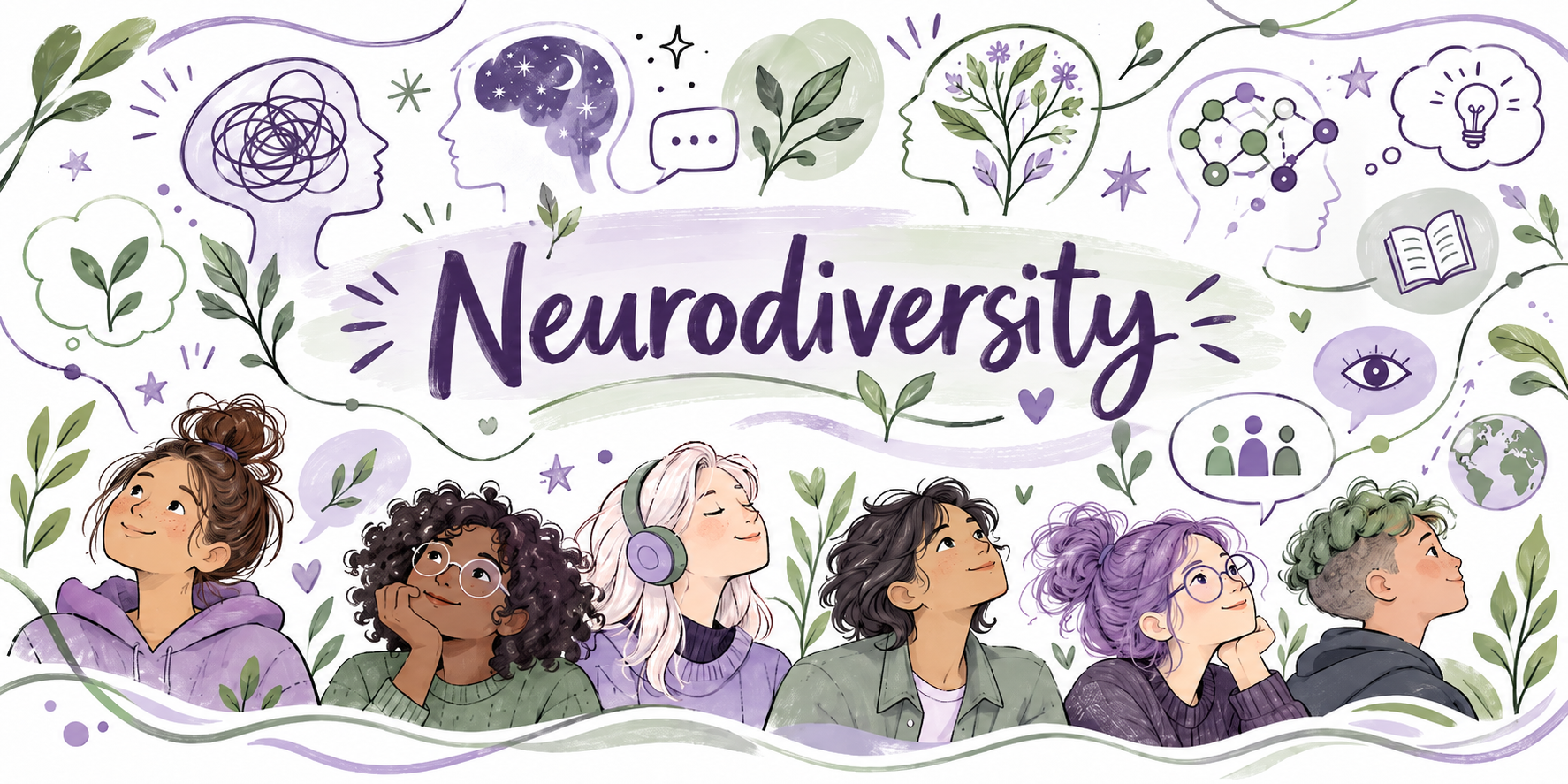
- Neurodiversity: PetiteProf79 | CC BY-SA 4.0 International