
 Sometimes we know how to do something and still find it almost inaccessible in a particular moment. A learner may solve a task without much difficulty one day and sit in front of a similar one the next as if the route towards it had disappeared. Someone who usually expresses themselves easily may struggle to find words under stress. Another person may normally be good at planning, making decisions, or keeping track of several things and suddenly realise that one more small demand is too much. These experiences are hardly unusual. Yet in education, we often treat abilities as though they were equally available at all times.
What is available to us in a given moment
The work of US psychiatrist Bruce D. Perry offers an interesting perspective on this. His Neurosequential Model in Education (NME) grew out of his work on development and trauma and brings ideas about stress, regulation, and neurodevelopment into educational settings. Perry explicitly describes NME as something other than a specific intervention. It is intended to help educators understand behaviour and performance in relation to development and context, particularly when working with children and young people who have experienced adversity.
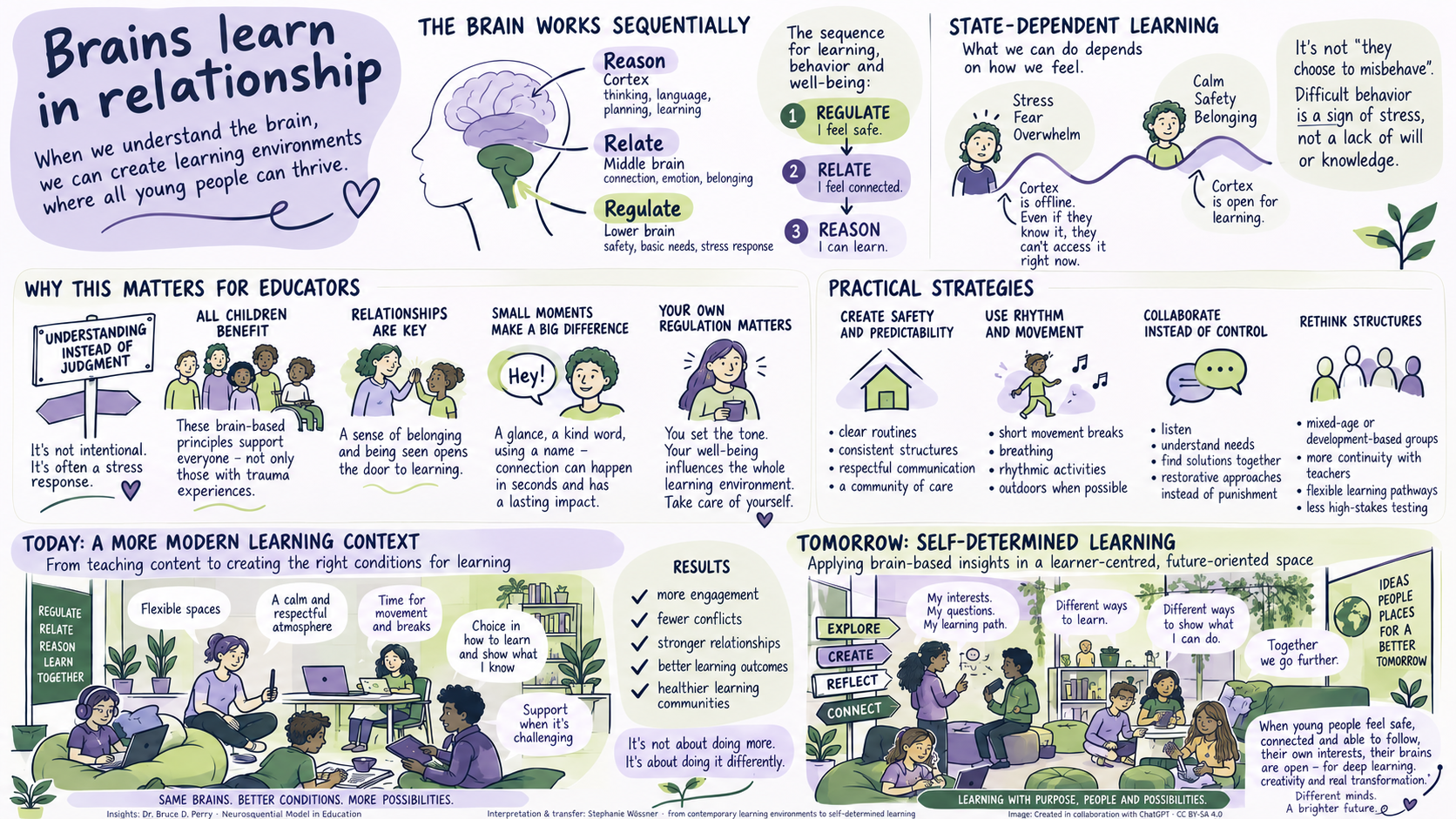
One term Perry uses is state-dependent functioning. What interests me is less the terminology than what it describes: what is available to us at a given moment also depends on our current physical and emotional state. Stress changes what we can access, how we perceive what is happening, how quickly we react, how readily we can work with complex information, and how easy it is to remain connected with other people.
A capacity has not necessarily disappeared simply because somebody cannot access it in a particular situation. That distinction matters educationally. If a learner cannot show something at a given moment, we do not yet know whether the knowledge is missing, the task is unclear, the environment is consuming too much of their attention, or something entirely different is happening. Yet such situations are easily turned into descriptions of the person: unfocused, unmotivated, disorganised, difficult. Those labels sound stable. A person’s state is not.
“Regulate, Relate, Reason” – and what I take from it
Perry’s phrase “Regulate, Relate, Reason” has become widely known. In his series Stress, Trauma, and the Brain: Insights for Educators, he describes regulation as an important condition for relational engagement and more complex thinking.
I would be careful about turning this into a fixed pedagogical sequence. Human beings do not move neatly through separate stages until they finally arrive at reasoning. What I find useful is the reminder that thinking is embodied. Attention, language, memory, social interaction, and problem-solving do not happen independently of whether somebody feels safe, exhausted, tense, overwhelmed, or overloaded by sensory input.
This changes the kinds of questions we might ask about behaviour. Withdrawal, impulsive responses, or difficulty engaging with a task should not automatically be explained by stress, much less trauma. Perry’s work comes from a trauma-informed context, and extending that explanation to everybody would create a different kind of simplification. The question “what is happening here between this person and this environment?”, however, remains useful. It leads somewhere quite different from asking what is wrong with the person.
Neurodiversity: a connection, not an equation
This is also where I see a connection with neurodiversity, while keeping the distinction clear. Neurodivergence and trauma are not the same and should not be conflated. What connects the two discussions for me is attention to context.
A room may be physically the same room for everyone and still be experienced very differently. Noise, lighting, smells, social proximity, movement, unclear expectations, or rapid shifts between demands may barely register for one person and consume a substantial part of another person’s available attention. Even for the same person, what works well today may be difficult tomorrow.
It might be tempting to conclude that good learning environments should therefore always be calm, highly predictable, and low in sensory stimulation. Human variability makes that conclusion difficult to sustain. Some people need movement while others need quiet. Some seek sensory input, others need to reduce it. Predictability can create a sense of safety and can also become constraining when everything is predetermined. Openness may feel liberating to one learner and leave another without enough orientation.
Designing environments that offer possibilities
I am more interested in environments that make different forms of regulation possible. A quieter place can be available without somebody being sent there. Movement can be possible without becoming a compulsory “movement break”. Information can be structured in ways that support orientation while still leaving room for different pathways. A break does not have to be earned by reaching a point of visible exhaustion. Over time, learners can also become more able to recognise what helps them and to communicate it without every difference from an assumed norm requiring justification.
This also complicates the way we talk about self-regulation. In education, it is often treated as an individual skill. Learners are expected to manage their attention, control their emotions, organise themselves, and remain focused despite distraction. People clearly can develop capacities in all of these areas. Yet nobody regulates completely independently of other people or of the environments they inhabit.
Relationships can reduce stress or intensify it. Structures can provide orientation or continuously consume additional energy. Some demands are challenging because learning can and should involve challenge. Others are barriers with very little relationship to the learning itself.
Regulation is not an individual responsibility alone
Perry also turns his attention to educators. In his series for schools, he addresses adult regulation and the effects of stressful educational and organisational environments. I find this important because conversations about resilience and self-regulation otherwise risk becoming rather one-sided. Teaching people better strategies for coping with difficult conditions is relatively easy. Asking which of those conditions are produced by the institution itself, and which of them could be changed, is more uncomfortable.
Where Perry’s brain model becomes too simple
I would nevertheless be cautious with some of the neuroscience used to explain the Neurosequential Model. Some representations draw a very clear hierarchy between the brainstem, limbic system, and cortex. The image is intuitive and has therefore travelled widely through educational contexts. Contemporary neuroscience, however, does not support such a simple division. The older notion of a largely “triune” brain, with evolutionarily older parts responsible for survival and emotion and a newer cortex responsible for rational thought, does not adequately describe how the brain works. Emotion and cognition involve interconnected networks, and stress responses cannot be assigned neatly to different floors of the brain.
That limitation does not make the educational question disappear. Stress affects perception and what becomes accessible to us. We do not need an oversimplified map of the brain to take that seriously. It may even be more useful to spend less time deciding which part of a person’s brain is supposedly “in charge” and more time looking at what they are perceiving, how much energy the situation requires, and what might give them better access to learning.
Agency depends on conditions
This brings me back to a question that also runs through my Future:Guide Education and Learning for a Livable Future: under which conditions can people become active shapers of their learning and their futures?
Agency is often associated with freedom, choice, and responsibility. All of these matter. I find it difficult, however, to assume that self-determination automatically increases as soon as adults provide less structure. An open learning environment can overwhelm just as much as a tightly controlled one. A learner who already uses a substantial amount of energy processing sensory input, navigating social expectations, or trying to establish orientation may experience additional choices differently from somebody for whom those things require little effort.
This is why I understand agency as relational. People develop the capacity to act in relationships with others and within conditions that allow them to bring their own capacities into a situation. Freedom and boundaries, orientation and room to move, retreat and connection may all matter. The useful balance cannot be determined in advance for every learner.
Perhaps this is one of the more interesting implications of Perry’s work for education. It does not give us instructions for constructing the perfect learning environment. It draws attention to something that easily disappears in systems strongly organised around performance and visible outcomes: a person does not have the same access to themselves every day and in every situation. The educational question then includes more than what somebody can do. It also asks what is making access to those capacities easier or harder at this particular moment—and how much of that is being created by the environment around them.
Sources and further reading
Bruce D. Perry / Neurosequential Network: Neurosequential Model in Education (NME). Link
CET/ThinkTV Education: Stress, Trauma, and the Brain: Insights for Educators. Link
Steffen, Patrick R.; Hedges, Dawson; Matheson, Rebekka (2022): The Brain Is Adaptive Not Triune: How the Brain Responds to Threat, Challenge, and Change. Frontiers in Psychiatry 13. Link
Bildquellen
- Neurodiversity: PetiteProf79 | CC BY-SA 4.0 International