

ADHD is still described linguistically in terms of an attention deficit and hyperactivity. This suggests that attention is fundamentally lacking and that we are dealing with a person who simply cannot sit still. The more I engage with the topic, the less convincing I find that idea. People who have been diagnosed with ADHD can concentrate very intensely, sometimes for extended periods of time. What is often more difficult is voluntary regulation: directing attention toward a particular task at a particular time, sustaining it there, disengaging from it again, or shifting it elsewhere. Deliberately controlled attention (directed attention) is consciously applied, for example when beginning and continuing a task that is not particularly interesting. Automatic attention responds more strongly to interest, novelty, or immediate relevance. This distinction is simplified, but it aligns with what we know about hyperfocus: Hyperfocus does not mean that the ADHD has somehow “disappeared.” Concentration can become extraordinarily intense while the person has little control over when it begins, what it locks onto, or when they are able to disengage from it.
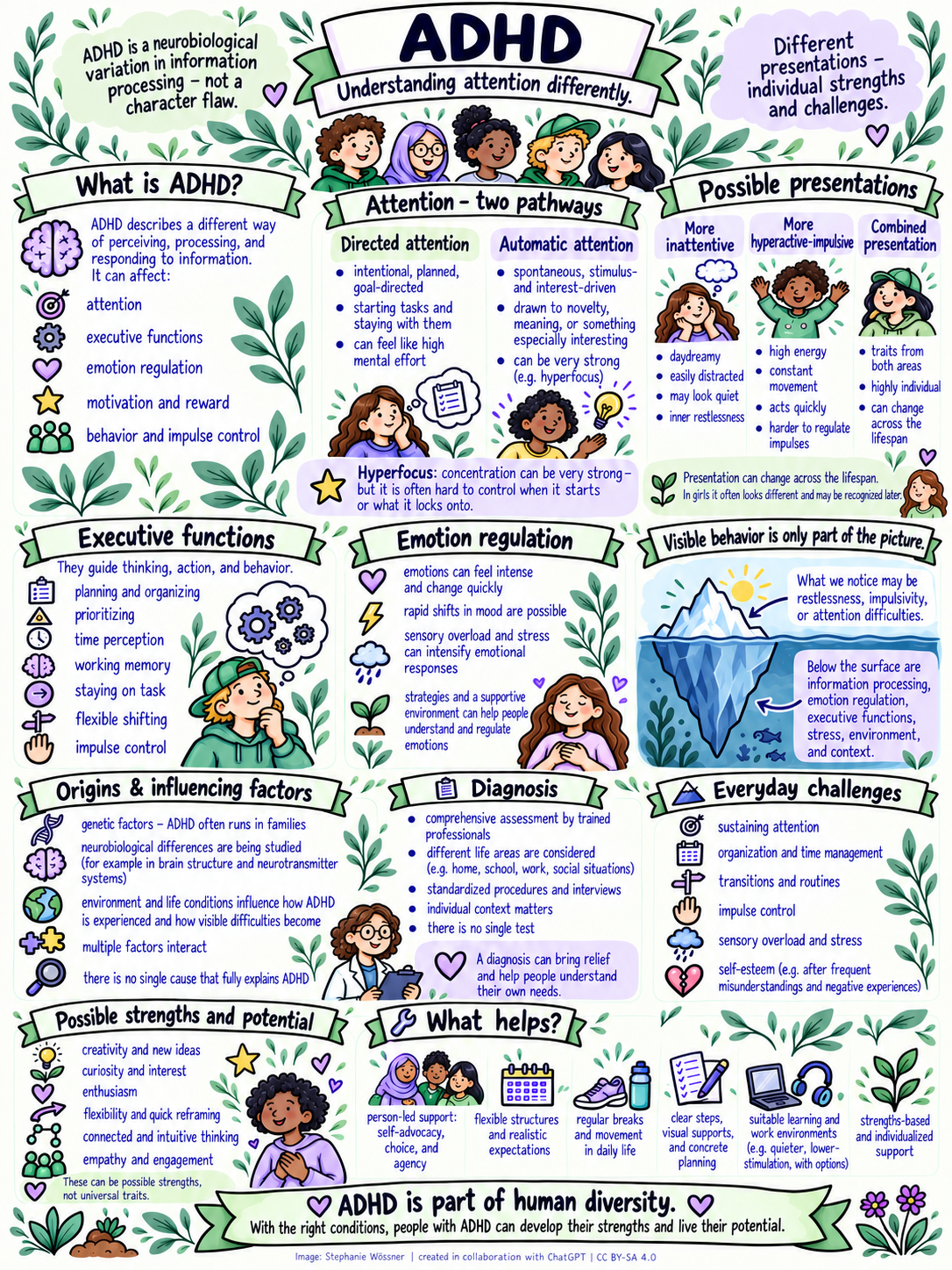 Credits: Stephanie Wössner | CC BY-SA 4.0 InternationalThis also changes how we interpret everyday situations. A person may spend hours working on a highly engaging topic and then, shortly afterward, struggle to begin a comparatively simple task at all. The statement “You can concentrate when you want to” misses the difference between being capable of concentration and being able to regulate it voluntarily. Interest, novelty, challenge, immediate feedback, or urgency can have a powerful effect on attention. The fact that a task is objectively important does not mean that it automatically becomes accessible to a person’s attention and motivation systems. This is precisely why it is so unhelpful to infer motivation or willingness directly from visible behavior.
This can be compared to an iceberg: What we can see may include restlessness, impulsivity, difficulty concentrating, or forgetfulness. Beneath the surface are processes that are much harder to observe from the outside: information processing, emotions, executive functions, stress, co-occurring conditions, the environment, and the judgments a person experiences from others. I find this perspective useful because it shifts attention away from isolated behavior and toward the factors that help produce that behavior. Not every task that remains unstarted reflects a lack of motivation. Not every instance of being late reflects indifference. Not every impulsive action is a deliberate decision to disregard rules or other people.
Executive Functions, Regulation, and Different Presentations
Executive functions are closely connected to all of this. Planning and organizing, prioritizing, estimating time, holding information in working memory, starting and completing a task, shifting flexibly between activities, or regulating impulses can require very different levels of conscious effort. The visible outcome tells us little about that effort. Someone may know exactly what needs to be done and still be unable to start. A person may take an appointment very seriously and still struggle with time perception. A transition between activities may look minor from the outside while requiring considerable effort internally. The iceberg image captures exactly this difference: Much of what makes a situation difficult remains invisible to other people.
ADHD also presents in very different ways. Diagnostic frameworks distinguish between predominantly inattentive, predominantly hyperactive-impulsive, and combined presentations, and these presentations can change over the course of a person’s life. A predominantly inattentive presentation may involve daydreaming, distractibility, internal restlessness, or difficulty sustaining effort while appearing relatively quiet from the outside. In a more strongly hyperactive-impulsive presentation, a need for movement, high energy, spontaneous action, frequent talking, or difficulty waiting may be more visible. Girls and women are sometimes identified later for precisely this reason, because their presentations may fit less easily with the long-dominant image of the hyperactive boy.
Emotional regulation also belongs more clearly within this picture than the term ADHD itself might initially suggest. Emotions may be experienced intensely, emotional states may shift quickly, and frustration or sensory overload can make regulation more difficult. There are also experiences that develop secondarily: repeatedly being misunderstood, being unable to manage organization reliably despite considerable effort, or hearing for years that one simply needs to try harder can affect a person’s self-esteem. Alongside concentration, sleep, energy, emotional and behavioral regulation, executive functions, relationships, and self-esteem are all relevant areas. Here too, looking beneath the surface tells us more than a list of visible symptoms.
The causes cannot be reduced to a single factor. According to current research, genetic influences play a strong role, while differences in neural networks, brain development, and neurotransmitter systems continue to be investigated. The precise significance of individual findings therefore remains unresolved. At the same time, environment, living conditions, and stress influence how strongly difficulties become visible in specific situations. Explanations based on parenting, lack of willpower, or intelligence do not hold up. But it is equally insufficient to view ADHD solely as an individual neurological problem. Neurological profile, demands, relationships, structures, and concrete living conditions interact. This is why it makes sense to consider both medical and social models of ADHD.
A diagnosis therefore draws on a broader assessment across different areas of life, developmental history, conversations, observations, and standardized measures; there is no single test that can simply prove the presence of ADHD. A diagnosis can bring relief because experiences suddenly make more sense and support needs can be named. It still does not explain what ADHD looks like in this particular person. That is why we should be careful not to simply attach a label to someone too quickly: self-advocacy, self-efficacy, and the person’s own perspective need to move much more clearly into the foreground. A label can provide orientation. It cannot replace individual experience or the question of what a person actually needs.
Support and Strengths Remain Individual
The same caution is useful when talking about possible strengths. These can include hyperfocus, creativity, lateral thinking, problem-solving, spontaneity, energy, humor, empathy, openness, and resilience. These may be genuine strengths for individual people. They are not traits that automatically come with ADHD, nor are they compensation that somehow needs to justify the difficulties a person experiences. A person may be creative or not at all; strong interests may open access to attention while simultaneously making other things extremely difficult to reach. Strengths and challenges therefore need to be taken equally seriously. I consider this particularly important because a neurodiversity-affirming perspective can easily be misunderstood as requiring every difficulty to be reframed as a special strength.
Support therefore needs to be a good fit for the individual. Clear and visible structures can reduce demands, as can realistic time planning, concrete steps, movement, breaks, a lower-stimulation environment, or choices in how to learn and work. Interests can be used meaningfully when they genuinely belong to the person. Some people need more external structure, while others experience too much control as an additional burden. A respectful and affirming environment is more than a pleasant addition because ongoing shame and misinterpretation can themselves become part of the burden.
This is also where the term person-led becomes relevant. Support does not begin with other people deciding which strategy works for “people with ADHD.” It begins with the specific person, their perception, their experiences, and the conditions under which they are able to act. When individual experience becomes the starting point, self-advocacy—the ability to speak up for oneself—and self-efficacy—belief in one’s own ability to act—are not additional skills to be trained afterward. They are part of the larger question of who gets to define support and who has a say in determining which conditions are appropriate.
For me, ADHD is therefore becoming less useful to understand through the question of whether attention is present. What is more interesting is how attention is organized, what captures it, what allows it to shift, what invisible regulatory work is involved, and which conditions make existing abilities genuinely accessible. A diagnostic term can provide a framework for that. Understanding begins only when the actual person becomes visible within it again.
Bildquellen
- ADHD: Stephanie Wössner | CC BY-SA 4.0 International
- Neurodiversity: PetiteProf79 | CC BY-SA 4.0 International