
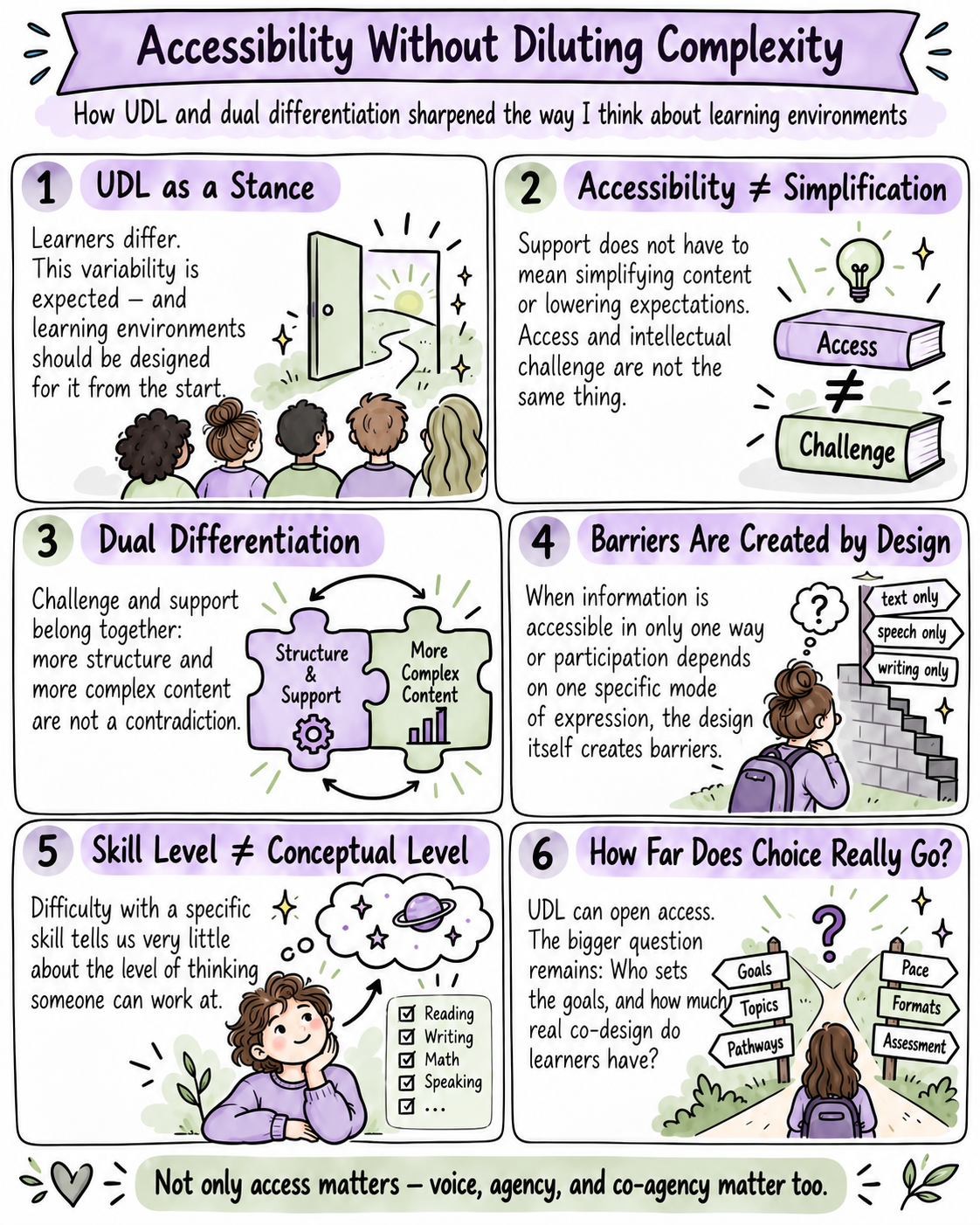
 Credits: PetiteProf79 | CC BY-SA 4.0 InternationalUniversal Design for Learning did not introduce me to an entirely new educational philosophy. Much of it aligns with how I already think about learning: learners vary, that variability should be expected, and learning environments should anticipate it before an individual is treated as an exception to the intended design. What the course gave me was a more precise framework for translating that stance into concrete design decisions.
This matters, for instance, in the context of giftedness and 2e. Accessibility is still easily confused with simplification. A learner who needs support may receive easier work, less content, or lower expectations. With a twice-exceptional profile, that response can miss the point entirely. Difficulties with reading, writing, attention, organization, sensory processing, or communication tell us very little by themselves about the conceptual level at which someone can think. Support therefore does not have to mean reducing intellectual complexity.
The concept of dual differentiation became especially useful to me here. Challenge and support are designed together. A learner may need more structure and more complex content. They may use assistive technology while engaging with highly abstract problems. They may require additional time for a particular form of production and still think far beyond the level of the assigned task. Once these combinations stop appearing contradictory, the design of learning environments begins to look very different.
Barriers are also created by design
UDL shifts part of our attention from the individual to the learning environment. If information is available in only one form, participation depends on one preferred mode of communication, or competence can only be demonstrated through a narrowly defined product, the design itself creates barriers. Multiple ways of accessing information, participating, and expressing thinking then become part of the initial design rather than accommodations added later for particular learners.
For me, this connects closely to neurodiversity-affirming practice. The central question becomes less about how successfully an individual fits an existing process and more about the conditions that enable or constrain learning. This does not make individual support needs disappear. An environmental perspective should never be used to minimize disability, distress, or the need for specific supports. It simply prevents every difficulty from automatically being treated as an inherent deficit in the person.
This is where I find the connection between UDL and 2e especially productive. Someone can need support with a particular skill without that need defining their overall learning potential. The distinction between skill level and conceptual level is useful for exactly this reason. Difficulty with one skill does not require us to lower the intellectual level of the work.
How far does choice really go?
There is one point at which UDL still feels incomplete to me. A learning environment can provide highly flexible routes toward a predetermined goal while leaving unanswered who selected that goal and whether learners have any influence over it. An exceptionally accessible learning experience can remain externally controlled.
This is why learner voice and co-agency became increasingly important to me as the course progressed. I am interested in choice when that choice has consequences. Offering three predetermined formats for completing the same task can be useful. Agency, however, reaches further than selecting from a menu. It includes questions, goals, methods, relationships, and the ability to challenge the direction that has been set. Feedback becomes participation when it can actually change something.
That question extends well beyond giftedness and 2e. It goes to the core of how I understand learning. I am not particularly interested in perfecting learning environments so that increasingly diverse learners can move more smoothly through the same predetermined structures. I am interested in how those structures themselves become open to change and how learners can participate in changing them.
After this course, UDL is a useful tool for me, but it is neither a complete educational model not the only answer. It helps me identify barriers more systematically, separate accessibility from intellectual challenge, and design for learner variability from the beginning. The larger question remains: Who gets to shape what learning is for?
Further Reading
CAST (2024): Universal Design for Learning Guidelines 3.0. UDL Guidelines
Meyer, Anne & David H. Rose, ed. David Gordon (2025): Universal Design for Learning: Principles, Framework, and Practice, 3rd ed. CAST
Lewis, Katie D. & Molly E. Milam (2026): “Powerful Learning: Dual Differentiation for Twice-Exceptional Learners.” Sage Journal
Bildquellen
- Giftedness 2: PetiteProf79 | CC BY-SA 4.0 International
- Neurodiversity: PetiteProf79 | CC BY-SA 4.0 International