
An educator walks around the room, observes what the learners are working on, looks over their shoulders, and intervenes when someone seems to be off task. She wants to offer support, identify difficulties early, and make sure no one falls behind. At first, this sounds like responsible educational practice. But what does it feel like when someone is constantly watching what you do? When every movement is noticed and support is sometimes offered before you have even had a chance to try something yourself? Neurodivergent learners in particular may find that their behavior is monitored more closely and corrected more quickly than that of others. What is seen as harmless distraction in one child may be interpreted as a manifestation of another child's diagnosis. Even well-intentioned support can then feel like a lack of trust. Having someone constantly at your side, ready to intervene whenever you encounter a difficulty, also sends a message about what others believe you are capable of.
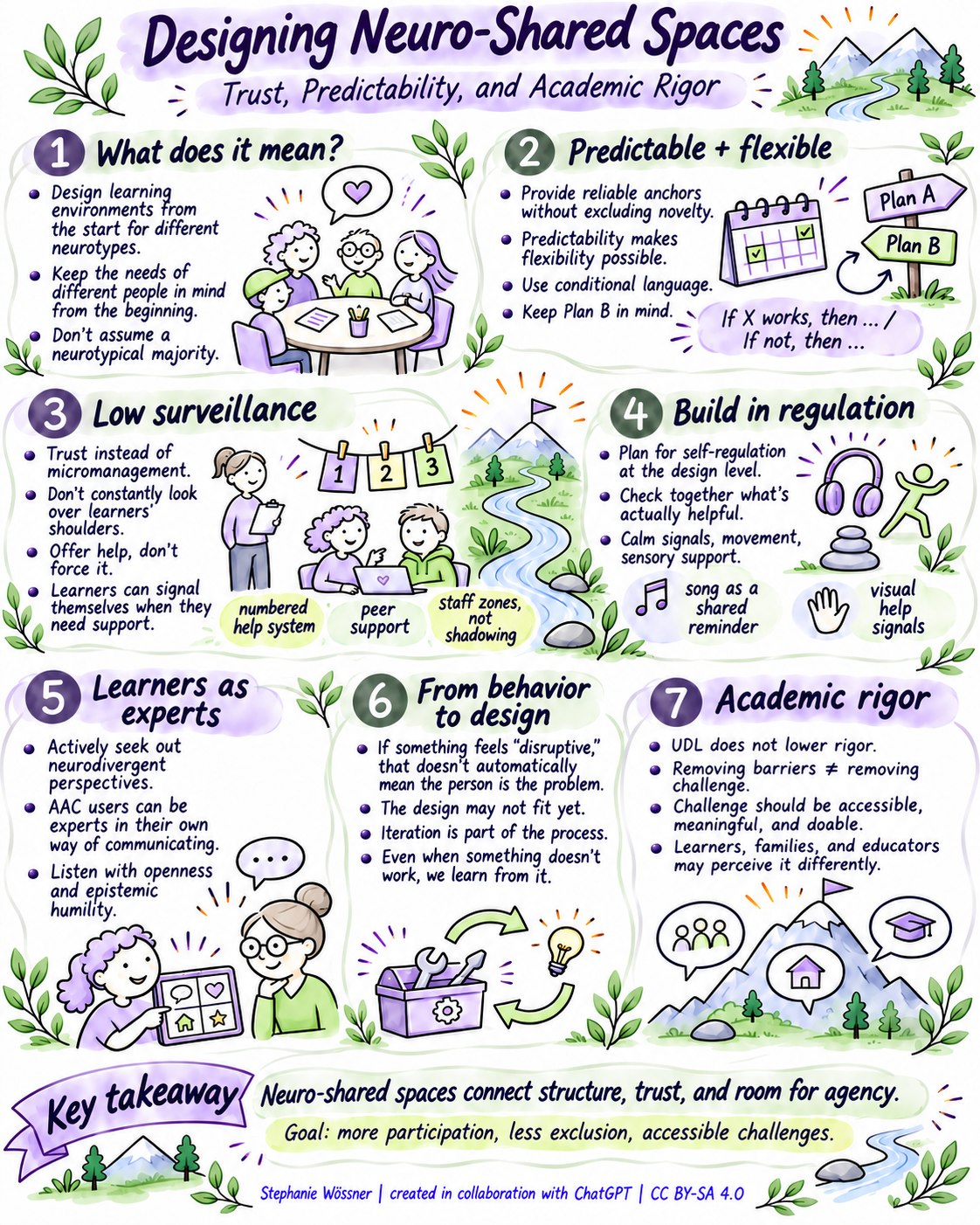 Credits: Stephanie Wössner | CC BY-SA 4.0 InternationalThis is why I find the concept of low surveillance particularly interesting in the context of Universal Design for Learning (UDL) and Neuro-Shared Spaces. It describes learning environments where people experience as little monitoring, control, and unsolicited correction as possible. Behind it lies a fundamental question about how we understand support, trust, and responsibility. A learning environment can be designed according to UDL principles and still limit people's self-determination through the way they are supported. Neuro-Shared Spaces therefore go beyond providing different ways to access learning. They take the needs of people with different neurocognitive profiles into account from the design stage onward, while also questioning which expectations, behaviors, and power dynamics are taken for granted in a learning environment.
Trust also means knowing when to step back
Low surveillance by no means implies leaving learners to fend for themselves. Some need close support, while others benefit from physical proximity or regular prompts. Whether that support is actually helpful, however, depends on the person, the situation, and the task at hand. What was necessary yesterday may no longer be needed today. And what helps one person feel safe may make another feel tense. Problems arise when previous observations turn into fixed expectations. Someone who has repeatedly struggled to concentrate may be monitored particularly closely. As soon as they look out the window, they are reminded to get back to the task. Yet this behavior alone does not tell us whether they are actually distracted. Perhaps they are thinking deeply or regulating their attention in this way. Outward behavior, after all, is not a reliable indicator of a person's internal state.
This has direct implications for agency and self-advocacy. Learners need to get to know their own needs, ask for support, and increasingly decide for themselves which strategies help them. These abilities have limited room to develop when adults constantly anticipate what kind of support is needed. Part of the experience is being allowed to make mistakes, encounter difficulties on one's own at first, and work out when help would be useful. Even a simple numbered system for requesting help can make a difference here: learners who need support can signal this using a numbered clothespin, for example, and see when it is their turn. They do not have to keep drawing attention to themselves or worry about being overlooked. At the same time, it becomes easier for everyone involved to anticipate how support will be provided. A similar approach is to create a learning environment where adults are responsible for particular areas and available to all learners, rather than having individual children constantly accompanied by an aide. Being able to seek out support on one's own changes the relationship between help and control. But it is also a question of how power is distributed. Who decides when support is necessary? Whose interpretation of a situation counts? And how can learners influence the way they are supported? Peer support can help reduce dependence on adults. However, it must not create new hierarchies in which certain children are permanently seen as needing help while others are assigned exclusively to the role of helper. Mutual support assumes that everyone has something to contribute and can receive support themselves. This requires a learning culture where different needs are recognized and help is seen neither as a sign of weakness nor as a mark of superiority.
Predictability makes room for new experiences
Another interesting tension lies in the relationship between structure and flexibility. Neuro-Shared Spaces should be predictable while remaining open to different needs, changes, and new experiences. At first glance, that sounds contradictory because predictability is often associated with fixed routines and as little change as possible. Yet a reliable structure can be precisely what helps people engage with the unfamiliar. If you know how a learning environment generally works, what you can rely on for orientation, and where support is available, you need to spend less energy just figuring out the situation. Within that framework, there is room for exploration. Predictability can therefore make flexibility possible. That flexibility, however, needs to be considered from the design stage and put into practice. A plan can provide direction without having to be set in stone.
The role of our language is interesting here as well. Sometimes, in trying to provide reassurance, we create new uncertainty. If we announce something as though it is already set in stone, any subsequent change may be experienced as especially stressful. Communicating honestly about what a plan depends on and what alternatives are available offers guidance without creating a false sense of certainty. Reliability does not necessarily come from making everything appear predictable and under control. It can also come from people knowing how to deal with change, knowing that their needs will be considered, and knowing that they themselves can influence what happens next. For me, there is a direct connection here to future-oriented learning, which aims to enable people to deal with uncertainty without feeling powerless in the face of it.
Designing Neuro-Shared Spaces therefore also means considering regulation from the outset. Quiet spaces, opportunities for movement, sensory materials, visual cues, and shared routines can help reduce stress and provide a sense of orientation. A song everyone sings together, for example, can serve as a reminder that a transition is approaching, taking the place of a reminder that would otherwise be directed at particular learners. This makes necessary support available to everyone without singling anyone out. However, we cannot tell whether something is effective simply because it is available. A quiet space to retreat to can be helpful, but it may not be helpful for everyone. The same applies to opportunities for movement, sensory materials, or other forms of support. Their actual impact needs to be reflected on together with the people they are intended to support.
Perhaps the problem lies in the design
The way we respond to behavior we perceive as disruptive reveals a great deal about our understanding of learning. When someone does not participate, interrupts others, or does not get started on a task, our attention often turns immediately to their behavior. We remind, encourage, reprimand, or offer additional support. But it is worth looking at the learning environment first. Perhaps the task is not clear enough, there is not enough guidance, or the person has not found a meaningful connection to the topic. Perhaps sensory conditions make it difficult to concentrate, or social expectations are unclear. The task might require abilities that have little to do with the actual learning goal. This certainly does not mean that every behavior can be explained solely by the design of the environment. People bring different experiences, interests, abilities, and current stressors to a situation. But if we immediately treat it as an individual behavioral problem, we may overlook conditions we have the power to change.
The importance of iterative design becomes apparent here as well. Providing an opportunity for movement that is intended to be helpful may, for example, initially make it harder to complete a task. Perhaps moving while working requires additional attention, or perhaps the particular type of movement does not suit the activity or the person. Such a result does not mean the entire approach is unsuitable. It provides information we can use to reconsider and refine the design. In this sense, UDL is not a state we achieve by implementing a certain number of measures. It is an ongoing process of design and reflection that needs to incorporate feedback, experiences, and new insights.
This also raises the question of who we are actually designing for. If nine out of ten learners do well with an activity or resource, that might count as a success from a conventional organizational perspective. From the perspective of Neuro-Shared Spaces, however, we also need to ask who the tenth person is and which barriers we could have identified during the design process. Knowingly accepting someone's exclusion does not become unproblematic simply because it affects only a few people. At the same time, even carefully designed learning environments cannot fully anticipate every individual support need. Alongside universally accessible resources, there still needs to be room for specific accommodations and the ability to respond to different experiences and changing needs.
Who is the expert here, anyway?
An especially important consideration is whose knowledge we recognize when designing learning environments. Learners who use an augmentative and alternative communication (AAC) device, for instance, have experiences and knowledge that the adults supporting them may lack. When a learner explains how they use their communication device, their role changes as well. They become the expert in a way of communicating that others have yet to become familiar with. This shift matters because people who frequently need support because of the way they communicate often find that their abilities are underestimated. The actual communication barrier may just as easily lie with the people who are unfamiliar with that form of communication.
Underlying this is the principle of epistemological humility: the willingness to acknowledge the limits of our own knowledge and learn from others. I consider this essential, especially in educational relationships shaped by institutional power imbalances. Educators have both subject-specific and pedagogical knowledge. That does not mean they understand their learners' experiences and needs better than the learners themselves do. This is particularly true of neurocognitive differences, sensory experiences, and individual ways of communicating. Of course, learners cannot always clearly identify their needs. Our own perceptions change, too, and sometimes it is only through trying things out together that we discover what support is actually helpful. This is why we need a dialogue in which different perspectives can contribute and complement one another. For me, there is an important connection to co-agency here: designing learning environments together means genuinely sharing responsibility and influence. If people are to have a say in decisions, their experiences and judgments need to be taken seriously, even when they conflict with adults' assumptions.
Academic rigor without unnecessary barriers
Designing accessible learning environments often comes with the concern that academic expectations will be lowered. Yet what actually makes an activity intellectually demanding is far less clear-cut than it might initially appear. When educators think of academic rigor, they often have in mind subject-specific complexity, deep engagement, analysis, or independent construction of knowledge. Learners, on the other hand, may find a task difficult because they lack prior knowledge, expectations are unclear, the workload seems overwhelming, or they cannot find a way into the topic. An activity can therefore be exhausting without requiring particularly sophisticated thinking. Conversely, people may experience a complex challenge as manageable when they are interested in it, have appropriate strategies, and find themselves in conditions that make it possible. This also reminds me of the concept of flow: an activity can be highly demanding and still feel motivating and fulfilling when there is a good fit between the challenge and the abilities people already have or can develop.
Removing barriers therefore does not necessarily mean reducing academic rigor. We are creating conditions in which people can engage with that level of challenge. At the same time, we should not be too quick to eliminate every challenge. Initially doubting one's ability to do something, developing a new strategy, or eventually completing a difficult task independently can be meaningful experiences in developing self-knowledge and agency. What constitutes a productive challenge for one person may be a barrier for another. Even for the same person, that assessment can change with the context. Making this distinction therefore requires ongoing consideration of learning goals, the actual demands of the activity, and learners' experiences. A heavy workload, insufficient support, or rigid requirements must not be confused with academic rigor.
This makes particularly clear how much our ideas about achievement and professionalism are shaped by inherited expectations. An activity may seem demanding because it takes a lot of time, allows little support, or requires a specific format. But what does that really tell us about the insights people gained or the abilities they developed? Learners, parents, and educators may also have very different ideas about these things. If different ways of accessing learning and flexible forms of support are perceived as a lowering of expectations, we also need to discuss how we recognize academic quality and which requirements actually serve learning.
A different understanding of educational responsibility
All these considerations reveal a tension that directly affects how we understand our role as educators. We want to support learners, yet sometimes the best way to support someone is to refrain from intervening. We want people to feel safe, yet to provide that sense of safety, we need to accept that we cannot control everything. We want to take different needs into account, yet we cannot determine on our own what those needs actually are in a particular situation. This requires a form of educational professionalism in which we examine our own actions just as critically as the design of the learning environment. It involves taking responsibility while relinquishing control, providing structure without prescribing everything, and challenging people without overlooking the actual barriers they face.
Neuro-Shared Spaces make it clear that inclusion is also a question of relationships and power dynamics. An environment may appear inclusive by design and still give rise to experiences of control, pressure to conform, or exclusion. Providing different ways to access learning and various forms of support is therefore not enough. We also need to ask how people experience this environment, whether they feel taken seriously, and how much influence they have over its design. Do they receive support when they need it and freedom when they want to act independently? Can they contribute their perspectives and experience those perspectives making a real difference?
For me, this leads to a fundamental question: How much self-determination are we willing to grant people whose decisions, perceptions, and needs we do not always understand? It is difficult to communicate trust when we want to control everything at the same time. And agency can hardly develop if we do not truly trust others to take responsibility for their own learning.
Bildquellen
- Designing Neuro-Shared Spaces: Stephanie Wössner | CC BY-SA 4.0 International
- Neurodiversity: PetiteProf79 | CC BY-SA 4.0 International