
In the second module of my training to become a Neurodiversity & Inclusion Trainer with the Positive Psychology Guild (PPG), I am exploring positive psychology and the role character strengths, authenticity, resilience, and flow play in our personal and professional development. Another part of this module is reflective practice, which involves consciously examining our own experiences, perceptions, and actions. At first glance, this hardly seems surprising. After all, those of us who work professionally in education, learning, and societal transformation are constantly reflecting: questioning concepts, making sense of experiences, reconsidering decisions, and developing new perspectives. But thinking about our work does not necessarily mean we recognize our own assumptions and blind spots in the process.
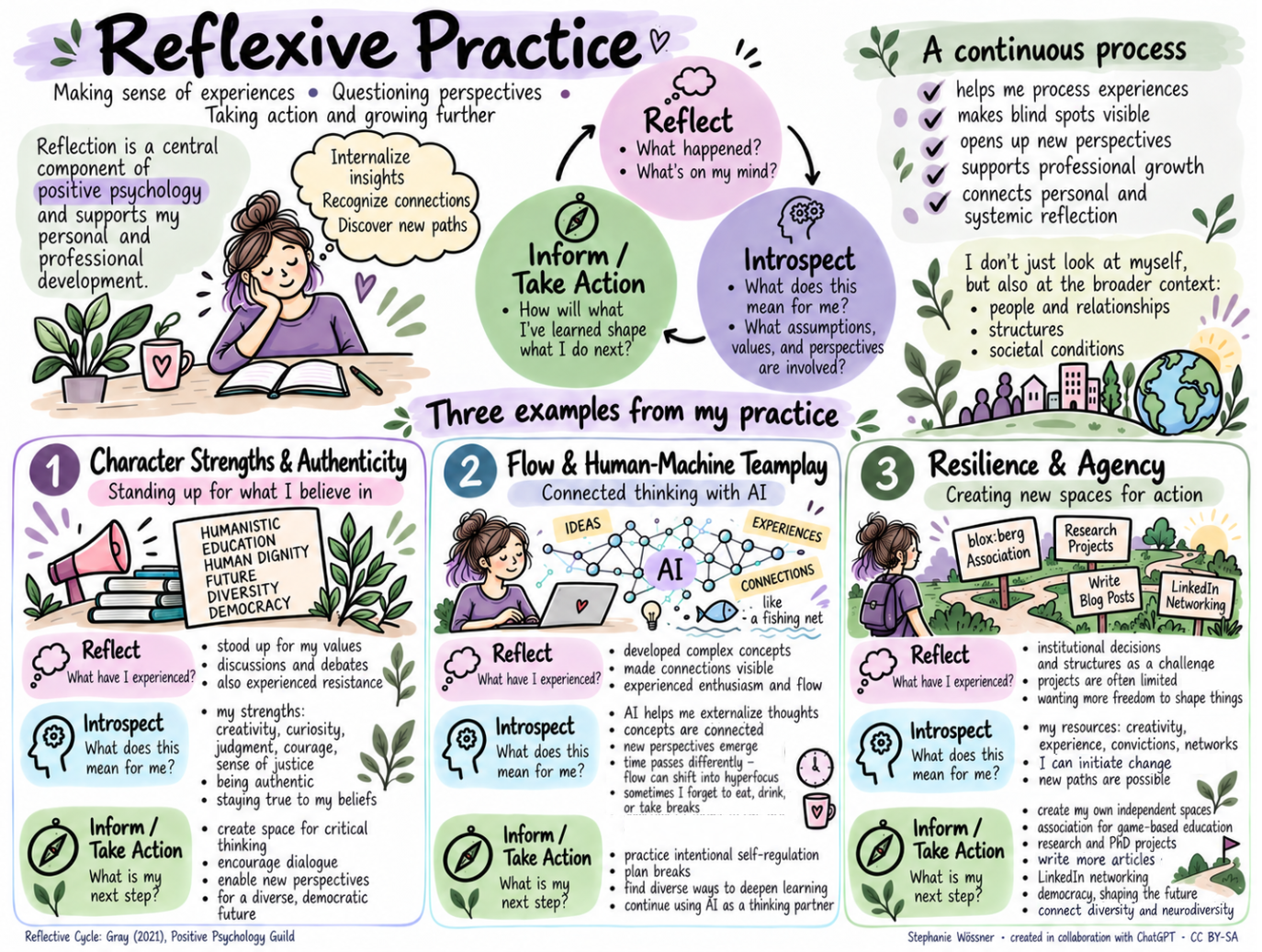 Credits: Stephanie Wössner | CC BY-SA 4.0 InternationalI am particularly interested in what happens when we deliberately turn our attention to what drives us, how we think, and the conditions under which we act. In positive psychology, reflection is used, among other things, to develop a more nuanced understanding of our own strengths, values, needs, and resources. For me, however, that does not go far enough. My experiences take shape within relationships, organizations, and societal structures that influence my opportunities to act just as much as my personal beliefs and abilities do. Focusing exclusively on internal resources may lead us to overlook the fact that pressures and limitations come from outside. Conversely, examining external conditions alone may obscure the assumptions, decisions, and patterns of behavior of our own that need to be critically examined.
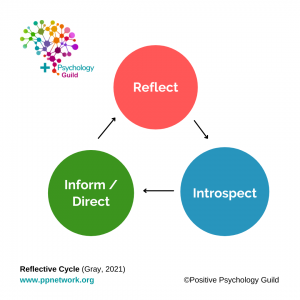
The PPG course introduces Gray's (2021) Reflective Cycle. It describes a continuous process with three interconnected steps: Reflect, consciously examining an experience or issue; Introspect, taking a deeper look at our own perceptions and the underlying assumptions and values; and Inform/Direct, using the insights gained to guide what we do next. For me, the cycle is primarily a guide that helps organize my thoughts. In reality, reflection rarely follows the orderly course of a model. Sometimes the original question changes as we think about it. Sometimes an insight leads to further questions, contradictions, or the realization that we are not yet in a position to make a decision. To me, that, too, is part of taking reflective practice seriously.
After the lecture, we were invited to apply the model to one or more areas of our own work and lives. In my case, these areas are interconnected, yet each offers a different perspective on my experiences: my character strengths and values, my experience of flow in Human-Machine Teamplay, and how I deal with institutional change.
Character strengths and authenticity: Why I stand up for what I believe in
When I think about my character strengths, creativity, curiosity, judgment, bravery, and fairness come to mind. These qualities emerge in different situations, but they are particularly apparent in my public engagement with issues relating to education and society. In my books, blog posts, talks, and discussions, I advocate for a humanistic understanding of education. Human dignity, self-determination, diversity, and democracy form the set of values that guides my work. I question developments in education policy, institutional routines, and ideas that reduce education to measurable competencies or economic utility. This repeatedly meets with resistance and sometimes gets me into trouble in institutional settings, probably precisely because my perspective challenges established ways of thinking.
Through reflection, I came to realize how closely my character strengths are linked to my values. Curiosity alone, for example, does not explain why I engage so deeply with questions of education. It enables me to explore different perspectives and recognize connections. My sense of fairness influences which questions I pay particular attention to. I need judgment to examine positions and arguments, while creativity helps me develop alternatives. Courage comes into play when I express my convictions publicly and encounter resistance. My actions are therefore shaped by the interaction between these qualities and what I consider meaningful, rather than by isolated character traits.
The question of authenticity stands out in particular. For me, being authentic means staying true to my convictions and not watering them down just because other people find them uncomfortable or disagree with them. This explicitly includes a willingness to engage in critical self-reflection. After all, I can take a clear position and still recognize that I have not adequately considered certain aspects of my argument or that new insights require me to develop it further. This distinction is especially important in public discourse. Being open to other perspectives does not require us to treat every position as equally valid, and having a well-founded standpoint is entirely compatible with a willingness to keep learning.
What I take from this for my future work, above all, is that I want to continue opening up spaces for critical thinking and societal dialogue. I want to express my positions clearly, encourage people to think, and open up new perspectives on a diverse, democratic future worth living in. Reflecting on my strengths helps me become more aware of the personal resources that support me in this endeavor and of where I need to question my own perceptions.
When thinking spreads like a fishing net: Flow and Human-Machine Teamplay
Another area of reflection concerns flow. I experience this state particularly intensely when I develop complex concepts, make connections between different ideas, or design new learning environments. That was the case, for example, when developing the Future:Lab Stuttgart, but also when writing, designing game-based learning experiences, and increasingly when working in partnership with AI. Once I become immersed in an activity like this, I barely notice the passage of time. Thoughts connect with other thoughts, experiences with theoretical concepts, current developments with visions of the future. Something takes shape in my mind that I can best compare to a fishing net. Individual knots are connected, new links form, and the net changes, becoming increasingly dense and catching more and more elements. In the process, I keep discovering connections I was not even looking for in the first place.
In Human-Machine Teamplay with AI, this interconnected way of thinking takes on another dimension. I can externalize parts of my thinking and working processes, articulate my thoughts, have them organized or examined from a different perspective. This frees up cognitive space and allows me to develop complex ideas further without having to keep all the intermediate steps in mind at once. AI can suggest new connections, challenge my thinking, or help me make ideas visible that are not yet fully formed. But it is not a neutral sounding board. AI-generated responses are themselves based on patterns, assumptions, and processes of selection that can influence the direction of my thinking. It therefore remains my responsibility to critically examine the results, assess whether the connections hold up, and decide which ideas I want to pursue. My own agency and judgment remain central.
What particularly fascinates me about this form of collaboration is the possibility of continually revisiting ideas and following them further. It often creates a sense of intense excitement and concentration. I can work on an idea for long periods without consciously noticing how much time has passed. At the same time, there is an ambiguity here that the course's reflection questions brought into sharper focus for me: sometimes I forget to eat, drink, or get up. My concentration is so intense that physical needs temporarily fade into the background.
This raises the question of how flow and hyperfocus relate to each other. Both terms describe aspects of intense attentional engagement, although the scientific distinction between them is not entirely settled. Flow is usually described as a positively experienced state of absorption in an activity, whereas hyperfocus often emphasizes the intensity of attentional engagement and a reduced awareness of other stimuli. The experiences can overlap, and forgetting to take breaks alone is not enough to distinguish between the two. For my personal reflection, such a distinction is less important anyway than the realization that an activity can be fulfilling and physically taxing at the same time.
This gives me a reason to approach self-regulation more consciously. I want to continue making use of the opportunities that deep thinking and Human-Machine Teamplay offer, but I need routines that help me take breaks and keep my physical needs in view. I also find this experience interesting from the perspective of designing learning environments. It reminds me how differently people experience and regulate attention, interest, and concentration. A way of thinking and working that I find particularly stimulating cannot simply be transferred to others. Learning environments therefore need to accommodate different approaches, ways of perceiving, and forms of self-regulation. Deep learning takes place under different conditions; it cannot be produced by imposing the same requirements on everyone.
Resilience and agency: New opportunities to act as circumstances change
My third reflection concerns an experience that has particularly shaped my work over the past few years: the tension between my desire to actively develop education and the institutional conditions under which this work takes place. I have designed, implemented, and supported numerous projects intended to open up new possibilities for future-oriented learning. At the same time, I have experienced how political decisions, organizational changes, and institutional structures can limit these developments or prevent them from continuing. The discontinuation of a project that meant a great deal to me and the changes affecting my organization are concrete examples. Decisions like these affect structures and relationships that have grown over time, as well as all the development work that has gone into them. They can take a toll even when we try to deal with them professionally.
Exploring resilience has therefore prompted me to think about which resources sustain me in situations like these. They include my experience, professional convictions, creativity, and ability to recognize new connections and possibilities. Equally important are my networks, relationships with people who share similar concerns, and collaboration across institutional boundaries. These resources help me continually reassess my opportunities to act. At the same time, I do not want to understand resilience as a demand to adapt to every change or endure pressures with as little resistance as possible. Institutional decisions remain institutional decisions—and they are often not grounded in the kinds of perspectives one would expect in education. Individual resilience does not absolve organizations or political actors of responsibility for the conditions under which people work and educational development takes place.
In my own situation, agency is particularly apparent in the independent spaces I am creating for this work. By founding blox:berg, an association for game-based education, I want to build on what I have learned through my work so far and take it further. Its focus on democracy and shaping the future will expand to include diversity and neurodiversity. For me, these issues belong together because shaping desirable futures always raises questions about who gets to participate, whose perspectives are visible, and under what conditions different people can develop their potential. My planned doctoral research will take this exploration further academically, bringing together my previous experiences with game-based education, AI, neurodiversity, and educational transformation.
Another development is my increasingly public engagement with these questions. I am writing more blog posts and using LinkedIn to share ideas, refine my positions, and engage in conversations with others. Writing is itself a form of reflective practice for me. It is often only when I try to put an idea into words that others can understand that I realize which connections I have already made, what assumptions lie behind them, and where I need to think further. Feedback and discussions open up additional perspectives. At the same time, I am creating a public space that is less dependent on any one institution. I can address issues I consider important regardless of whether they are currently among an organization's priorities.
These new opportunities do not change the fact that losing established structures can be painful and involve uncertainty. But they show me that my convictions and my professional commitment are not tied to a particular institutional role. I can open up new paths, make connections, and continue working with others on ideas that matter to me. Part of this is also recognizing my own limits and distinguishing between where I can take responsibility myself and where the conditions need to change.
This example makes particularly clear to me why reflective practice needs a societal perspective. If we ask only about individual responses to difficult situations, the decisions, power relations, and structures that created and sustain those situations remain invisible. In its understanding of reflective practice, the Positive Psychology Guild explicitly includes extrospection, the examination of our external context, alongside introspection. For my own work, I want to extend this perspective to include a critical examination of institutional and societal conditions. This is especially relevant to education and inclusion, where a focus on individual strengths can all too easily shift responsibility for a lack of opportunities to participate onto individuals.
When I look at my three reflections side by side, I recognize connections that go beyond the individual questions of character strengths, flow, and resilience. My values give my work direction. My interconnected way of thinking and Human-Machine Teamplay allow me to develop complex ideas. And when external circumstances limit the ways I have been able to act, I try to open up new spaces. These experiences are intertwined, sometimes contradictory, and by no means complete. Perhaps this is precisely where the value of reflective practice lies: in continually revisiting our experiences, questioning familiar interpretations, and remaining open to the possibility that new ideas and opportunities to act will emerge from doing so.
Further reading
- Positive Psychology Guild (2025): Safe Practice Guidance. On professional reflection, introspection, extrospection, and ethical practice.
- Gray (2021): Reflective Cycle – original graphic from the Positive Psychology Guild. The three-step reflection model used in the PPG course.
- Finlay, Linda (2008): Reflecting on “Reflective Practice”. A critical examination of the possibilities, limitations, and contextual conditions of reflective practice.
- Csikszentmihalyi, Mihaly (1990): Flow: The Psychology of Optimal Experience. A foundational account of the concept of flow.
- Ashinoff, Brandon K. & Abu-Akel, Ahmad (2021): Hyperfocus: The Forgotten Frontier of Attention. On the scientific discussion of hyperfocus and its relationship to flow.
Bildquellen
- Reflective Practice: Stephanie Wössner | CC BY-SA 4.0 International
- Neurodiversity: PetiteProf79 | CC BY-SA 4.0 International