
What makes a good life? It sounds like a simple question until we start thinking about what “good” actually means, who gets to decide, and under what circumstances people even have the opportunity to lead a life they find fulfilling. Psychology has long been concerned with these questions, but historically, scientific attention has hardly been evenly distributed. Mental illness, deficits, and limitations have often received more attention than the conditions that foster human well-being. Positive psychology explicitly set out to broaden that perspective. What particularly interests me is what happens when we bring this approach into conversation with neurodiversity, inclusion, and a humanistic understanding of what it means to be human.
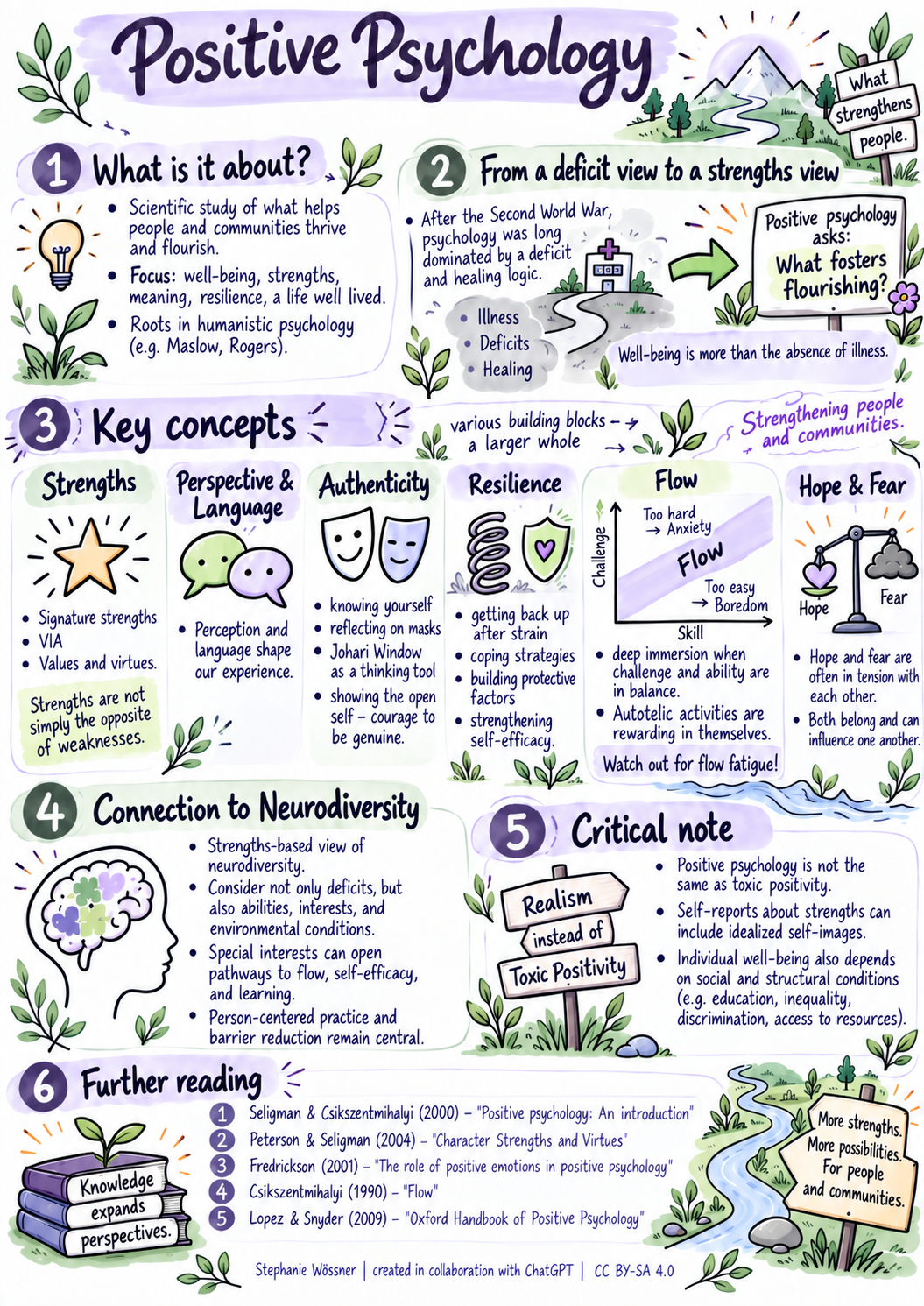 Credits: Stephanie Wössner | CC BY-SA 4.0 InternationalThe second module of my Neurodiversity & Inclusion training with the Positive Psychology Guild (PPG) explores positive psychology in greater depth. In his first lecture, Dr. Reece Coker introduced its historical roots, key concepts, and potential applications. I was particularly interested in how closely Coker connects positive psychology with his own experiences as an autistic person with Tourette syndrome. He describes how he was perceived as a poor learner at school, struggled with sensory demands, and ultimately had to leave the education system. Later in life, he discovered abilities and interests that his learning environment at the time had apparently left little room for. He now holds several academic degrees, including a doctorate, and teaches as well. Perhaps most strikingly, he considers his love of learning to be his particular strength. His experience raises a fundamental question for me: What does a perceived weakness actually tell us about a person when it might manifest itself quite differently under other circumstances?
Moving beyond deficits: What makes life fulfilling?
Modern positive psychology is often associated with Martin Seligman and Mihaly Csikszentmihalyi, who published a foundational article in 2000. They criticized psychology's heavy emphasis on treating mental illness, a focus that had developed particularly in the aftermath of World War II. The factors that impair human functioning had been studied extensively. Less attention had been paid to what helps people thrive, supports their development, and enables them to lead fulfilling lives. Positive psychology builds on humanistic psychology, particularly the work of Abraham Maslow and Carl Rogers, while seeking to investigate its questions systematically using empirical research methods. However, it would be an oversimplification of history to portray all earlier psychological approaches as deficit-oriented. Long before positive psychology became an established field, there was already substantial, nuanced research on well-being, motivation, autonomy, and human development.
One idea from the lecture strikes me as particularly important: the absence of mental illness does not automatically mean that someone is doing well. Corey Keyes developed this idea further through his Mental Health Continuum, distinguishing between languishing and flourishing. People can experience low mental well-being without meeting the criteria for a mental illness. Conversely, people dealing with mental health challenges can still experience aspects of what makes life fulfilling. For our understanding of neurodiversity, this opens up an important space for reflection, because diagnostic categories alone tell us little about how someone experiences their own life. At the same time, we need to distinguish carefully between mental well-being, neurological differences, and societal barriers. These dimensions are interconnected, but none can be reduced to another.
I find the possibility of seeing people beyond the problems they experience particularly compelling. Yet this is precisely where a tension arises that stayed with me throughout the lecture. When we ask what makes a life fulfilling, we already bring assumptions about what counts as fulfillment. Autonomy, social relationships, personal growth, or a sense of meaning can all be important dimensions of well-being. But they do not hold the same significance for everyone, nor are they experienced in the same way across cultures and contexts. A positive psychology that takes human diversity seriously therefore needs to examine its own normative assumptions.
Strengths develop and emerge in context
A major focus of the lecture was strengths. Christopher Peterson and Martin Seligman's VIA Character Strengths and Virtues framework identifies 24 character strengths grouped under six overarching virtues. These include curiosity, creativity, bravery, fairness, gratitude, and love of learning. The framework gives us a vocabulary for recognizing qualities that can easily go unnoticed when we focus exclusively on deficits. However, character strengths as defined by the VIA framework, individual abilities, acquired skills, interests, and socially desirable behaviors are distinct categories. Making that distinction matters because someone may have an exceptional ability without particularly valuing it, or may see something as a strength that the people around them devalue.
In this context, Coker asked whether strengths always have to be positive. A quality that is helpful in one situation may be problematic in another. I also found the distinction between actual and aspirational strengths interesting. In self-assessments, people may describe qualities they would like to possess or that fit their self-image. This is especially relevant when such instruments are used in educational or organizational settings. A questionnaire initially provides a description shaped by its particular categories and wording. It does not automatically reveal the abilities a person actually brings to different situations.
For me, there is a direct connection to neurodiversity here. People have different neurological profiles, interests, experiences, and ways of regulating themselves. How they behave and which abilities become apparent depend to a considerable extent on the demands and opportunities of their environment. Someone who struggles to concentrate in a sensory-rich environment may be able to engage deeply with a complex subject for hours under different sensory conditions. This neither makes their difficulties insignificant nor means that a strong interest compensates for everything they find challenging. The more interesting question is how the person, the activity, and the environment relate to one another, and what possibilities for change emerge from those relationships.
In educational settings, this perspective changes how we see learners. When we describe someone as unmotivated, inattentive, or unable to cope with stress, we should ask ourselves what expectations and norms underlie that assessment. What opportunities did the person have to bring their own interests into the learning process? What forms of participation were available? What demands were created by the learning environment itself? And which abilities may have remained invisible because we were looking for only certain ways of expressing them? A strengths-based perspective becomes truly meaningful when it also has consequences for how we design learning environments.
Authenticity, masking, and the limits of individual adaptation
Another major focus was authenticity. Coker explored self-perception, social expectations, and which aspects of our personalities we are able to show in different situations. Among other things, he drew on Joseph Luft and Harrington Ingham's Johari Window, which distinguishes between the open, hidden, blind, and unknown aspects of the self. The model can help us think about what we know about ourselves, what others perceive, and which parts of ourselves we deliberately keep hidden. In the lecture, this idea was connected to masking, the adaptation or concealment of certain behaviors to meet social expectations.
This is particularly complex in the context of neurodivergence. Masking can demand considerable cognitive and emotional resources. At the same time, it often develops in response to understandable experiences of rejection, stigma, or uncertainty. People adapt because they want to belong, need to avoid conflict, or depend on it for their safety. It would therefore be too simplistic to treat authenticity as an individual decision and assume that people simply need to find the courage to take off their masks. If we want to make authenticity possible, we need to examine the conditions under which people feel safe enough to show different sides of themselves. This includes social relationships, institutional expectations, and the question of which forms of human behavior are taken for granted and which constantly need to be explained or justified.
We also need to bear in mind that authenticity is not a static state that people eventually achieve and then maintain. We change through our experiences and relationships. We behave differently in different contexts without necessarily being inauthentic. The idea of a single “true self” that merely needs to be uncovered falls short for me. I am more interested in how people can develop and shape their own identities without constantly having to choose between belonging and self-determination.
Resilience, flow, and the tension between hope and fear
Resilience, often cited as a skill for the future, also received considerable attention. Coker described several dimensions of resilience, including psychological, emotional, physical, and perceptual aspects, as well as adaptability. He discussed protective factors such as self-efficacy, problem-solving abilities, self-regulation, acceptance, and a sense of meaning. This illustrates why resilience cannot meaningfully be understood as a single, unchanging personality trait. It emerges and changes through the interplay of different resources and stressors. The lecture primarily focused on the individual perspective. For me, the social dimension needs to be part of the discussion as well: people may or may not have relationships, support, institutional structures, and societal resources to draw on. How well someone can cope with difficult circumstances also depends on whether their environment creates additional stress or provides effective support.
Particularly relevant to my work on game-based learning is Mihaly Csikszentmihalyi's concept of flow. Flow describes a state of deep absorption in which people become fully immersed in an activity. An important condition for flow is often a good fit between a person's abilities and the demands of the activity. When the demands significantly exceed what a person can currently manage, anxiety may arise; when they are far below that level, boredom may set in. However, the classic flow diagram is a simplified model of a complex experience. Coker expanded on these ideas by discussing autotelic activities, meaning activities that are rewarding in and of themselves. He also referred to his own intense interests and the fact that prolonged periods of absorption can become exhausting. I see his thoughts on possible “flow fatigue” as an intriguing personal reflection.
What interests me most about this in the context of learning is the importance of voluntary participation and personally meaningful activities. Play can make these experiences possible because it allows people to take on challenges, experiment, receive feedback, and engage with a situation out of genuine interest. But this is by no means automatic. Play is not inherently motivating, flow cannot simply be engineered through a particular design, and strong interests do not necessarily lead to positive experiences. What one person finds stimulating may be overwhelming or uninteresting to someone else. Here, too, the relationship between the person and the learning environment remains central.
Toward the end of the lecture, Coker explored hope and fear in some detail. In his own Polar Model, he describes them as interconnected experiences: when we hope for something, we may also fear that it will not happen. What I found interesting was that he does not try to resolve this tension but instead draws on his own experience to examine it. For him, hope does not mean the absence of fear. Courage, too, does not necessarily arise when people feel no fear; it can emerge precisely in how they deal with it. This offers a different perspective from the common idea that positive thinking should replace negative feelings as much as possible.
What happens when we make well-being an individual responsibility?
As thought-provoking as I find many of the ideas from the lecture, I also think it is important to critically examine the limits of positive psychology. While it investigates human strengths and possibilities, it can fall into a problematic way of thinking when well-being becomes a matter of individual achievement. The implicit expectation then becomes that people simply need to recognize their strengths, become more resilient, think more optimistically, or live more mindfully to cope better with difficult situations. Suddenly, societal problems become matters of personal attitude. I encounter this shift time and again in education, where structural pressures remain in place while people are expected to learn how to cope with them more effectively.
Engaging with this criticism has itself become part of the development of positive psychology as a scientific field. Second- and third-wave approaches pay greater attention to the interplay between positive and negative experiences, as well as to cultural, social, and systemic conditions. Seligman and Csikszentmihalyi's original vision for the field was by no means exclusively individualistic either; it explicitly included communities and institutions. A nuanced critique therefore needs to distinguish between the scientific field, individual models, and the sometimes highly simplified ways in which positive psychology concepts are applied.
For my understanding of education, the fundamental question remains who is responsible for ensuring that people can develop their potential. Learners do not need yet more demands to be happy, resilient, or ready to perform. They need learning environments in which their different starting points are recognized, they can have a say, and their interests, needs, and perspectives matter. For me, a strengths-based approach is inseparable from inclusion, participation, and the removal of barriers. At the same time, we must not downplay the difficulties and pressures people experience out of a well-intentioned desire to adopt a more positive perspective. A humanistic view of people takes their abilities just as seriously as their vulnerability.
What I take away from this first lecture in the second module at the Positive Psychology Guild is, above all, a productive tension. Positive psychology broadens our understanding of human well-being and development. For me, its potential lies in connecting questions about individual strengths with questions about the societal conditions under which people can actually live out those strengths. Because if we want people to flourish, it is not enough to explain to them how a flower grows. We also need to pay attention to the soil in which it grows.
Further reading
- Seligman, Martin E. P., & Csikszentmihalyi, Mihaly (2000): Positive Psychology: An Introduction. American Psychologist, 55(1), 5–14. A foundational article outlining the aims and scientific direction of positive psychology.
- Peterson, Christopher, & Seligman, Martin E. P. (2004): Character Strengths and Virtues: A Handbook and Classification. The foundational work on the VIA classification of 24 character strengths and six virtues; the link leads to the VIA Institute's overview.
- Keyes, Corey L. M. (2002): The Mental Health Continuum: From Languishing to Flourishing in Life. Journal of Health and Social Behavior, 43(2), 207–222. On the distinction between mental well-being and mental illness.
- Csikszentmihalyi, Mihaly (1990): Flow: The Psychology of Optimal Experience. Harper & Row. A foundational account of flow and intrinsically rewarding activities.
- Fredrickson, Barbara L. (2001): The Role of Positive Emotions in Positive Psychology: The Broaden-and-Build Theory of Positive Emotions. American Psychologist, 56(3), 218–226. On how positive emotions broaden the ways we perceive and act in the world.
- Milton, Damian E. M. (2012): On the Ontological Status of Autism: The ‘Double Empathy Problem’. Disability & Society, 27(6), 883–887. An important relational perspective on neurological differences and mutual understanding.
- van Zyl, Llewellyn E., et al. (2023): The Critiques and Criticisms of Positive Psychology: A Systematic Review. The Journal of Positive Psychology. A systematic review of scientific, methodological, and societal criticisms of the field.
Bildquellen
- Positive Psychology: Stephanie Wössner | CC BY-SA 4.0 International
- Neurodiversity: PetiteProf79 | CC BY-SA 4.0 International