
Sometimes the most interesting ideas emerge when different concepts come together that were never originally connected. The second module of my current Neurodiversity & Inclusion training with the Positive Psychology Guild (PPG) focuses on positive psychology. During Dr. Reece Coker's first lecture, which covered human strengths, authenticity, resilience, flow, and the tension between hope and fear, I kept thinking about two other concepts I have explored before: the Japanese concept of ikigai and the idea of trust in the future (Radikale Zuversicht), as described by Lena Papasabbas of The Future:Project. These three perspectives come from different cultural and theoretical traditions. Yet they touch on similar questions, particularly what makes life worth living, how we deal with uncertainty, and how much influence people can have over their lives and their future.
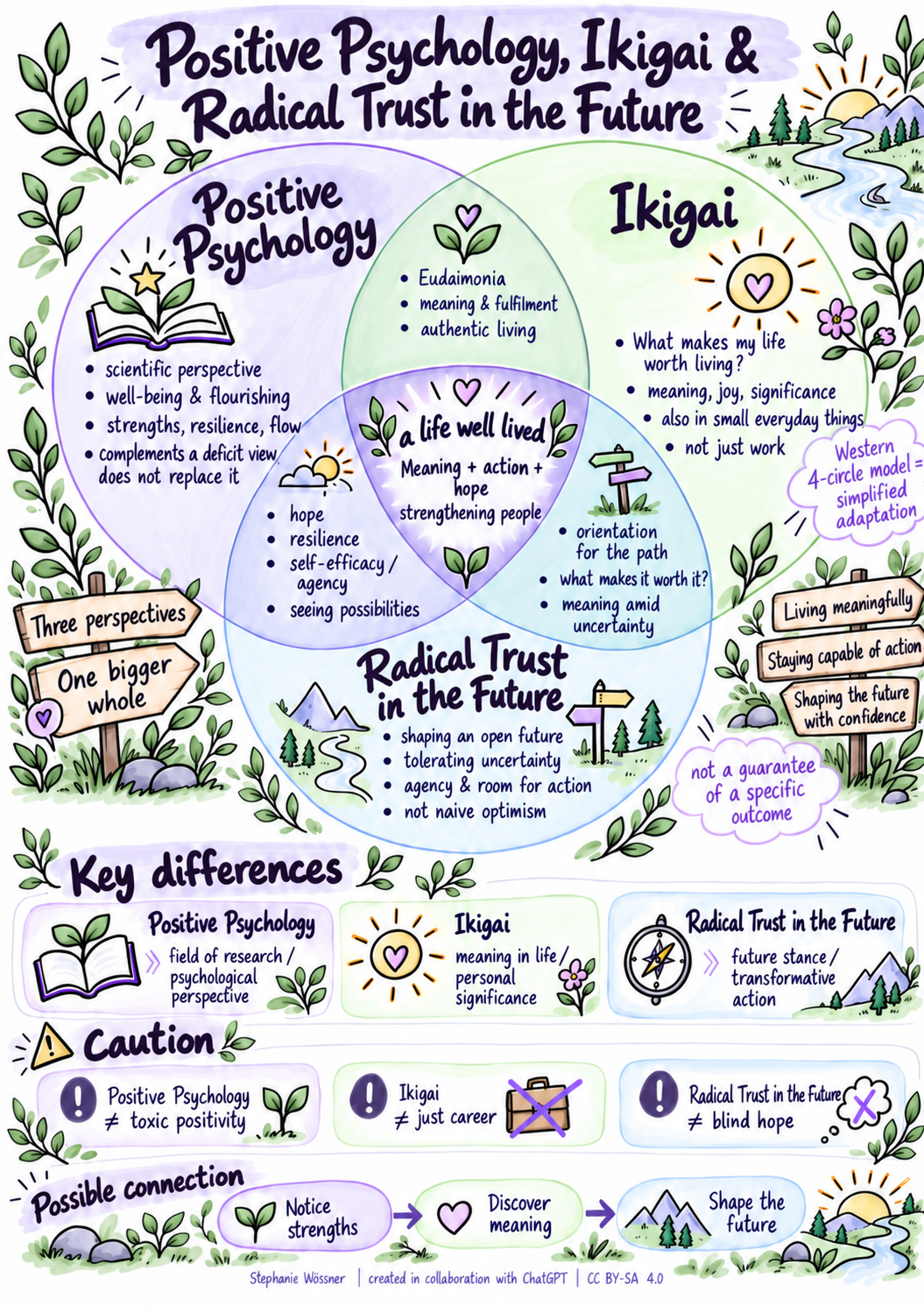 Credits: Stephanie Wössner | CC BY-SA 4.0 InternationalI also find this connection interesting because it brings into focus a tension that has long been part of my work on education and transformation. On the one hand, people need a sense of direction and meaning, along with the belief that their actions can make a difference. On the other hand, we live in a world where change is neither linear nor entirely predictable or controllable. What does it mean to lead a fulfilling life under these circumstances? And how can we develop trust in the future without losing sight of crises, inequality, and the very real limits on people's ability to act?
Ikigai and what makes life worth living
The distinction between hedonia and eudaimonia plays an important role in positive psychology. Hedonia refers to pleasurable experiences and positive emotions, whereas eudaimonia is more closely associated with experiencing life as meaningful, coherent, and fulfilling. Coker also addressed this distinction in his lecture. I find it useful as long as we do not turn it into a hierarchy in which immediate pleasure is considered superficial and meaning is automatically deemed more valuable. People experience well-being in different ways. A beautiful moment does not need a deeper justification to matter. At the same time, a life filled mostly with pleasurable moments can feel unfulfilling if other needs or relationships are consistently neglected.
I see a connection here to the Japanese term ikigai (生きがい), often described as what makes life worth living. Ikigai can be found in an activity someone is deeply devoted to, in personal relationships, a responsibility, an interest, or small everyday experiences. It need not be some extraordinary life purpose. In his book written for a general audience, Japanese neuroscientist Ken Mogi emphasizes the importance of small things, being present in the moment, and devoting oneself to an activity. Ikigai can thus be associated with a sense of meaning and a joy in living without prescribing a particular form of self-actualization.
In Japan, the history of thinking about ikigai extends well beyond its current international popularity. I find the work of Japanese psychiatrist Mieko Kamiya particularly interesting. She published her book Ikigai ni tsuite in 1966 and explicitly explored what deprives people of their sense of meaning, as well as how they discover new reasons to live after loss or difficult experiences. This adds an important dimension to the often highly simplified accounts of the concept. After all, the question of what makes life worth living does not arise exclusively under favorable circumstances. It may become especially urgent when the things we once took for granted fall away.
Why the Western ikigai diagram bothers me
Ikigai became widely known in the West primarily through a diagram of four overlapping circles. Supposedly, your ikigai lies at their intersection: what you love, what you are good at, what the world needs, and what you can be paid for. At first glance, the diagram seems plausible and is easy to grasp visually. Yet it conveys an understanding of ikigai that only partially reflects the Japanese concept.
The diagram originally came from a Western model of personal purpose developed by Andrés Zuzunaga. Marc Winn linked it with the term ikigai in 2014. He himself now explicitly describes this as bringing together two separate ideas. The four circles are therefore not a traditional Japanese representation of ikigai. What I find particularly problematic is the economic dimension, which introduces paid work as a component of what is supposedly a fulfilling life. Almost imperceptibly, the focus shifts from what is meaningful to someone to whether that meaning also has to translate into a career.
There have been periods in my own life when this interpretation applied to me, when I was more than happy to put my abilities to use in my professional life in a way that felt meaningful both to me and to society. Even so, from a humanistic perspective, I find this connection questionable. People do not have to be economically productive or pursue a socially recognized calling for their lives to have value. Someone who is unable to work because of a disability or illness can lead a life just as fulfilling as someone who finds their calling in their career. People can find meaning in relationships, in play, in exploring a special interest, or in experiences that serve no external purpose at all. This openness is particularly important to me when it comes to neurodiversity. Intense interests do not have to become a career, an exceptional achievement, or a socially useful ability in order to matter.
For me, this also connects with Mihaly Csikszentmihalyi's concept of flow and Coker's discussion of autotelic activities. People can become fully absorbed in an activity because the experience itself is rewarding. They need neither an external reward nor a demonstrable benefit. Flow and ikigai are not synonymous, however. Flow describes a particular quality of experience while engaging in an activity. Ikigai refers more broadly to what gives one's life value and meaning. The two can coincide, but they do not have to. A relationship, a responsibility, or a long-term commitment can also give our lives meaning without continually bringing us joy or putting us in a state of flow.
What happens when hope meets uncertainty?
From ikigai, my thoughts turn to the future. Knowing what matters to us in life does not mean we can shape that life under any circumstances. Our opportunities change, relationships begin and end, and social conditions shift. The future always involves uncertainty. That is precisely why I found Coker's reflections on hope and fear so interesting.
In his lecture, Coker introduced his own Polar Model, which describes the tension between wanting a particular outcome and fearing that it will not come about. As soon as we hope something will happen, we may also fear that it will not. He developed this perspective in part from his own experiences as a neurodivergent person. His discussion makes clear that hope does not necessarily feel good. It can create expectations, expose our vulnerability, and confront us with the possibility of failure. I can relate to this idea, although I would not derive a universal psychological explanation of hope from it. Coker's model is, first and foremost, his own conceptual approach.
There are more nuanced accounts of hope within scientific research on positive psychology as well. In his Hope Theory, C. R. Snyder describes hope as the interplay between agency thinking and pathways thinking. According to this model, people experience hope when they believe they can find ways to reach desired goals and have the motivation to pursue them. Hope, in this sense, already involves active engagement. This is why a blanket distinction between passive hope and active trust in the future falls short. Even so, it raises an interesting question: What happens when we want to retain our ability to act but cannot yet know what our goals or the paths toward them might be?
This is where trust in the future comes in for me. Lena Papasabbas describes the concept in her 2025 book Radikale Zuversicht – Handbuch für Krisenzeiten (Trust in the Future: A Handbook for Times of Crisis) and in a related article on the nine pillars of this mindset. She develops the concept against the backdrop of a present shaped by multiple, interconnected crises, in which familiar visions of the future are increasingly losing their appeal. Trust in the future is precisely about a future we cannot yet fully imagine. Papasabbas speaks of “trust in what is yet to come and cannot yet be imagined” (translated from German). I find this particularly apt because it challenges the widespread assumption that we need a clear, positive vision of the future in order to approach what lies ahead with confidence.
To me, this mindset is much more compatible with a complex understanding of transformation than the idea that we can steer the future by setting precise goals and implementing them systematically. If societal transformation is a cultural, relational, and emergent dynamic, new possibilities often arise only as the process unfolds. People can exert influence, help shape developments, and open up new paths together without being able to anticipate the outcomes in full. I understand trust in the future as trust in its openness and in our ability to help shape it, rather than as an expectation that everything will turn out well in the end.
Trust in the future requires real opportunities to act
This line of thinking, however, leads directly to another tension. If we associate trust in the future with confidence in our own agency, who actually has the opportunities necessary to act? People do not experience the future independently of their social, economic, and societal circumstances. Opportunities to change careers, pursue a different educational path, leave a difficult situation, or get involved politically are unevenly distributed. Experiences of discrimination, poverty, illness, or institutional barriers affect which future possibilities even seem within reach.
This is precisely why I find a passage in Papasabbas's work particularly interesting, in which she critically examines the “tyranny of resilience.” She describes the danger of turning societal pressures into individual development tasks. People are then expected to learn to cope with increasingly difficult circumstances while those circumstances themselves remain largely unchanged. This connects directly to my critical engagement with positive psychology. Here, too, there is a risk of focusing so heavily on individual well-being, self-efficacy, and resilience that the structural causes of people's difficulties are lost from view.
I therefore see a need to distinguish between a person's sense of agency and the actual opportunities they have to shape their circumstances. People may experience themselves as capable of taking action even when they have only limited influence over their living conditions. Conversely, existing opportunities may seem out of reach because of negative experiences, uncertainty, or a lack of support. Both dimensions matter. If we want to foster trust in the future, encouraging people to adopt a different mindset is not enough. We also need to create conditions in which participation is possible and people's actions can have real consequences.
In educational contexts, this means taking agency and co-agency seriously. Learners need experiences in which they can pursue their own interests, make decisions, work with others, and initiate change. In doing so, they will also encounter resistance, different perspectives, and limitations. That is an important part of future-oriented learning. A learning environment that expects young people to trust in the future while allowing them to make hardly any meaningful decisions creates a contradiction between its educational aspirations and their lived experience.
For neurodivergent people, this contradiction can become particularly apparent when their individual needs are formally acknowledged but the underlying structures remain unchanged. Encouraging people to use their strengths or speak up for themselves does not in itself create accessible environments. Trust in the future also grows out of experiences in which people's perspectives are heard, support is available, and necessary changes can be negotiated together.
Three perspectives on a fulfilling life
When I consider positive psychology, ikigai, and trust in the future alongside one another, I see three distinct approaches to closely related questions. Positive psychology investigates the conditions for human well-being and flourishing through scientific research. Ikigai offers a culturally and philosophically grounded perspective on what people experience as meaningful and valuable in their lives. Trust in the future draws our attention to our relationship with an open, uncertain future and to the possibility of actively helping to shape it.
I find the areas of overlap particularly revealing. Positive psychology and ikigai are especially closely connected through questions of meaning, authenticity, and eudaimonia. Positive psychology and trust in the future intersect in their concern with hope, resilience, self-efficacy, and the ability to recognize possibilities. Between ikigai and trust in the future, I see a connection in the question of why we want to shape the future in the first place. Meaning can give us a sense of direction without requiring us to define an unchanging life purpose or a definitive goal. At the same time, an open future leaves room for our own understanding of what makes life worth living to change.
Nor do I see a possible connection between recognizing our strengths, finding meaning, and shaping the future as a linear developmental path. People may only discover what matters to them through an experience of having real influence. They can find meaning in an activity for which they have not yet developed any particular skill. And sometimes new opportunities emerge precisely when our previous ideas of a fulfilling life are called into question.
Perhaps this is what fascinates me most about bringing these concepts together: a fulfilling life cannot be reduced to individual satisfaction or defined by a one-time decision about meaning and life goals. People develop, change their perspectives, and continually reshape their relationships with the world. They can draw on their strengths, discover new abilities, experience meaning, and develop trust in the future. But they do so under conditions they can never determine entirely for themselves.
This presents a demanding task for education and societal transformation. We need to open up spaces where people can explore their own ideas of a life worth living, envision different futures, and work together to influence the conditions under which we live together. This also means learning to live with uncertainty, failure, doubt, and contradictions. Trust in the future is particularly interesting to me in this context precisely because it does not require certainty about what is to come.
Perhaps what we need less is the reassurance that a particular future will come about, and more the experience that the future remains open and that we can help shape it together. This does not make every possible future desirable, nor does it mean that we can influence every development. But as long as we see ourselves as part of a world we can help shape and take other people's opportunities to act as seriously as our own, the future remains a space in which something new can emerge.
Further reading
- Papasabbas, Lena (2025): Radikale Zuversicht – Handbuch für Krisenzeiten (Trust in the Future: A Handbook for Times of Crisis). The Future:Project. On developing a future-oriented mindset in the face of societal crises and uncertainty.
- Papasabbas, Lena (2025): 9 Säulen der radikalen Zuversicht (Nine Pillars of Trust in the Future). The Future:Project. An accessible account of the concept and its societal implications by its author.
- Kamiya, Mieko (1966): Ikigai ni tsuite (生きがいについて). Misuzu Shobō. A foundational Japanese work on meaning in life, its loss, and the possibility of discovering new sources of meaning.
- Mogi, Ken (2017): The Little Book of Ikigai. Quercus. German title: Ikigai – Die japanische Lebenskunst. On the significance of everyday experiences, personal dedication, and being present in the moment.
- Winn, Marc (2014; later expanded): Ikigai: The Story Behind the Diagram. An account of how the Western four-circle diagram originated and became associated with the Japanese term.
- Snyder, C. R. (2002): Hope Theory: Rainbows in the Mind. Psychological Inquiry, 13(4), 249–275. On the active, goal-oriented dimension of hope and its distinction from related psychological concepts.
- Lomas, Tim (2016): Flourishing as a Dialectical Balance: Emerging Insights from Second-Wave Positive Psychology. On the relationship between positive and negative experiences and a more nuanced understanding of flourishing.
- Ryff, Carol D. (1989): Happiness Is Everything, or Is It? Explorations on the Meaning of Psychological Well-Being. Journal of Personality and Social Psychology, 57(6), 1069–1081. On the multidimensional nature of psychological well-being, including autonomy, relationships, and purpose in life.
Bildquellen
- Positive Psychology, Ikigai, Radical Trust in the Future: Stephanie Wössner | CC BY-SA 4.0 International
- Neurodiversity: PetiteProf79 | CC BY-SA 4.0 International