
The longer I engage with neurodiversity, the less sufficient any single category seems for understanding what people experience. Even within one neurological profile, there is enormous variability. Attention and executive functions, learning and information processing, communication and social interaction, regulation and emotions, interests and motivation, motor skills and praxis, perception and cognition, or sensory processing can vary considerably within the same person depending on context. Such a profile is not linear. High abilities in one area do not rule out substantial support needs in another, just as a diagnosis does not reliably predict how a person thinks, perceives, or acts.
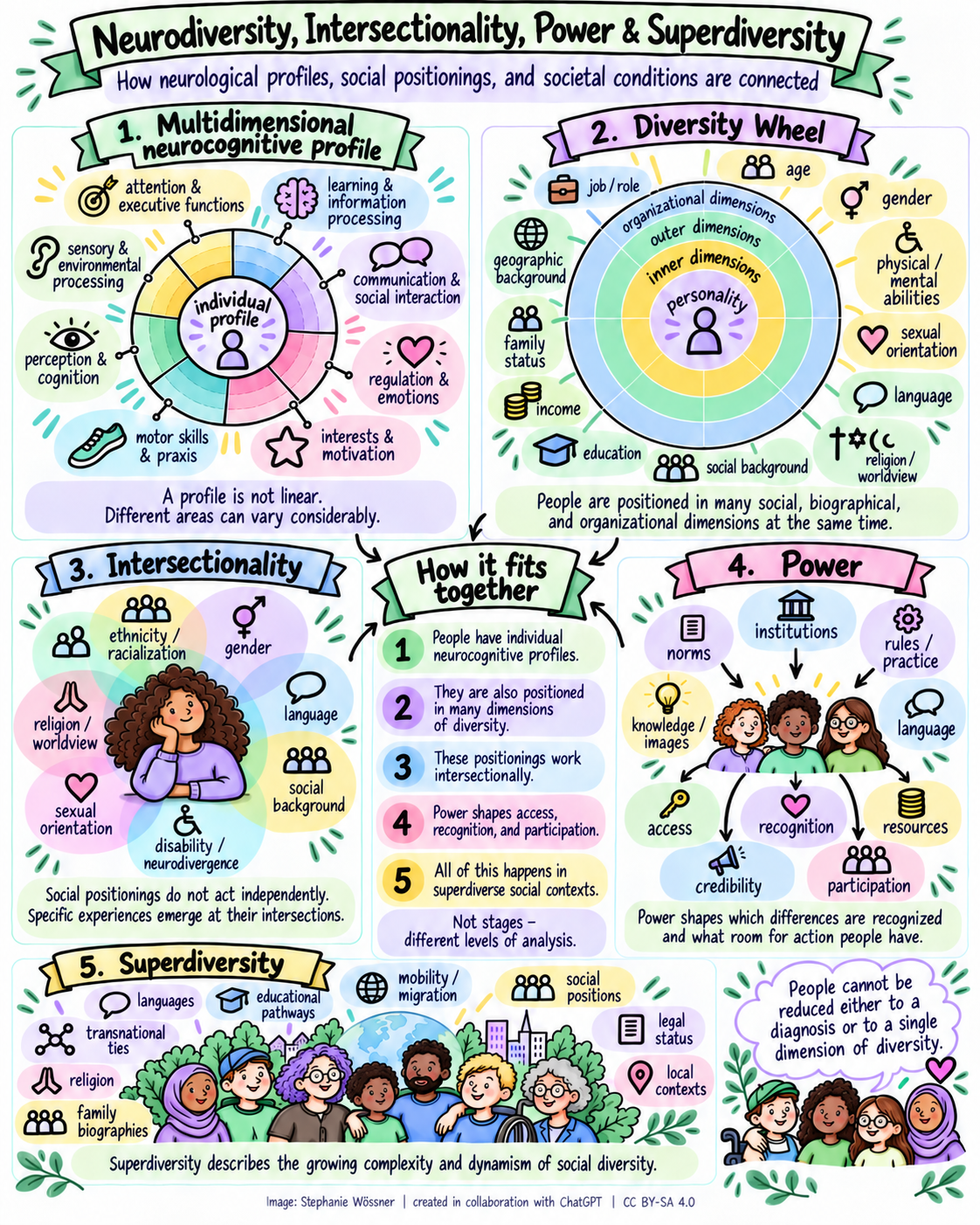 Credits: Stephanie Wössner | CC BY-SA 4.0 InternationalIt follows that neurodivergence cannot be understood through rigid categories. At the same time, this marks a limit. A person is not defined solely by their neurological profile. No one experiences autism, ADHD, dyslexia, or another neurodivergent profile separately from gender, age, language, social background, education, religion, physical characteristics, sexual orientation, family history, professional position, or the many other dimensions that shape a biography. And these dimensions do not simply exist side by side. They encounter social norms, institutional structures, and power relations that help determine which differences become visible, how they are interpreted, and what consequences they have.
From Neurological Profiles to Dimensions of Diversity
As a first way of looking at neurological diversity, I find the idea of a multidimensional profile helpful. It captures the fact that different areas within one person can be expressed differently without producing a fixed overall picture. The profile describes an internal constellation of different processing, perception, and regulation domains that may themselves vary depending on context.
The Diversity Wheel developed by Lee Gardenswartz and Anita Rowe asks a different question. Personality sits at the center, surrounded by different dimensions of diversity on several levels. Depending on the version, these include age, gender, physical abilities, sexual orientation, and other relatively stable dimensions, but also education, family status, income, geographic or social background, religion, work experience, and organizational positions. These levels matter. A person is not positioned exclusively through a few especially visible or socially prominent categories. Education, economic resources, professional role, or family constellation can be equally formative and may change over the course of a lifetime.
The Diversity Wheel makes this multidimensionality visible. At least to some extent, it helps prevent a person from being reduced to a single characteristic. On its own, however, it does not explain why some combinations become more socially visible than others. A wheel can show that dimensions exist. It does not yet explain who, within those dimensions, has greater access, recognition, or room to act.
Intersectionality Is Not the Addition of Characteristics
Kimberlé Crenshaw’s concept of intersectionality emerged from a critique of approaches that analyzed discrimination along only one axis at a time. Her starting point was the experience of Black women, whose discrimination could not be adequately understood through a perspective focused exclusively on racism or exclusively on sexism. At the intersections of social positionings, there is therefore no simple sum of independent disadvantages. The positionings change through their interaction.
For neurodivergence, this means that a person is not first autistic and then additionally a woman, multilingual, gifted, or socially privileged or disadvantaged. These positionings operate simultaneously. Expectations around communication, adaptation, emotionality, performance, or independence may emerge precisely from their combination. The same behavior may be interpreted differently depending on who displays it. Who is seen as competent, whose overwhelm is acknowledged, whose self-description is taken seriously, or who is perceived as “difficult” is therefore not a purely neurological question.
Diagnosis cannot be completely separated from this either. Diagnostic criteria may be standardized, but the path toward a diagnosis still takes place within social systems. Knowledge about neurodivergence, access to specialists, financial and time resources, language, family expectations, and widespread ideas about what autism or ADHD “typically” look like all influence this process. When certain groups are diagnosed later or differently, the explanation “their profile looks different” is therefore not sufficient on its own. The conditions under which that profile is researched, perceived, and interpreted also belong in the analysis.
Intersectionality therefore shifts attention away from the idea of separate, neatly distinguishable identity characteristics. People exist simultaneously within different social relationships and positions. Some of these create room for action, others constrain it, and many operate differently depending on context. A person can be privileged in one context and marginalized in another. This is also why I find the term “multiple burden” only partly useful. It sounds too additive and suggests that different burdens can simply be stacked on top of one another. Intersectional experiences emerge in more complex ways.
Where Power Comes In
This makes power a distinct analytical level. It is not another dimension of diversity alongside age, gender, or neurodivergence. Rather, power shapes the conditions under which these dimensions acquire social meaning.
Models such as a Wheel of Power and Privilege try to make exactly this visible. They direct attention toward access to resources, institutional recognition, credibility, social norms, and opportunities for participation. Such models necessarily remain simplified and have to be read in context. Even so, they add something that can easily remain invisible in the Diversity Wheel: differences do not exist in a power-free space.
For neurodivergence, this is immediately relevant. Who can afford to pursue a diagnosis, wait for one, or seek a second opinion? Who works in an environment where flexible ways of working are accepted? Whose direct communication is seen as authentic and whose as rude? Who is allowed to be unusual without having their competence immediately questioned? Who receives support without first having to prove that they are sufficiently impaired?
Masking and adaptation also look somewhat different from this perspective. Masking is often described as an attempt to hide neurodivergent traits or adapt to neurotypical expectations. That captures an important part of the experience. At the same time, the question arises of who has to adapt, how much, and what consequences follow when this adaptation does not succeed or is consciously refused. Such expectations arise neither exclusively from the neurological profile nor exclusively from an individual person’s decision. They belong to social relationships and power structures.
At the same time, it would be too simple, for example, to explain the fact that more and more women are receiving diagnoses in adulthood by assuming that they are supposedly more inclined to use masking strategies or better at doing so. Research and diagnostics were also shaped for a long time by manifestations that were studied and recognized primarily in men or boys. A dreamy girl simply does not disrupt in the same way as a hyperactive boy. Even the term ADHD contributes to a reductive picture: an “attention deficit” is not simply a matter of too little attention, but includes, among other things, its regulation and control; hyperactivity, in turn, does not necessarily have to be prominent. Impulsivity, executive functions, and the regulation of activation also play a role. This shows how social power relations help determine whose experiences are considered relevant and typical—and how this continues to affect research, diagnosis, and therefore the lives of many non-white, non-male people.
Agency also becomes more complex here. People have possibilities for action, develop strategies, make decisions, and help shape their environments. Yet this agency never exists under neutral conditions. Resources, recognition, institutional rules, and social positioning influence which options are realistically available in the first place. Taking agency seriously therefore means neither viewing people as passive victims of structures nor ignoring structural conditions.
Superdiversity: When Diversity Itself Becomes More Complex
This is where superdiversity comes into play for me. The term, coined by Steven Vertovec, originally emerged in the context of migration and the observation that conventional categories such as ethnic origin or nationality were increasingly insufficient to describe social diversity. Different migration trajectories, residence statuses, languages, educational backgrounds, labor market positions, age structures, transnational relationships, and local contexts created constellations that could hardly be captured through a small number of stable group labels.
The idea is interesting far beyond its original point of departure, as long as it is used precisely. Superdiversity does not simply mean “especially high diversity.” The term points to the growing complexity, dynamism, and combination of social differences. People are embedded in multiple social, cultural, biographical, and institutional relationships that change and become relevant in different ways depending on context.
Superdiversity therefore operates on a different level from the neurological profile or the Diversity Wheel. It describes more strongly the social space in which individual profiles and social positionings encounter one another. A school, an organization, or a city is not diverse simply because people from different, clearly distinguishable groups come together there. Even within supposedly similar groups, there are substantial differences in language, education, social position, family biography, mobility, legal status, religion, experience, and ideas about the future. Neurodivergence adds another dimension to this complexity without explaining or replacing it. Particularly in relation to school contexts, Aladin El-Mafaalani is an important reference.
Superdiversity and intersectionality are therefore related, but they are not synonymous. Superdiversity describes the growing complexity of social diversity. Intersectionality asks how social positionings interact within that diversity and how they are intertwined with power relations. The Diversity Wheel can make visible which different dimensions may be involved in the first place. A power-and-privilege model draws attention to the fact that these dimensions are socially valued and resourced differently. The multidimensional neurological profile, in turn, captures the fact that the neurological side of a person is itself not a uniform category.
I find this representation particularly compelling because no single model has to explain everything. A neurological profile describes how different neurocognitive domains interact within a person. The Diversity Wheel broadens the view to include biographical, social, and organizational dimensions. Intersectionality asks what happens at their intersections. Power explains why these intersections can produce real differences in access, recognition, and participation. Superdiversity, finally, makes visible that all of this takes place in social contexts whose diversity itself is becoming increasingly complex, dynamic, and difficult to capture through stable categories.
This also changes the question of participation for me. People do not simply need the right support for their neurological profile. Access also depends on resources, institutional conditions, language, social positioning, relationships, and the possibility of having one’s own needs regarded as credible in the first place. Two people with very similar neurological profiles can therefore have entirely different experiences. The profile alone does not explain that difference.
Taking neurodiversity seriously increasingly means being able to see several levels at once without confusing them with one another. People have individual neurological profiles. They live within multiple social positionings. These are interwoven intersectionally and embedded in power relations. And they move through societies in which diversity itself is becoming increasingly complex.
That leads to an important consequence: people cannot be reduced either to a diagnosis or to a single dimension of diversity. Anyone who wants to enable participation has to look more closely at profiles, positionings, barriers, and resources—and at the conditions under which people are given room to act at all.
Further Reading
Crenshaw, K. (1989). Demarginalizing the Intersection of Race and Sex: A Black Feminist Critique of Antidiscrimination Doctrine, Feminist Theory and Antiracist Politics. University of Chicago Legal Forum, 1989(1), 139–167. Link to the article
Crenshaw, K. (1991). Mapping the Margins: Intersectionality, Identity Politics, and Violence against Women of Color. Stanford Law Review, 43(6), 1241–1299. Link to the article
El-Mafaalani, A. (2023). Kinder – Minderheit ohne Schutz. Aufwachsen in der alternden Gesellschaft. Cologne: Kiepenheuer & Witsch. Publisher page
Gardenswartz, L. & Rowe, A. (2003). Diverse Teams at Work: Capitalizing on the Power of Diversity. 2nd ed. Society for Human Resource Management. SHRM – Four Layers of Diversity
Immigration, Refugees and Citizenship Canada (IRCC) (2022). The Wheel of Privilege and Power. Link to the website
Vertovec, S. (2007). “Super-diversity and its implications.” Ethnic and Racial Studies, 30(6), 1024–1054. DOI: 10.1080/01419870701599465
Bildquellen
- Different Layers of Diversity: Stephanie Wössner | CC BY-SA 4.0 International
- Neurodiversity: PetiteProf79 | CC BY-SA 4.0 International