
Autism is generally described as a neurodevelopmental variation that can affect, among other things, perception and information processing, communication and social interaction, interests, and behavior. However, these characteristics vary considerably from person to person. This is precisely why the common idea of a linear scale is problematic. Autism cannot meaningfully be represented along a single axis from “mild” to “severe.” Different areas within a person’s profile can vary greatly, and support needs cannot be inferred from a single visible ability.
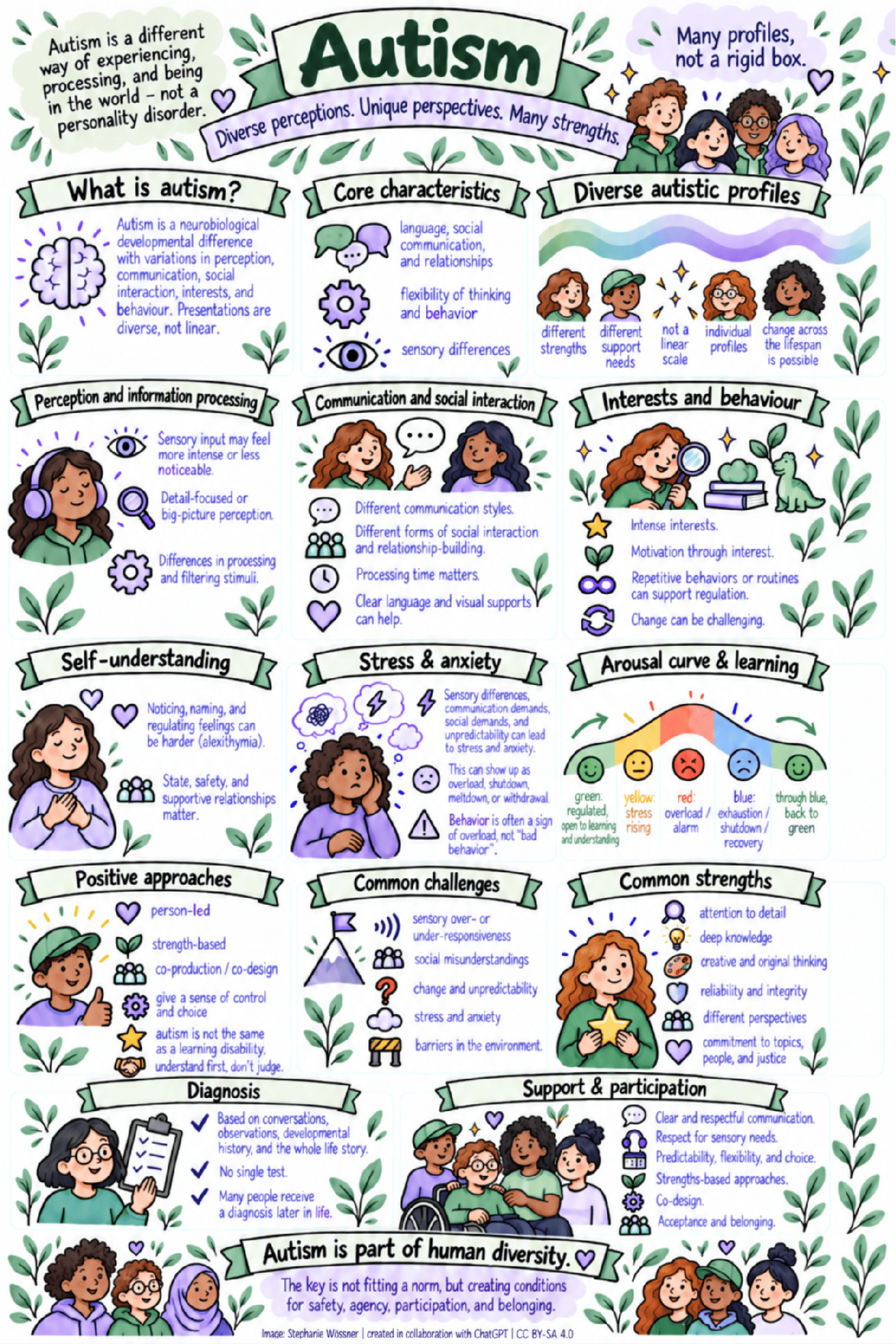 Credits: Stephanie Wössner | CC BY-SA 4.0 InternationalOne person may speak in highly nuanced ways while also needing substantial support with sensory processing, planning, or transitions. Another may use little spoken language while still processing complex ideas in highly differentiated ways. Some people notice details very intensely, while others work more readily with larger patterns and connections; sensory input may be experienced more or less intensely and filtered differently. Sound, light, touch, movement, or a high density of social information therefore become part of the situation itself and can affect how much capacity remains available for communication, planning, or flexible responses.
It is also important in this context not to equate autism with intellectual disability or a learning disability. They can co-occur, but neither defines the other. This is exactly why assumptions fall short when cognitive ability is inferred directly from communication, behavior, or visible independence.
For me, this connects with the question of a person’s current state. Abilities are not available independently of someone’s physical and emotional condition. Under high levels of stress, language may become harder to access, flexibility may decrease, or social interaction may become barely manageable. Meltdowns, shutdowns, or withdrawal cannot then be meaningfully interpreted as “bad behavior.” They may be expressions of overload in which demands, sensory input, social expectations, and a lack of predictability interact.
I found the so-called arousal curve particularly interesting in this context. It describes a possible progression from regulation through increasing tension and overwhelm to exhaustion or shutdown and, eventually, back toward a more regulated state. The green phase represents a state in which learning, understanding, and reflection are most readily accessible. This strongly reminds me of Regulate – Relate – Reason: demanding more explanation, insight, or flexibility during a state of high activation ignores the condition a person is actually in. Regulation is therefore not a preliminary stage that should be moved through as quickly as possible. It is a condition for certain abilities to become accessible again in the first place.
Communication, Interests, and Self-Perception
Communication is also broader than the question of whether someone has mastered the expected social form. Autistic people may communicate in different ways, speak more directly or explicitly, process nonverbal cues differently, or build relationships in other ways. My earlier post on the Double Empathy Problem explores the relational side of these misunderstandings in greater depth. What matters most here is that differences in communication should not automatically be interpreted as a lack of social interest or empathy. Support therefore does not mean bringing autistic communication as close as possible to a supposedly normal form. Time to process can be just as important as clear, unambiguous language or visual and written support. Communication happens between people. When mutual understanding breaks down, responsibility for being understood does not automatically lie with the autistic person.
Intense interests and repetitive behaviors are also part of autistic profiles. This is where I find monotropism particularly interesting as an additional perspective. Developed by Dinah Murray, Mike Lesser, and Wendy Lawson, the model describes attention as more tightly focused and helps explain why a small number of topics can absorb a great deal of attention and why shifting between attentional channels can require substantial effort. Intense interests can enable deep knowledge and strong motivation. Transitions and interruptions can be difficult at the same time. Repetitive movements and routines can help maintain regulation, create a sense of safety, or meet sensory needs. Their meaning therefore cannot be inferred from visible behavior alone.
Alexithymia also belongs in this picture, without being equated with autism. Difficulties identifying, differentiating, or putting one’s own emotional states into words can occur among autistic people and directly affect self-understanding. This does not mean that emotions are absent or experienced less intensely. The connection between interoception, emotional awareness, regulation, and language makes clear why a quick request such as “Just tell me how you feel” can demand a great deal from some people. Being unable to name something does not mean that nothing is being felt—quite the opposite.
Stress and anxiety can intensify when sensory differences, high social demands, unpredictability, and communication difficulties come together. Visible withdrawal or a sudden reduction in access to abilities is then part of a larger state. Safety, predictability, and reliable relationships become conditions that influence how much regulation is required. This also includes the feeling of being able to exert influence, make choices, or shape a situation at least to some degree. Choice is not a minor comfort issue in this context. It can make a difference in whether a situation feels manageable or completely controlled by others.
Diagnosis, Strengths, and Support
An autism assessment therefore looks at more than isolated behavioral traits. Conversations, observations, developmental history, and different areas of life need to be considered together. No single test captures a person in full, and many people are not diagnosed until later in life. Here again, it becomes clear why visible behavior or individual abilities cannot stand in for an entire neurological profile.
Possible strengths can include attention to detail, deep subject knowledge, original thinking, reliability, integrity, different perspectives, or a strong commitment to particular topics and to justice. These are not characteristics that every autistic person must have, nor can autism be inferred from them alone. A neurodiversity-affirming perspective does not need this kind of positive balancing act. It takes individual abilities seriously while also taking sensory, communicative, and regulatory support needs seriously.
In this context, as with other forms of neurodivergence, person-led, strengths-based approaches and co-production are highly important. The person themselves then has a say in what is right, appropriate, or helpful for them instead of someone else deciding on their behalf. This strongly reminds me of the Sun Model of Co-Agency and of my broader perspective on learning. Not because the contexts are identical, but because the same question lies underneath: Who defines the goals, who decides what support means, and how much genuine power to shape the situation remains with the person themselves?
Support can include clear and respectful communication, respect for sensory needs, predictability, flexibility, choices, and a strengths-based orientation. Co-production and co-design go further than asking afterward whether an already developed solution is acceptable. People are involved when defining what would be helpful in the first place. This also changes how we interpret behavior, because understanding takes the place of a premature judgment. A behavior is visible; its function and context often are not. The same behavior can serve different functions for different people, and environmental conditions, communication, lack of control, or unmet needs also need to be taken into account.
Acceptance and belonging, ultimately, can hardly be created by making someone fit an existing norm as unobtrusively as possible. They emerge where difference genuinely has room to exist and where support is neither shaming nor tied to the expectation that someone should appear different from who they are. For me, this is also where neurodiversity connects with a humanistic understanding of learning: The person does not need to be made to fit. We need to create conditions in which safety, agency, participation, and belonging are possible for everyone.
Further Reading
Murray, D., Lesser, M., & Lawson, W. (2005). Attention, monotropism and the diagnostic criteria for autism. Autism, 9(2), 139-156. https://doi.org/10.1177/1362361305051398
Bildquellen
- Autism: Stephanie Wössner | CC BY-SA 4.0 International
- Neurodiversity: PetiteProf79 | CC BY-SA 4.0 International