
 Credits: PetiteProf79 | CC BY-SA 4.0 InternationalI was already familiar with the concept of neurodiversity before taking this course. Still, my understanding of it shifted over the past several weeks. This was not because the basic idea of neurological diversity was new to me. What became much clearer was what happens when we actually use that diversity as a starting point for how we think.
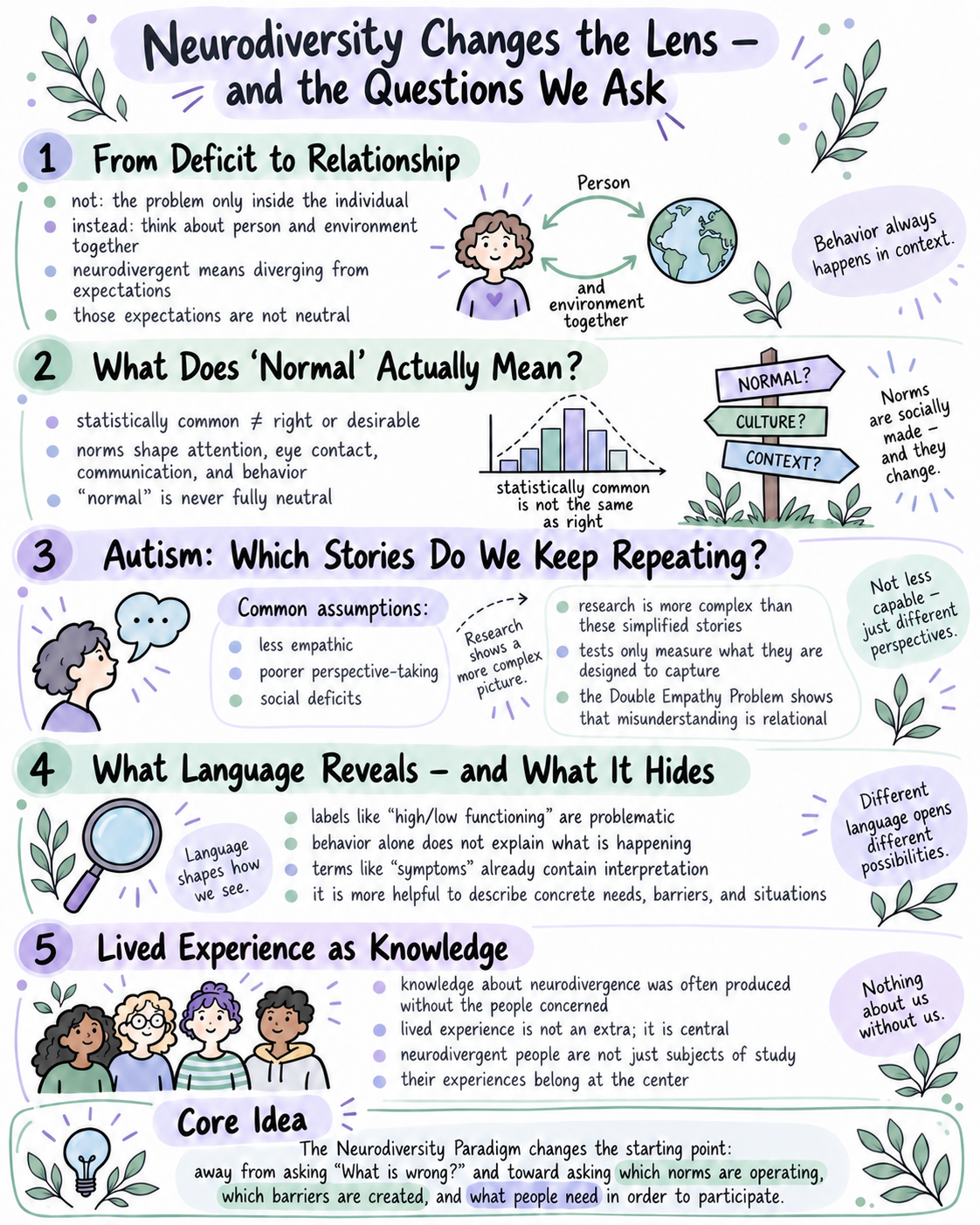
The Neurodiversity Paradigm first changes where we locate a problem. Many traditional models describe differences in behavior, communication, learning, or regulation primarily as characteristics of an individual person. At first, that can seem reasonable. After all, it is a particular person who may be struggling. The environment in which those difficulties emerge, however, can easily disappear from view.
The word “neurodivergent” itself already points toward that relationship. To diverge means to diverge from something. That reference point is not neutral. It is shaped by expectations about how long someone should pay attention, how eye contact should work, how people should express their thinking, how much noise they should tolerate, how quickly they should complete a task, or what counts as appropriate social behavior. Many of these expectations feel natural as long as we can function within them relatively easily ourselves. This also made me even more uncomfortable with the word “normal” than I already had been. It often sounds descriptive while quietly carrying a normative assumption. What is statistically common can easily become confused with what is right, appropriate, or desirable.
None of this means making disability, neurological differences or genuine difficulty disappear through language. Some neurodivergent people experience significant disability and require substantial support. A neurodiversity-affirming perspective should not ignore those experiences any more than a purely medical perspective should ignore barriers, ableism, or social conditions. One of the most important things I am taking from the course may be the need to resist resolving this tension too quickly. Neurodiversity is not simply a positive story about different strengths. It asks us to look more carefully at the relationship between a person and an environment.
Which stories about autism do we keep repeating?
This became particularly clear to me when we discussed autism. Some ideas remain surprisingly persistent even though the evidence behind them is far more complicated than their popular versions suggest. One example is the assumption that autistic people are less empathetic or less able to understand what other people are thinking. Nick Walker’s critique of work by Simon Baron-Cohen and Uta Frith made me think much more carefully about this. Any assessment first measures what its design allows it to measure. If someone processes information differently, needs more time, or interprets an artificial testing situation differently, a lower score does not automatically tell us whether that person understands other people.
The Double Empathy Problem offers a different perspective. Misunderstandings between autistic and non-autistic people can be understood as communication difficulties between people with different experiences and communication styles – just like in cross-cultural communication. Understanding is relational. It develops between people and therefore cannot easily be treated as an ability that belongs to only one person.
That shift matters for education. Instead of asking only what a learner still needs to acquire in order to meet existing social or communication norms, we can also ask what those norms are, who can meet them easily, and what genuine mutual understanding requires from everyone involved.
What language reveals — and what it hides
Functioning labels such as “high functioning” and “low functioning” create similar problems. A person may appear highly independent in one context and need substantial support in another. Visible performance also tells us very little about the amount of effort, compensation, or stress involved. The language of “symptoms,” or even apparently neutral descriptions of behavior, can already contain interpretation. Behavior by itself rarely tells us why something is happening. Withdrawal may indicate overwhelm, concentration, self-regulation, or something else entirely. When we assess only what is visible, we risk missing the experience behind it. Over the course of the summer course, language therefore became much more than a question of respectful terminology for me. The alternative to deficit-based labels cannot simply be finding a positive word for everything. It seems more useful to describe specific needs, barriers, experiences, and contexts.
This is closely connected to the question of whose voices we hear. Lived experience was not presented in the course materials as an optional addition to research. It exposed how much knowledge about neurodivergence has historically been produced by people outside those experiences. That influences the questions researchers ask, the behaviors professionals consider unusual, and the interpretations that become established.
Perhaps this is one of the most fundamental changes introduced by the Neurodiversity Paradigm. Neurodivergent people no longer appear primarily as objects of study whose differences need to be explained. Their experiences become part of the knowledge we need if we want to understand what neurological diversity actually means in a world whose structures are far from neutral.
Literature
- Baron-Cohen, S., Leslie, A. M., & Frith, U. (1985). Does the autistic child have a “theory of mind”? Cognition, 21(1), 37–46. doi: 10.1016/0010-0277(85)90022-8. PubMed
- Bottema-Beutel, K., Kapp, S. K., Lester, J. N., Sasson, N. J., & Hand, B. N. (2021). Avoiding ableist language: Suggestions for autism researchers. Autism in Adulthood, 3(1), 18–29. doi: 10.1089/aut.2020.0014. PubMed
- den Houting, J. (2019). Why everything you know about autism is wrong [TEDx talk]. TED
- Manalili, M. A. R. (2021). Ableist ideologies stifle neurodiversity and hinder inclusive education. Ought: The Journal of Autistic Culture, 3(1), Article 6, 22–36. doi: 10.9707/2833-1508.1072. gvsu.edu
- Milton, D. E. M. (2012). On the ontological status of autism: The “double empathy problem.” Disability & Society, 27(6), 883–887. doi: 10.1080/09687599.2012.710008. Taylor & Francis Online
- Walker, N. (2021). Neuroqueer heresies: Notes on the neurodiversity paradigm, autistic empowerment, and postnormal possibilities. Autonomous Press.
Bildquellen
- Neurodiversity 1: PetiteProf79 | CC BY-SA 4.0 International
- Neurodiversity: PetiteProf79 | CC BY-SA 4.0 International