

Dyslexia, dysgraphia, dyscalculia, and dyspraxia, or Developmental Coordination Disorder (DCD), affect different areas and are not diagnostically grouped into a single category. I still find it useful to consider them alongside one another because they make particularly visible how much cognitive and physical work can lie behind an observable result. Dyslexia primarily affects reading and the processing of linguistic or phonological information. Dysgraphia relates to writing, handwriting, and, in some cases, written expression. Dyscalculia affects the processing of mathematical and numerical information as well as the development of arithmetic facts and procedures. With dyspraxia, or the profile diagnostically referred to as Developmental Coordination Disorder (DCD), coordination and motor planning are central, although some people experience concentration, planning, and executive functioning as even more challenging than the more obvious motor difficulties.
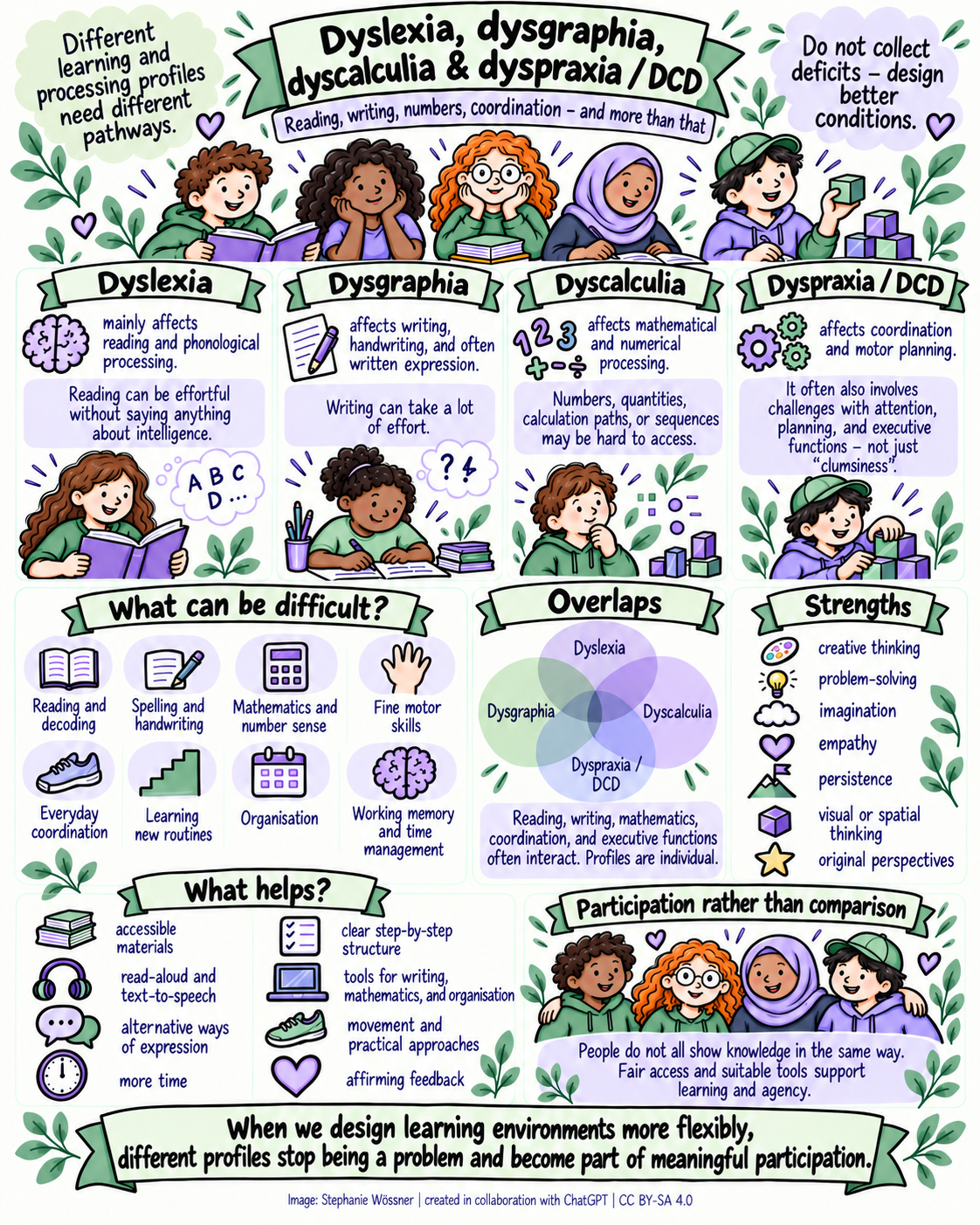 Credits: Stephanie Wössner | CC BY-SA 4.0 InternationalFor experienced readers, reading eventually feels almost automatic. Yet numerous processes are happening at the same time: letters and sound structures are recognized and connected, words are decoded, meaning is constructed, and information is held in working memory while the larger context continues to be followed. When some of these processes require a great deal of conscious attention, the overall cognitive load changes. Slow or effortful reading then tells us very little about how complexly someone can think or how well they can understand content. Dyslexia, accordingly, is not only about reading speed. Phonological processing, short-term memory, organization, time management, and other areas may also come into play in specific situations.
The same is true of writing. Someone who has to consciously coordinate letter formation, fine motor skills, spacing, spelling, sentence structure, and content planning uses different cognitive resources for the same visible task than someone for whom many of these processes are automatic. Dysgraphia therefore cannot be reduced to “poor handwriting.” Noticeable handwriting can have different underlying causes, and there are different forms of dysgraphia. Ideas may also be fully present while the process of translating thought into written text requires considerable effort.
With dyscalculia, the same underlying question appears in a different domain. Numbers, quantities, mathematical relationships, calculation procedures, or number sequences can require a great deal of conscious processing. Here too, a visible result does not allow us to draw direct conclusions about a person’s general thinking ability. Someone who has difficulty automating math facts or processing numerical relationships may understand complex problems and still struggle with tasks that assume certain numerical processes are quickly and automatically available.
With dyspraxia or DCD, the connection between motor skills and cognition becomes particularly visible. Motor planning affects everyday actions as well as fine- and gross-motor activities, unfamiliar movement sequences, and coordination. This can include writing, getting dressed, managing buttons and shoelaces, running, jumping, and learning new skills. Organization, working memory, time management, sequencing, and learning new routines may also be involved, along with planning, memory, language, and social and emotional aspects. Describing this simply as “clumsiness” fails to capture the reality.
Overlaps and Uneven Profiles
This is where a multidimensional understanding becomes especially useful. Reading, writing, mathematics, motor skills, working memory, organization, or time perception can overlap without appearing in the same combination for every person. Dyslexia can co-occur with ADHD, just as dyspraxic profiles can include executive functioning difficulties. Dyscalculia does not exist in isolation from these other areas either; diagnostically and developmentally, it can sometimes be difficult to distinguish from dyslexia. A diagnostic label therefore tells us relatively little about a person’s overall learning and processing profile.
Twice Exceptionality makes this unevenness even more visible. High cognitive ability and specific learning or developmental differences can exist at the same time. A learner may grasp complex relationships unusually quickly and still have considerable difficulty putting those same thoughts into writing. Another person may recognize mathematical patterns or develop original approaches to problem-solving while struggling with automated math facts. High ability can make years of compensation possible, which may delay recognition of support needs. Conversely, visible difficulty with reading, writing, math, or coordination can lead others to underestimate cognitive ability. This is particularly relevant in DCD, where actual performance can fall significantly below what a person’s intelligence would suggest.
Possible strengths should therefore also be considered individually. Creative thinking, imagination, problem-solving, empathy, persistence, or visual-spatial thinking may play an important role for some people. They are not automatic consequences of dyslexia, dyscalculia, or DCD. A neurodiversity-affirming perspective does not require a balancing equation in which a difficulty has to be offset by a special talent. A person’s profile remains uneven, and that unevenness quickly disappears when diagnoses are treated as fixed packages of traits.
Changing Access Without Diluting Expectations
Because current discussions about school systems often focus on foundational skills—reading, writing, and math—these profiles raise a very concrete question: What is a task actually intended to make visible? If the goal is subject-matter understanding, an exclusively handwritten task may also be measuring fine motor skills, spelling, working memory, and writing speed. If reading itself is the learning goal, the situation is different. The same applies to mathematics: If the aim is to make mathematical thinking visible, we need to ask whether the task also requires rapid retrieval of memorized facts, high writing speed, or complex notation. If that specific skill is what is being learned, however, then it belongs in the task. This distinction is central to me because otherwise support is quickly confused with “making things easier.”
More accessible materials, read-aloud support or text-to-speech, speech-to-text, alternative forms of expression, additional time, clear step-by-step sequences, or digital tools for writing, mathematics, and organization can change access without necessarily lowering the academic goal. With DCD, movement and hands-on approaches may be just as relevant as reducing unnecessary fine-motor demands. Respectful and affirming feedback also matters because people whose visible results repeatedly fall short of what they know may spend years receiving very different messages about what others assume they are capable of.
Not everyone demonstrates knowledge in the same way. These profiles make particularly visible how risky it is to equate a specific mode of expression with the ability behind it. Participation also means allowing different pathways, as long as they genuinely make the intended goal of a task visible. Different learning and processing profiles then no longer become something that has to be eliminated or compensated for. Instead, they change the question of how learning environments need to be designed so that knowledge, thinking, and ability can become visible in the first place.
Bildquellen
- Dyslexia: Stephanie Wössner | CC BY-SA 4.0 International
- Neurodiversity: PetiteProf79 | CC BY-SA 4.0 International