
 If we invited thirty people for dinner, most of us would probably not assume that everybody would want or be able to eat exactly the same dish. There might be allergies and intolerances, some people might be vegetarian or vegan, and others simply dislike particular foods. We would rarely interpret any of this as a personal failure. If someone cannot eat the casserole, very few of us would conclude that they need to become better at coping with casserole.
From casserole to buffet
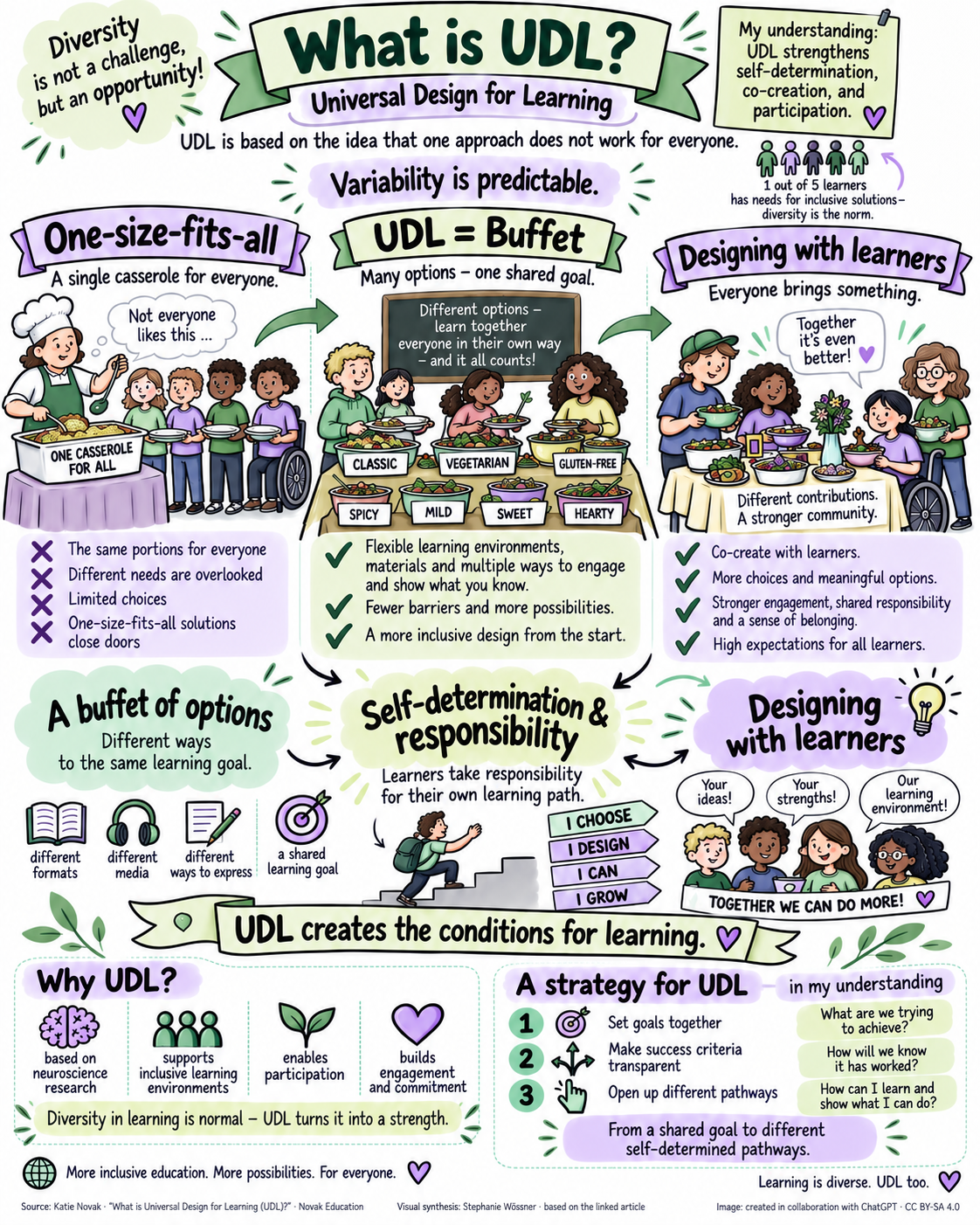
Katie Novak uses a similar dinner-party analogy to explain Universal Design for Learning (UDL). In her example, a single prepared meal represents a learning environment in which everybody is expected to use the same pathway. A buffet offers different possibilities. At a potluck, guests contribute something themselves and become part of shaping what happens.
One aspect of Novak’s analogy is particularly important because it can disappear in simplified accounts of UDL: the goal of the evening was never for everybody to eat the same casserole. The food serves the larger purpose of sharing a meal and spending time together. Applied to learning, the metaphor raises a fundamental question:
What is actually part of the learning goal, and what have we begun to treat as a goal simply because it has become part of the way we organise learning?
This distinction matters. If learners are expected to understand a particular concept, demonstrating that understanding may not always require a handwritten text. If the learning goal is specifically to write an argument, however, writing cannot simply be replaced by recording a podcast. Katie Novak describes this as “firm goals, flexible means”: the goal needs to be clear enough for different pathways towards it to make sense. Flexibility is not the same as arbitrariness.
Looking for barriers earlier
For me, this is quite different from an understanding of individual support that begins with a standard learning environment and then provides additional solutions for those who struggle within it. Such support can of course be necessary. Universal Design simply starts earlier by asking which barriers might be anticipated while the environment is still being designed.
The current UDL Guidelines 3.0 developed by CAST go considerably further than the familiar shorthand of Engagement, Representation, and Action & Expression might suggest. CAST explicitly identifies learner agency as the goal of UDL and connects it with learners becoming increasingly purposeful and reflective, resourceful and authentic, and strategic and action-oriented. Version 3.0 also gives much more space to belonging, identity, different ways of knowing and making meaning, collaboration and interdependence, and barriers rooted in systems of exclusion.
I find this significant because it moves UDL away from the idea of a collection of accommodations for people with “special needs”. Variability becomes part of the underlying view of human beings. CAST assumes that differences between learners are predictable and also recognises that the same learner will vary across time and circumstances.
When the barrier is not located in the learner
From a neurodiversity-affirming perspective, I find the location of the problem particularly important. Difficulty is not automatically located within the person. A barrier often emerges through a particular combination of person, task, social context, and environment. A support need can therefore be very real without telling us that there is something inherently deficient about the person who needs that support.
Consider a learning environment in which everybody is expected to present their work in front of the whole group. Some learners will have no difficulty with this; some may enjoy it; others might deliberately choose it as something they want to practise. For another learner, the presentation itself may consume so much energy that the situation tells us very little about how well they understood the actual subject matter.
At that point, the relevant question is whether public presentation is part of the learning goal. If it is, support and gradual steps may be needed to develop precisely that capability. If it is not, the presentation requirement may simply be an avoidable barrier.
The same question can be asked about writing, time limits, group work, seating arrangements, language, digital tools, and many other features that quickly become invisible because we are used to them. UDL invites us to examine those assumptions. I would nevertheless be wary of responding by trying to provide every imaginable option in advance. An interface containing twelve choices is not necessarily more accessible than one containing two carefully designed possibilities.
Choice is not the same as agency
This is where agency becomes important to me. Choice may contribute to agency, but the two are not interchangeable. Being allowed to choose between three pathways planned entirely by someone else gives me more influence than being assigned one pathway. It does not necessarily mean that I am co-shaping my learning environment.
The current UDL Guidelines open this idea further. CAST explicitly notes that the Guidelines do not have to be applied exclusively by educators. Depending on the learning goal, learners themselves—or educators and learners together—can use them to co-create more supportive learning environments. This is where Novak’s buffet can genuinely become a potluck.
Learners can then do more than choose between text A and podcast B. Over time, they can become more aware of the conditions that support their learning, suggest their own pathways, introduce questions, choose tools, provide feedback on the environment, and participate in decisions where there is a genuine space for decision-making. Some goals may be given; others may be negotiated. Sometimes the form is part of what is being learned. Sometimes it is simply one possible route.
Self-determination still needs orientation
None of this requires the disappearance of structure. A learning environment with meaningful possibilities also needs orientation. People making decisions need to understand what they are deciding about, where they are trying to get to, and what different pathways might involve. Some learners will initially need substantial support to make these decisions; others mainly need adults to stop making every decision for them. The same learner may need different degrees of support at different times.
This matters because self-determination itself can quietly become a new norm. Suddenly everybody is expected to plan independently, manage their time perfectly, formulate goals, and navigate a broad menu of possibilities with confidence. Learners who find this difficult then appear deficient again, this time within a supposedly open learning culture.
That would be a peculiar outcome: we introduce choice to acknowledge human variability and then turn the ability to make use of that choice in one particular way into another standard everybody is expected to meet.
Understanding UDL as a design question helps avoid this. Good design does not require people to make the maximum possible number of decisions. It keeps possibilities open where differences matter and provides support where support is useful. A clear recommendation may be far more helpful to one learner than ten equally weighted options. Another learner may know exactly what works for them. Agency can include choosing structure and accepting support.
From buffet to potluck
This connects UDL quite directly with the questions I explore in my Future:Guide Education and Learning for a Livable Future. If we want people to participate in shaping their present and future, learning environments can become places where that experience is already real. A learner can experience that their perception matters, that they can make decisions and reflect on their consequences, that other people may need different conditions, and that shared spaces therefore require negotiation.
The word shared matters here. Personalization can easily drift towards the idea that everybody ultimately needs an entirely separate pathway. That is not how I understand learning. Learning is also relational. It involves thinking with others, encountering differences, cooperation, friction, and the experience of belonging to a community. Interestingly, UDL 3.0 itself places greater emphasis on interdependence and collective learning. Human variability does not require isolation.
Perhaps this is why Novak’s dinner metaphor continues to work. A buffet does not require thirty people to eat in thirty different rooms. They can remain around a shared table without having identical food on their plates. A potluck adds another layer: people are no longer simply guests in an arrangement somebody else has created for them. They contribute to it.
For learning environments, this is more demanding than finding one method that supposedly works well for everybody. It requires us to distinguish more carefully between goals and habits, to resist locating every barrier inside the learner, and occasionally to give up the assumption that good educational design means having all the answers in advance. Some of those answers only become visible when the people who actually learn in these environments are able to participate in shaping them.
Sources and further reading
CAST (2024): Universal Design for Learning Guidelines 3.0. Link
CAST: About the Guidelines 3.0 Update. Link
Katie Novak (2024): What is Universal Design for Learning (UDL)? Link
Katie Novak (2024): UDL vs Differentiated Instruction: The Dinner Party Analogy. Link
Katie Novak (2023): The What and How of Firm Goals, Flexible Means: UDL in the Classroom. Link
Bildquellen
- Neurodiversity: PetiteProf79 | CC BY-SA 4.0 International