
In one of my current courses on individual learning needs and neurodiversity, I am working with a collection of very different frameworks and resources. Some come from educational contexts, others from therapy, speech and communication support, or developmental practice. The assignment initially sounded fairly straightforward: Which approaches are new or less familiar to me? Which ones make immediate sense to me? Which might be helpful for learners? As I read, however, I quickly realized that another question interested me more than categorizing individual models. I began paying attention to where responsibility is located when communication, learning, regulation, or participation becomes difficult. Is it placed with the individual, who is expected to develop certain skills or meet certain demands? What role do the people around them play? And at what point do the environment, institutional expectations, and the way we design situations in the first place become part of the picture?
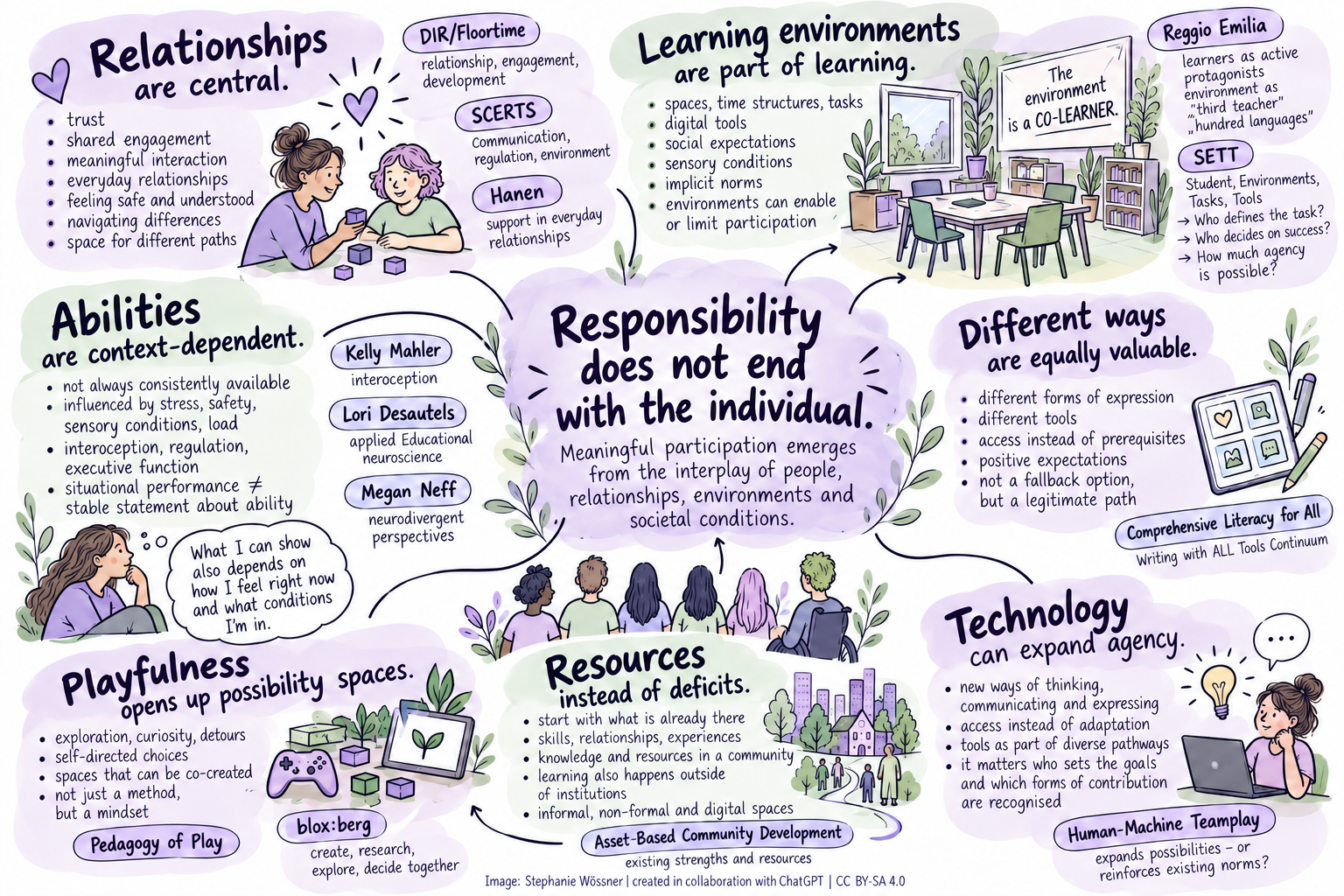 Credits: Stephanie Wössner | CC BY-SA 4.0 InternationalMany of the specific frameworks were new to me, even though some of their underlying ideas were very familiar. DIR/Floortime, for example, approaches development largely through relationships, engagement, and meaningful interaction. What particularly resonated with me in SCERTS was the concept of Transactional Support, because it means that communication and regulation are not located exclusively within an individual. Other people and the conditions of a situation become part of what support actually means. This connects closely to a question that has been part of my own work for a long time: What changes when we stop treating learning environments as neutral backdrops in which learning takes place and instead understand them as part of the learning process itself?
Conditions Are Not a Side Issue
In educational contexts, we are surprisingly quick to talk about people as though their abilities and difficulties could be clearly located within them. Someone cannot concentrate, participates very little, communicates differently than expected, needs a long time to complete a task, or does not demonstrate a particular ability in a given situation. These observations may be accurate and still remain incomplete. On their own, they tell us very little about the conditions under which something happened. How predictable was the situation? What social expectations were present? What sensory demands were involved? How much time was available? Were there multiple ways to demonstrate or express something? How safe did the person feel in that situation? And who had actually decided what they were supposed to do?
That is exactly why I find some aspects of SETT interesting while remaining skeptical of others. Bringing together Student, Environments, Tasks and Tools clearly broadens the perspective beyond the individual. At the same time, I immediately got stuck on the word Tasks. Who defines the task? Who decides what counts as a successful outcome? To what extent is the learner involved in changing the task itself or pursuing a different goal? A framework can be sensitive to context and still be used within a logic in which professionals or institutions largely determine what is supposed to be achieved. For me, agency therefore matters far more than whether an approach is formally described as person-centered or environment-centered.
This connects directly to my work on Learning Environments. Spaces, time structures, digital tools, rules, forms of communication, and relationships always carry assumptions about what learning is supposed to look like. Some people can move through these environments easily, while others have to spend a great deal of energy adapting to their conditions. Reggio Emilia resonates strongly with me in this respect. The environment is understood there as the “third teacher,” children as active protagonists in their own learning, and the “hundred languages” represent a diversity of forms of expression that are not predetermined according to a linguistic or academic hierarchy. Yet when we allow different forms of expression, do we actually treat them as equally valid, or do they remain substitutes for people who cannot follow what is perceived as the normal path?
Relationships, Access, and the Question of Standards
Comprehensive Literacy for All connects with my thinking in a similar way. The approach assumes that learners with complex communication or support needs should also have access to reading and writing, and that different tools and forms of expression are legitimate ways of getting there. The Writing with ALL Tools Continuum makes this stance very concrete. What interests me here is less literacy in general than the assumptions behind the approach: What changes when we do not first require someone to demonstrate certain prerequisites before granting access? And what changes when a different path is not considered less valuable?
I encounter this question across many areas of my own work. With digital tools, and now especially in the context of Human-Machine Teamplay, discussions quickly turn to whether technologies can take something off people’s plates, simplify things, or compensate for something. Much less often do we ask whether they can expand people’s possibilities for action. A tool can be used to help someone conform more efficiently to an existing norm. But it can also enable forms of thinking, communication, and expression that were previously difficult or entirely inaccessible. Whether this creates greater agency is not determined by the technology itself. It depends on who sets the goals, who decides how the technology is used, and which forms of performance are ultimately recognized.
DIR/Floortime and the Hanen Program prompted a different line of thought for me. Relationships play a central role in both approaches, even though they come from different professional traditions. What I particularly appreciate about the Hanen Program is that support does not remain permanently tied to therapists but is embedded in everyday relationships. It reminds me how often relationships are treated in educational discourse as a soft, additional dimension, while the “real” learning is assumed to happen independently of them. I have not found that distinction convincing for a long time. Trust, safety, the feeling of being understood, the ability to express discomfort or confusion, and the possibility of proposing a different path all affect what people are able to show in a particular situation. Relationships do not solve structural problems. But they do change the space within which people can act.
Starting with What Is Already There
Asset-Based Community Development stayed with me most strongly. Perhaps that is also because the approach opens the perspective further and connects individual learning processes with a broader societal perspective. It begins with the existing abilities, relationships, experiences, and resources within a community. This is very close to my understanding of Learning for Life, because learning is not confined to institutionally organized situations. People bring experiences from families, peer groups, communities, clubs and organizations, digital spaces, and many other contexts. Within education systems, that knowledge often becomes visible only selectively. Much of it remains invisible because it does not fit the categories through which performance or expertise is typically recognized.
My work with virtual worlds can also be viewed differently from this perspective. A game-based space does not interest me primarily because play can be motivating. It becomes interesting where people can create, explore, exchange perspectives, and produce something together without the course of the experience being fully predetermined. This is where Asset-Based Community Development intersects, for me, with Playfulness and with my understanding of learning environments. The abilities and interests people already bring with them are not simply taken into account; they can help shape what the space itself becomes.
I was already familiar with Pedagogy of Play, so many of its underlying ideas were familiar to me. In relation to the other approaches, however, it becomes clear that Playfulness creates spaces in which exploration, uncertainty, curiosity, detours, and personal choices have room to exist. That makes it closely connected to agency. A playful learning environment can still be highly externally controlled if the goal, the path, and the desired outcome have already been determined. Conversely, a clearly structured environment can offer a great deal of agency. The outward form tells us very little about that.
Abilities Are Not Always Equally Available
Another strand also resonated with me personally: work on interoception, regulation, and the context-dependent availability of abilities. The materials include Kelly Mahler’s Interoception Curriculum, Lori Desautels’ Applied Educational Neuroscience, and resources by Megan Neff. They come from different professional perspectives, but they all draw attention to something that is easily underestimated in everyday education: A person may have an ability and still have only limited access to it in a particular situation.
I notice this more clearly in myself now as well. Writing has always been one of my primary ways of understanding things. I think a great deal, analyze connections, and then work through them again through language. That is still true. Under greater strain, however, I have noticed that I now also need a visual layer. Sketchnotes help me make relationships between ideas visible and retrieve information again later. I do not experience this as a substitute for something that used to work. It is more like an additional form of processing that becomes more important under certain conditions. This is exactly why I find it problematic to infer a stable ability directly from a single observed performance. What a person can demonstrate also depends on how much access they have to their own resources in that particular moment.
This is where neurodiversity intersects, for me, with a broader educational question. If abilities are available differently depending on context, then we cannot assess learners—if we need to assess them at all—without considering at least some of that context. This does not mean that every demand has to disappear or that every difficulty can be solved by changing the environment. People have different needs, limits, and support requirements. Some of these cannot be eliminated through better learning environments. What follows for me is that we should be more careful about attributing difficulties solely to an individual when we ourselves have helped shape the conditions under which those difficulties emerge.
Redistributing Responsibility
This also connects to both of my books. In Future Bildung, I use the meta-strategies Learning Environments, Learning for Life, Playfulness, and Human-Machine Teamplay to bring together different approaches to the future of learning. In Lernen für eine lebenswerte Zukunft, the question extends further toward people’s capacity to act in society: What kind of learning do people need in order to find their bearings in a complex world, shape relationships, and participate in change?
Responsibility seems particularly important to me. The longer I engage with neurodiversity, the less convincing I find the idea that support should primarily aim to help people adapt more successfully to existing conditions. At the same time, the opposite position would also be too simple: that we only need to change the conditions and all individual difficulties will disappear. What interests me is the space in between: Where do individual needs lie? Where do barriers emerge only through relationships and situations? Where can environments be changed? Who gets to decide? And how much actual power to act do the people concerned have?
When someone cannot participate in a learning environment, we should not automatically stop looking once we reach the individual. We can also ask how our offerings, spaces, time structures, technologies, social expectations, and forms of communication contribute to the situation. Individual responsibility does not disappear as a result. It is simply no longer mistaken for the whole of responsibility.
Ultimately, this leads to a question that is larger than any single framework: What conditions can we create together so that different people can learn, participate, and exercise agency?
Literature and Further Resources
- DIR/Floortime / Greenspan:
- Asset-Based Community Development / Community Asset Mapping | Open-Access Research
- Ayres Sensory Integration | Webinar Series
- The Hanen Centre
- Reggio Emilia Approach
- Kelly Mahler – Interoception
- Comprehensive Literacy / Writing with ALL Tools Continuum
- Pedagogy of Play / Project Zero, Harvard Graduate School of Education
- Lori Desautels – Applied Educational Neuroscience | Books | Free Resources
- Mona Delahooke
- Megan Neff – Neurodivergent Insights
- Two Sides of the Spectrum
- Mary Helen Immordino-Yang | Video | Video
Bildquellen
- Models: Stephanie Wössner | CC BY-SA 4.0 International
- Neurodiversity: PetiteProf79 | CC BY-SA 4.0 International