
A group of avatars stands in a digital world in front of an empty plot of land. Some immediately set off to explore the surroundings. Two start collecting materials. One character stays at the starting point and watches. Another begins placing blocks according to a plan of their own. Short exchanges appear in the chat while signs and pathways begin to emerge across the landscape. Later, someone takes responsibility for supplying building materials, while another person handles technical functions. Not everyone talks equally much or works in the same place. Still, something shared begins to take shape. Behind the avatars are children who perceive the same world very differently and find different ways to participate in it.
Assumptions we make too quickly
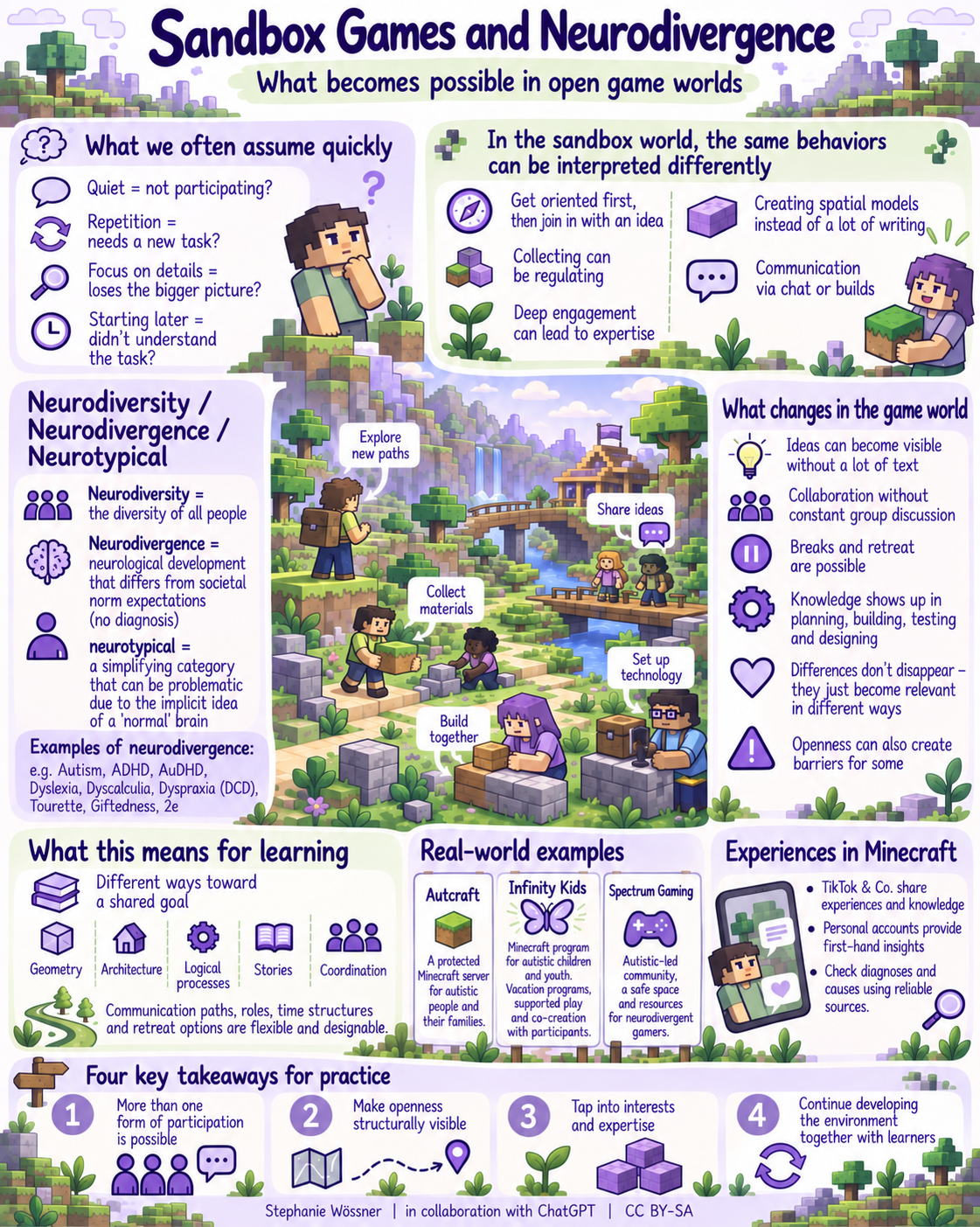 Credits: Stephanie Wössner | CC BY-SA 4.0 InternationalFrom the outside, situations like these are easy to interpret too quickly. Someone who is quiet is barely participating. Someone who keeps repeating the same activity may need a new task. Someone who becomes deeply absorbed in a detail is losing sight of the bigger picture. Someone who does not start immediately has not understood the task. Many children know these kinds of interpretations from other learning contexts.
In a sandbox world, the same behavior can be read differently. The child who stays at the starting point may first be getting oriented and later join in with an idea. Repeatedly collecting materials can be regulating while also serving an important function for the group. Deep engagement with a technical solution can lead to expertise or help existing expertise develop further. A child who avoids written tasks may create complex spatial models. Someone who finds spontaneous conversation difficult may communicate through chat or through what they build.
None of these observations can be clearly assigned to a diagnosis. Autistic children, children with an ADHD or AuDHD diagnosis, dyslexia, dyscalculia, dyspraxia (DCD | Developmental Coordination Disorder), or Tourette syndrome bring very different profiles with them. Giftedness is also sometimes included under the umbrella of neurodivergence. In Twice Exceptionality (2e), high potential occurs alongside another neurodivergence or disability. How children experience a game world like this depends on far more than their neurological profile: previous gaming experience, language, social experiences, access to technology, and the particular group all matter. Very different children can benefit from these kinds of design possibilities.
Neurodiversity, neurodivergence, and “neurotypical”
Neurodiversity refers to the diversity of human neurological development and processing and therefore includes everyone. It should not be used as a synonym for neurodivergence. Neurodivergent describes people whose perception, thinking, learning, or regulation differs significantly from societal expectations of what is considered typical. The term is not a diagnosis and describes neurological difference without framing it as a deficit.
Neurotypical is often used for people who are not considered neurodivergent. The term can, however, suggest a clear boundary between two groups and reinforce the idea of an unambiguously “typical” brain. Neurological profiles are diverse, overlap, and become significant in different ways depending on context.
What changes in the game world
Minecraft and worlds created with Luanti shift some of the demands that are taken for granted in many school-based learning settings. An idea does not have to be expressed in writing before it can become visible. Collaboration does not require continuous group conversation. Someone who needs a break can temporarily move to another part of the world and rejoin later. Knowledge becomes visible through planning, building, explaining, testing, organizing, or designing.
The differences do not disappear. Some demands may carry less weight, while others can become more prominent. A child with dyslexia can build a complex idea without spelling determining how competent they appear. A gifted or 2e child can pursue a problem in greater depth while others work on a different part of the project. A child who needs a lot of movement or frequent change can move through the world without automatically leaving the learning process. For some autistic children, a shared building project may make communication easier because interaction centers on something concrete and depends less on implicit social expectations. Others may find multiplayer settings, sounds, or visually complex worlds exhausting and may need to withdraw while still contributing.
Sandbox games can create barriers as well. A high degree of openness can make initiation, planning, or prioritization difficult. Visible goals or optional intermediate steps may help. Some learners need clear rules or spaces to withdraw, while others need as few constraints as possible. Support therefore also has to remain flexible: for some, a visible next step is helpful; others need the freedom to work out for themselves how they want to continue. The conditions that work for someone cannot be derived from a label.
What this has to do with learning
In a sandbox world, children can take different paths toward a shared focus. Learning then becomes less dependent on everyone doing the same thing at the same time. Someone discovers geometric relationships while building; another child researches historical architecture; someone experiments with logic circuits, tells a story through spaces, or coordinates a team. A project can connect language, mathematics, physics, spatial thinking, design, planning, and social negotiation without requiring everyone to focus on the same things.
For neurodivergent children, this can mean that abilities become visible that may easily be obscured by other demands in more standardized situations. Someone who spends a great deal of energy sitting still, speaking spontaneously, writing quickly, or making their attention externally recognizable may have to invest less of that adaptive effort in a differently designed environment. Under those conditions, whether a child can show what they think and what they can do may depend less on whether they can sit still, speak spontaneously, or write quickly.
For schools, this also raises the question of which seemingly self-evident conditions are actually fixed and which can be designed differently: communication channels, roles, time structures, collaboration, opportunities to withdraw, and the forms through which outcomes become visible.
How spaces like these are already being created
Communities designed around Minecraft for neurodivergent children and young people offer examples of what such spaces can look like. Autcraft has existed since 2013 as a protected Minecraft server for autistic people and their families. Alongside technical rules and moderation, the community itself is central; autistic members also take on responsibility.
Infinity Kids (Instagram channel) has offered a Minecraft space in Germany for autistic and other neurodivergent children and young people since 2023. Craft & Connect now also includes facilitated groups and vacation programs. What is particularly interesting is that feedback from the children informs the continued development of the server, while different forms of communication, opportunities to withdraw, and individual limits are explicitly taken into account.
Spectrum Gaming adds another perspective because Minecraft is part of a larger autistic-led community. Young people can use Minecraft and Discord spaces as well as in-person programs, and activities can build on their interests.
These examples cannot simply be transferred to current school-based learning. They do, however, show some of the conditions a community needs in order to make room for different ways of perceiving, communicating, and acting.
Neurodivergent experiences in Minecraft
Alongside designed programs like these, social media contains many accounts from neurodivergent people describing how they experience Minecraft. They talk about activities they experience as calming or focusing, why repetitive collecting or building can be appealing, which forms of playing together work for them, or when a multiplayer world becomes exhausting.
These accounts can make perspectives visible that are easily overlooked or interpreted differently from the outside. They are not the same as professional or research-based claims about neurodivergence. A person can describe very precisely how they experience something themselves. That does not mean that people with the same diagnosis will necessarily feel or act in the same way.
This distinction is particularly important on TikTok. In an analysis of the 100 most-viewed TikTok videos about ADHD, 52% of the posts were classified as misleading, while only 21% contained information the researchers considered helpful. Personal experience and professional information should therefore be distinguished, and claims about diagnoses, characteristics, or causes should also be checked against reliable sources. Both perspectives are equally valid.
Anyone who wants to explore these perspectives can, for example, search for combinations such as neurodivergence + Minecraft, autism + Minecraft, or ADHD + Minecraft.
Examples:
AuDHD explained in Minecraft
Autism explained in Minecraft
ADHD explained in Minecraft
Four ideas for practice
Enable more than one form of participation: allow building, observing, writing, speaking, exploring, and different roles within a shared project.
Make openness easier to structure: offer orientation, intermediate goals, or prepared areas without turning them into the same pathway for everyone.
Build on interests and expertise: specialist knowledge, intense interests, and gaming experience can become starting points for learning and responsibility.
Continue developing the environment with learners: ask what costs energy, what makes access easier, and which rules, spaces, or technical settings should be changed.
Further reading
Slattery, E. J., Lehane, P., Butler, D., O’Leary, M., & Marshall, K. (2025). Assessing the benefits of digital game-based learning with Minecraft in children, adolescents and young adults: A broad systematic review. Review of Education, 13, e70035. This recent systematic review of 29 intervention studies is particularly useful for the learning perspective, including the important limitation that the existing evidence remains methodologically constrained.
Open-access full text
Ringland, K. E. (2019). A place to play: The (dis)abled embodied experience for autistic children in online spaces. In Proceedings of the 2019 CHI Conference on Human Factors in Computing Systems (Paper 288, pp. 1–14). Association for Computing Machinery. The ethnographic study of Autcraft fits particularly well with the environmental perspective because it considers digital and physical spaces together.
Free full text at PubMed Central
Kilmer, E., Spangler, J., & Kilmer, J. (2023). Therapeutically applied Minecraft groups with neurodivergent youth. F1000Research, 12, 216. The article describes Minecraft groups with neurodivergent young people and explicitly works with multiple forms of communication and interaction. It is better understood as a methods/practice paper than as an effectiveness study.
Open-access full text
Thirumanickam, A., Attrill, S., Welz, N., & Hobbs, D. (2026). Enhancing social collaboration in autistic pre-teens through Minecraft™. International Journal of Speech-Language Pathology. Advance online publication. The small pilot study is particularly interesting because of its participatory co-design. Quantitative findings were modest; qualitatively, relational, structural, and contextual conditions of participation became visible.
Open-access full text
Dwyer, P. (2022). The neurodiversity approach(es): What are they and what do they mean for researchers? Human Development, 66(2), 73–92. A useful background text on neurodiversity because it keeps both individual experience and environmental conditions in view.
Free full text at PubMed Central
Rizzo, L., Pinnelli, S., & Minnaert, A. (2025). Twice-exceptional students: A systematic review to outline the distinctive characteristics through a multidimensional lens. Frontiers in Education, 10, 1696805. Useful for giftedness and 2e, as well as for the uneven profiles discussed in the article.
Open-access full text
Yeung, A., Ng, E., & Abi-Jaoude, E. (2022). TikTok and attention-deficit/hyperactivity disorder: A cross-sectional study of social media content quality. The Canadian Journal of Psychiatry, 67(12), 899–906.
https://doi.org/10.1177/07067437221082854
Bildquellen
- Sandbox Games and Neurodivergence: Stephanie Wössner | CC BY-SA 4.0 International
- Neurodiversity: PetiteProf79 | CC BY-SA 4.0 International