
minnit’ has been part of my work for a long time. The platform has been operated by the Landesmedienzentrum Baden-Württemberg since 2019; from April 2021 through July 2026, I was responsible for its pedagogical, strategic, and functional development as Product Owner. minnit’ started out as a digital survey application. Surveys are still at its core, but through a DigitalPakt project, it has since developed into a much broader digital learning environment: with different question and participation formats, quizzes, interactive stories, planning and organization features, augmented reality, and a QR-card format called Hands Up!, which allows learners to participate without having their own digital device. The roles have evolved as well. Learners can use and adapt templates from a library, create their own templates, and conduct surveys themselves.
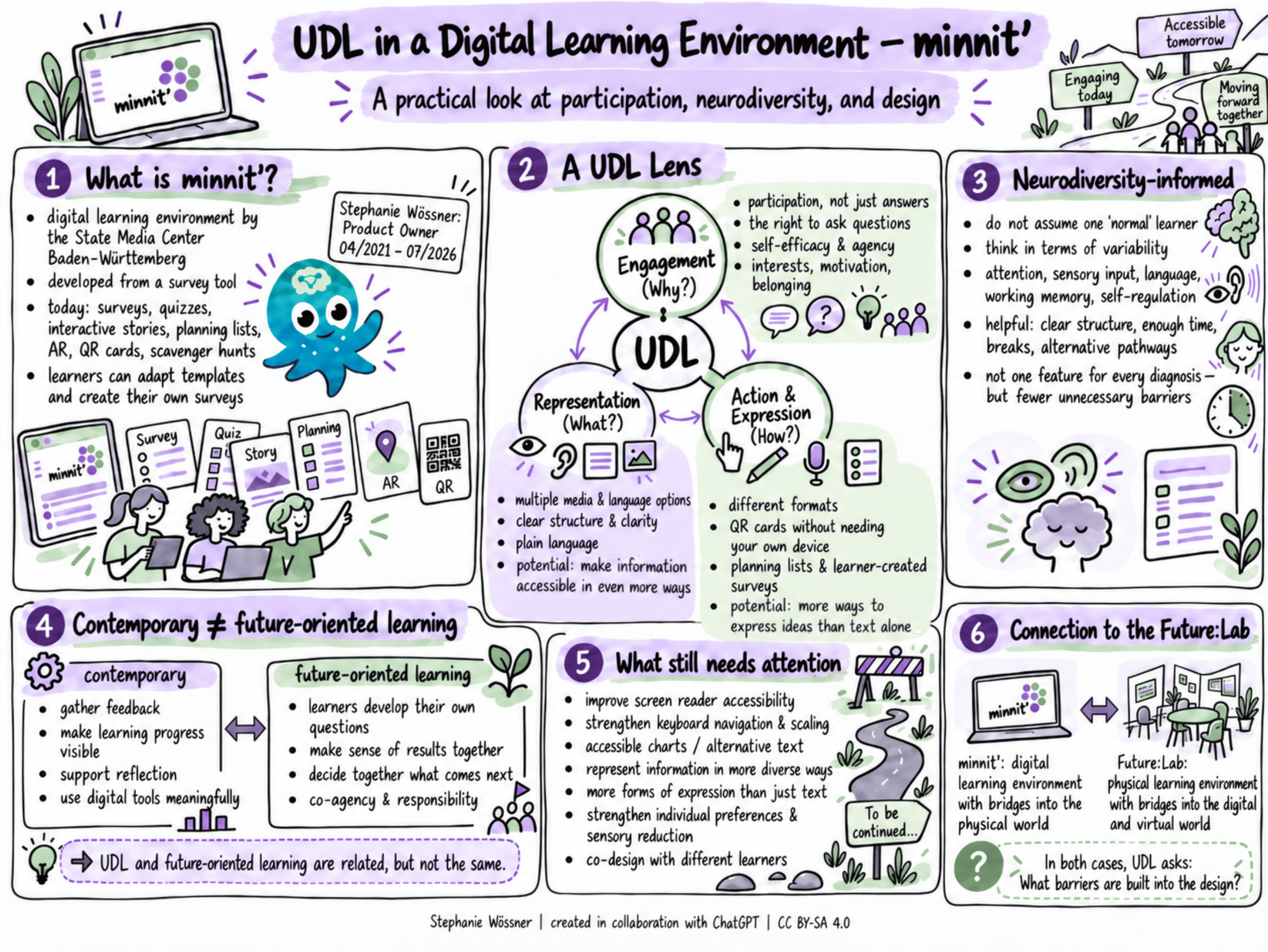 Credits: Stephanie Wössner | CC BY-SA 4.0 InternationalAs its functionality evolved, so did its pedagogical framing. The help section now includes several foundational texts that place minnit’ within an understanding of learning centered on participation, self-efficacy, relationships, responsibility, and co-creation. The introductory text, “Rethinking Learning,” already makes clear that a technical application neither creates nor automatically changes a learning culture. The same technology can make existing routines more efficient or become part of fundamentally different learning processes. minnit’ is therefore described as an “enabling space” whose significance emerges only through what people do with it and the pedagogical stance behind it. The subsequent texts develop this idea through the Why, How, and What and add ethical, social, and cultural conditions. Questions of trust, fairness, data protection, and power are explicitly part of the framework.
I have now taken another, closer look at this digital learning environment through the lens of Universal Design for Learning. I am less interested in whether minnit’ can be labeled UDL-compliant. I do not find such labels particularly useful anyway. What interests me more is what a UDL perspective reveals within an environment that already exists: What different forms of access are built in? Where is neurodiversity—that is, human variability—already taken into account? Which forms of participation and expression are possible? Where does the design still assume particular abilities, ways of perceiving, or forms of communication? And where do barriers emerge even though the underlying pedagogical idea is centered on participation?
Variability Changes How We Look at Features
UDL begins with learner variability. People differ in what gives them access to something and sustains their interest, in how they perceive and process information, and in how they act, communicate, or express what they have understood. The CAST Guidelines 3.0 organize these perspectives into three areas: Engagement, Representation, and Action & Expression. CAST identifies learner agency as the overarching goal and now connects it very explicitly with questions of identity, belonging, interdependence, and structural barriers.
Seen through this lens, a feature list takes on a different meaning. The fact that minnit’ offers multiple question types and both text- and image-based response options is, at first, a technical characteristic. Whether these actually create different forms of access depends on how the formats are designed and used. An open-ended question allows for more latitude than a predefined selection, but it still requires someone to formulate their thoughts in writing. A video adds another mode beyond text, but without captions or a transcript, it remains less accessible to others. A quiz can create enjoyment and focus attention; at the same time, pace, competition, and stimulus density can make it harder for some learners to demonstrate what they know under those conditions. UDL directs attention precisely toward these interactions. No form of representation, participation, or expression works equally well for everyone regardless of the person, situation, and learning goal.
minnit’ already includes different approaches to this variability. Content can be combined with different media; interactive stories, for example, combine characters, dialogue, and questions. The QR-card format separates digital participation from the need to have an individual device while also bringing physical movement into what would otherwise be a digital voting process. Planning lists enable different forms of action than traditional questionnaires and can be used to make interests, tasks, research questions, or responsibilities visible. The platform also offers different linguistic access points by allowing the interface to be displayed in a more complex version, a child-friendly version, or a plain-language version.
These possibilities are aligned with UDL, although the mere existence of different formats tells us relatively little about their accessibility. Representation makes this particularly clear. Providing multiple media is different from actually making essential information perceptible and understandable in different ways. A complex text does not automatically become more accessible because it is accompanied by an equally complex diagram. Conversely, a clear and well-structured representation can work for very different people. This is why minnit’s accessibility tips now include a perspective that goes beyond technical accessibility: comprehensibility, readability, working memory, multilingualism, sensory processing, attention, and self-regulation are explicitly taken into account. The reminder that an incomprehensible task is not automatically a problem located within the user also shifts the perspective from the person to the design.
Neurodiversity-Informed Does Not Mean One Feature for Every Medical Diagnosis
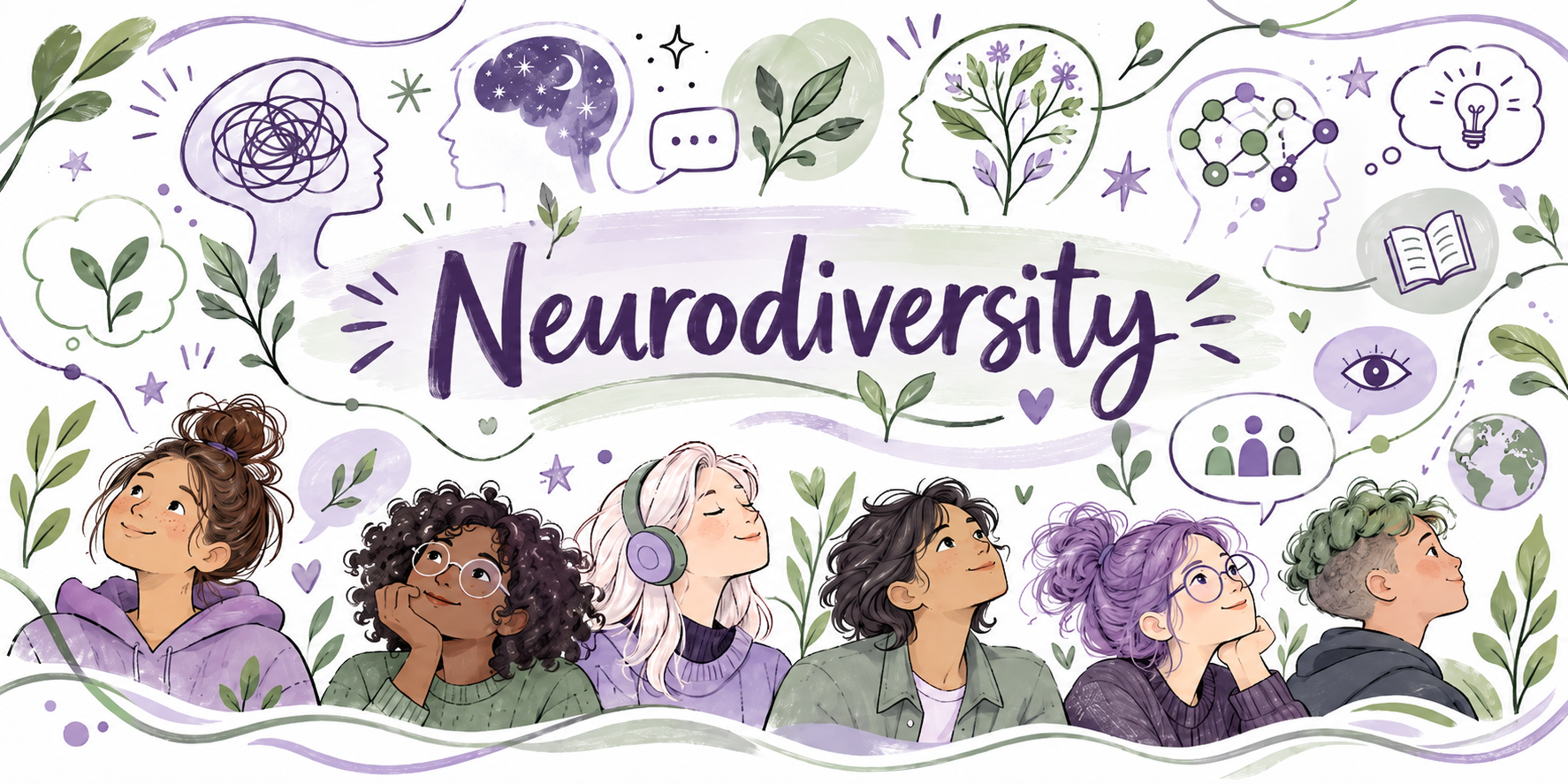
This is exactly where the connection to neurodiversity becomes visible. The accessibility guidance is explicitly not aimed only at people with a recognized disability or formally identified support needs. It refers to different forms of perception, information processing, attention, language, communication, and self-regulation. Dyslexia, ADHD, autism, dyspraxia, and Tourette are mentioned, while at the same time cautioning against turning these into homogeneous groups. Neurodiversity is understood as the diversity of human ways of perceiving, thinking, and learning; concrete barriers arise when digital environments treat particular forms of perceiving, processing, or acting as self-evident.
That corresponds quite closely to what I mean by neurodiversity-informed design. I do not find the idea particularly useful that a platform can simply add individual features “for autism” or “for ADHD” after the fact and thereby claim to have addressed neurodiversity. A neurological profile neither predicts clearly what a person needs nor explains their behavior independently of situation, experience, interests, stress, or environment. The more useful design question is therefore where an environment imposes unnecessary constraints and where options make sense.
This can be remarkably unspectacular. Sufficient time does not help only one particular diagnostic group. Predictability and clear structures can reduce demands for many people, for very different reasons. The ability to have text read aloud may be necessary for a blind person, reduce demands for someone with dyslexia, help when someone is exhausted, or simply reflect an individual preference. Low-stimulation design can matter for migraines just as it can for visual overload, ADHD, or autism. The minnit’ page deliberately describes these overlaps. Among other things, the guidance recommends reducing information density, using clear headings, allowing sufficient processing time, enabling breaks, and making visual results accessible through language as well.
That does not mean minnit’ is fully accessible. The site is transparent about that too. Keyboard focus is not sufficiently visible everywhere, high levels of zoom can cause display problems, and some controls, tables, or charts are not yet fully accessible with screen readers. For some issues, operating-system features or pedagogical workarounds currently help. That is pragmatic, but it does not replace further technical development. The page states this very clearly: Guidance on how to use the platform must not shift responsibility for barriers onto the people who encounter them.
For me, it is therefore fair to say that minnit’ is now designed and developed with a neurodiversity-informed perspective. I would not describe that as a state that has been achieved. The term is better understood as describing the kinds of questions we ask of the design.
From Answering Questions to Having the Right to Ask Them
I see the strongest connection to UDL somewhere else: in Engagement and Agency. The foundational pedagogical texts explore in depth what role learners take within learning processes and what participation actually means. A digital survey is not understood primarily as a method for learning facilitators to collect answers quickly. Questions can make uncertainty visible, place different positions alongside one another, initiate thinking, and become the starting point for further decisions. It becomes particularly interesting when the act of asking questions itself no longer remains exclusively with the learning facilitators.
That changes more than how an app is used. Whoever formulates the questions helps determine what can become visible in the first place. A predefined set of response options already contains an interpretation of which positions count as possible or relevant. Whoever is allowed to interpret the results has influence over what consequences follow from them. Participation is therefore always also about the power to shape what happens.
This idea is now reflected in minnit’s role structure. Learners can create their own templates and launch surveys; in certain contexts, they have even broader possibilities, for example in democratic participation within schools. The practical examples in the help section also take up this role. Learners develop a snapshot of opinions themselves before a discussion, make ambivalence visible through response options such as “I don’t know,” or use peer-feedback results to negotiate how they want to continue working together. Planning lists can help groups negotiate tasks and responsibilities within a project and recognize when perspectives are missing or responsibility is distributed very unevenly.
This comes very close to what CAST emphasizes more strongly in UDL 3.0 under learner agency and collective learning processes. Agency does not mean leaving learners to fend for themselves as early as possible. Guidance, support, collaboration, and interdependence are explicitly part of it. Open and participatory learning processes make this distinction especially necessary. A discussion may formally be open to everyone while still privileging people who respond quickly, enjoy speaking, and find it easy to take up space in a group. Self-organization can create freedom while simultaneously placing high demands on planning, prioritization, or working memory. A group may be allowed to make its own decisions—but that means little if some of its members can barely participate in the negotiation. UDL therefore sharpens a question that is already central to participation: Who can actually use the opportunities to shape a situation under the specific conditions provided?
This question is already embedded in several places in minnit’s foundational texts. The text on conditions and context addresses protected spaces, voluntariness, transparent decision-making, and the handling of personal perspectives. It explicitly asks who is heard, who can remain invisible, and what effects particular formats may have on different groups. I find the discussion of power particularly relevant: Participatory formats can shift hierarchies, but they can just as easily stabilize those same hierarchies. At that point, offering participants as many buttons as possible is no longer enough. The social architecture of a learning environment is just as much part of the design as its user interface.
Contemporary and Future-Oriented Learning Operate on Different Levels
Another distinction in the minnit’ texts is helpful for my UDL analysis: the distinction between contemporary and future-oriented learning. I do not use these terms synonymously because they describe different kinds of change.
Contemporary practice can substantially change learning processes. Learners receive more feedback and choice, reflection becomes part of the process, digital media expand communication and collaboration, and different starting conditions are taken into account more deliberately. With minnit’, for example, a current level of learning can be made visible without immediately turning it into an assessment. A group can reflect on its collaboration, gather feedback, or use different positions as the starting point for a discussion. All of this changes the quality of learning and is by no means merely a preliminary stage on the way to something supposedly more advanced. The current foundational texts explicitly situate many of these practices within contemporary learning.
Future-oriented learning addresses another level: the question of who helps shape learning processes, how responsibility is shared, and whether learning itself becomes a space for societal orientation and participation in shaping change. This becomes visible, for example, when learners are not simply given questions but develop them together; when they do not merely take note of results but use them to determine next steps; when reflection extends beyond the individual learning process to include the conditions of learning together. Play can then be understood differently as well. It is not used solely as motivational packaging but can become a space for exploration, perspective-taking, and engaging with openness and uncertainty.
There is no clean boundary between these two levels, and I do not find it useful to turn them into a hierarchy. Not every learning process needs to maximize openness. Structure can provide orientation and, especially in situations of high complexity, can make possibilities for action accessible in the first place. Self-determination also requires conditions under which it can actually be exercised. The more useful question is therefore how much room for shaping a situation genuinely works in a particular context and what learners need in order to make use of it.
UDL cuts across this distinction. A contemporary learning setting can take variability very seriously and provide different forms of access, support, and expression while central decisions remain with learning facilitators. A future-oriented setting with far-reaching Co-Agency, by contrast, can create significant barriers if openness, constant communication, or a high degree of self-organization are silently assumed. Future orientation and UDL therefore answer different questions that intersect at certain points. I find this connection particularly productive because it prevents us from idealizing agency.
What Still Remains Open for minnit’
From a UDL perspective, the first thing I notice is that Engagement is now conceptually very broad within minnit’. Choice, relevance, autonomy, play, collaboration, feedback, belonging, and shared responsibility can be found in different parts of the platform and its pedagogical framing. The platform does not guarantee these experiences, but its pedagogical foundation creates numerous opportunities for them. CAST also defines Engagement much more broadly than motivation and includes, for example, interests and identities, autonomy, joy and play, collaboration, belonging, and emotional experience.
I see more room for development in Representation. minnit’ already allows for different media and supports different linguistic forms of access. Even so, large parts of the platform remain organized visually and through text. Accessible alternatives for charts and other visual information matter just as much as asking more consistently whether essential content can be accessed through different perceptual pathways. For me, this is also about cognitive accessibility: information density, orientation, language, symbols, and the ability to recognize relationships and connections. The existing accessibility guidance already addresses some of this, although often at the level of what users or learning facilitators can compensate for. Where these solutions can be moved technically into the product itself, that would be more consistent.
The same applies to Action & Expression. Different question and response types allow for different kinds of responses; planning lists, surveys, interactive stories, or AR scenarios create different spaces for action. Even so, open-ended contributions are still often tied to text input. CAST points out that no single mode of expression is equally suited to all learners and all communication goals and includes speech, drawing, film, music, storytelling, and movement among possible forms of expression. This raises the question of whether minnit’ could eventually allow learners to choose more freely among forms of expression within a task. An audio response is not inherently better than text. Neither is a drawing. Choice becomes interesting when a particular mode of expression is not actually required by the learning goal and yet still becomes a prerequisite for access.
I would also continue to develop options for individual control. Time, pace, movement, visual density, and playful elements affect people very differently. Some adjustments can already be made through devices or operating systems; others cannot currently be controlled individually. In the long term, a digital environment in particular could work more extensively with preferences in this area without assigning people to diagnostic categories in order to do so.
And I would open participation in the product-development process itself even further. Barriers cannot be fully anticipated by thinking about different people. The people who actually experience those barriers need to be involved in determining what is recognized as a problem in the first place and what kind of solution genuinely works. For me, that would be the logical continuation of a platform whose pedagogical vision is strongly centered on participation and Co-Agency.
What Looking Back Shows Me
UDL was not the explicit framework we used to develop minnit’ during the years I was responsible for it. For this analysis, that is actually secondary. Only after engaging more deeply with UDL did I notice how familiar many of its questions felt from my work on minnit’—questions that had ultimately grown out of my own pedagogical stance. Participation and self-efficacy, different forms of access, the role of language and sensory input, choice, safety, power, and the question of who can actually exercise agency under which conditions had entered the development process from other contexts. UDL relates these questions to one another in a particular way while also making the gaps more visible.
I find that more interesting than retrospectively concluding that minnit’ “fits” UDL. An analytical model is most useful to me when it sharpens my view of the places where something does not yet work. For minnit’, that includes technical barriers as well as possibilities for expression, different forms of representation, and individual control. At the same time, the analysis shows that accessibility cannot be considered separately from pedagogical design. A technically accessible survey can take place within a participation setting shaped by power and a lack of safety. A highly participatory learning idea can exclude people through the way it is implemented. A learning environment consists of both.
This brings me back, in the end, to the Future, another project within my area of responsibility. In that context, I am currently examining UDL in a primarily physical learning environment. Spatial zones, the materials used in the mission-based pedagogical concept, light, sound, bodies, movement, opportunities to withdraw, and the spatial transitions between different activities are all directly part of the design. Digital technologies are embedded within it, but the physical space itself cannot be ignored. minnit’, by contrast, is primarily a digital learning environment that is also part of the Future concept. At various points, it extends into the physical world: through QR cards and embodied participation, location-based scavenger hunts, and group processes and decisions whose consequences unfold outside the platform. The emphasis is nevertheless different.
That difference is exactly what makes both examples interesting to me. In the Future, a barrier can lie in lighting, spatial layout, noise, a seating position, or the expectation that someone move through the space or work within it in a particular way. In minnit’, it may be embedded in navigation, language, representation, pace, an interaction pattern, or the expected mode of expression. In either case, it is not enough to offer people additional support afterward so that they can cope more successfully with an unchanged environment.
What connects the two projects, however, is that they are learning environments that are not designed around an imagined average person, with deviations to be compensated for afterward. Instead, both projects engage with the question of which understandings of perceiving, thinking, learning, communicating, and acting need to be built into these spaces of possibility—whether those spaces consist of walls, furniture, and materials or of code, interfaces, and the social practices that develop around them.
Bildquellen
- UDL and future-oriented learning with Sumi: Stephanie Wössner | CC BY-SA 4.0 International
- Neurodiversity: PetiteProf79 | CC BY-SA 4.0 International