
The term neurodiversity has become widespread, but it is used in surprisingly different ways. Sometimes it refers to people with autism, ADHD, dyslexia, or other neurological profiles; at other times, it is used almost interchangeably with neurodivergent. This is where an initial clarification of terms becomes useful. Neurodiversity refers to the natural variation in human brains and, with it, differences in how people perceive, process information, learn, communicate, direct attention, or regulate themselves. The term is associated with Australian sociologist Judy Singer, who coined it in the late 1990s. Neurodiversity therefore includes everyone. “Neurotypical” people are also part of neurological diversity.
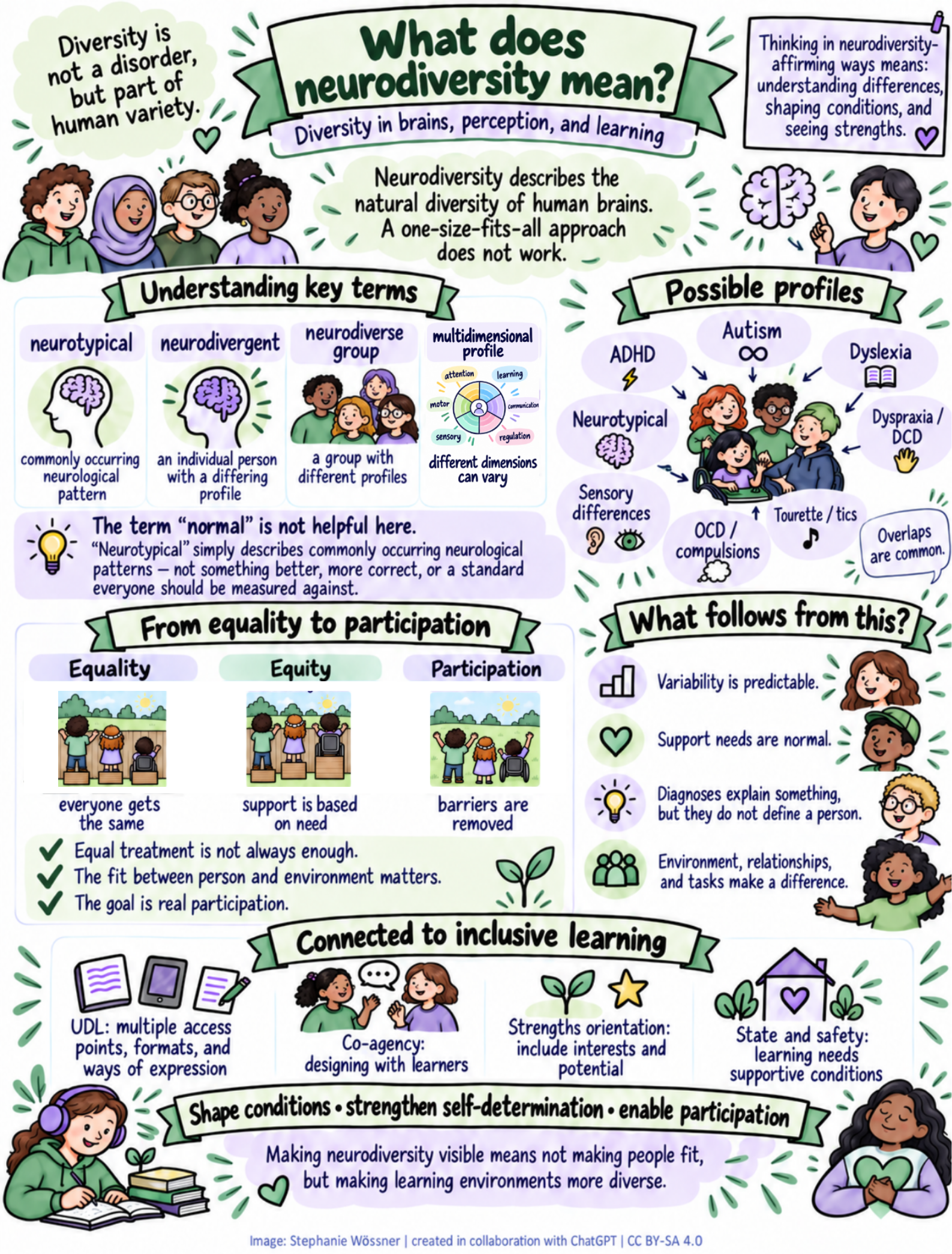 Credits: Stephanie Wössner | CC BY-SA 4.0 InternationalIn current usage, neurodivergent refers to individuals whose neurological profile differs from common or socially expected patterns. Neurotypical, accordingly, describes profiles that align more closely with those common and expected patterns. A group can be neurodiverse because it includes people with different neurological profiles. This distinction matters because otherwise neurodiversity quickly becomes another term for “the others.” We would simply have a new word for a familiar divide between an apparently unmarked normality and the people who deviate from it.
The term normal becomes problematic for the same reason. Neurotypical does not mean better, more correct, or healthier. It initially describes neurological patterns that occur more frequently or that fit more easily with social expectations. What is common, however, is easily confused with what is considered appropriate or desirable. Expectations around attention, communication, sensory processing, or organization often become visible only when someone does not meet them. A certain amount of eye contact, sitting for extended periods, filtering out background noise, transitioning quickly between tasks, or communicating verbally in a particular way can therefore appear to be neutral requirements even though they create very different conditions for different people.
Neurological Profiles Are Multidimensional
The idea of a spectrum also requires greater precision. A spectrum should not become a line on which people are placed somewhere between “slightly” and “highly” neurodivergent. Neurological profiles consist of different dimensions. Attention and executive functions may look different from learning and information processing; communication and social interaction may differ again from regulation and emotions. Interests and motivation, motor skills and praxis, perception and cognition, and sensory and environmental processing add further dimensions. These areas do not develop in sync, nor do they combine into any meaningful overall score. They are also not fixed and can change depending on the day or the situation.
This often results in uneven profiles, sometimes referred to as spiky profiles. A person may have very strong abilities in one area while needing extensive support in another. Neither cancels out the other. Twice Exceptionality makes this particularly visible: giftedness can coexist with ADHD, autism, dyslexia, or other neurodivergent profiles. High cognitive ability can temporarily compensate for difficulties and make them less visible; conversely, visible difficulties can prevent high abilities from being recognized in the first place. Part of the problem lies in our expectation that a person’s abilities should be distributed relatively evenly.
Medical diagnoses identify particular patterns within this diversity. They can be important because they help people make sense of their experiences, provide access to support, and create a shared vocabulary. They still never explain an entire person. Two people with the same diagnosis can have very different profiles, while people with different diagnoses may have similar experiences in particular areas. Autism and ADHD can co-occur, as can dyslexia and ADHD or Tourette syndrome and OCD. Sensory differences, executive functioning difficulties, or regulation challenges are not exclusive to any one diagnosis either.
A neurodiversity-affirming perspective does not mean making real difficulties disappear through language. People can experience significant distress, disability, and support needs. Some aspects of a neurological profile may be experienced as strengths, others as challenging, and their significance can change depending on the situation or stage of life. Searching for supposedly typical “superpowers” therefore does not help either. No one needs to demonstrate exceptional creativity, empathy, or analytical ability for their support needs to be legitimate. Strengths belong to individual people and should be understood as individually as difficulties are.
From Equal Treatment to Meaningful Participation
This also makes the distinction between Equality and Equity interesting: Equality means that people receive the same resources or opportunities. Equity recognizes that people start from different conditions and may therefore require different forms of support. For me, however, that idea alone still does not go far enough. Participation means more than gaining access to an existing system. People bring their own perspectives, make decisions, and should be able to help shape the conditions that affect them.
This is where neurodiversity connects with questions that already concern me in other contexts. Universal Design for Learning begins from the premise of predictable variability and offers multiple ways of accessing information, engaging, and expressing learning. Co-Agency takes learners seriously as co-creators. A strengths-based perspective considers interests and existing potential without explaining difficulties away. And my work on regulation has made even clearer to me that abilities are never entirely independent of a person’s current state. Safety, belonging, relationships, stress, and sensory conditions all influence what people can actually access in a given situation.
Neurodiversity, then, is first and foremost a description of human variation. What changes when we actually use that diversity as a starting point for interpreting behavior, difficulties, and social norms goes one step further. That is where my earlier post on the topic begins.
Bildquellen
- Neurodiversity: Stephanie Wössner | CC BY-SA 4.0 International
- Neurodiversity: PetiteProf79 | CC BY-SA 4.0 International