
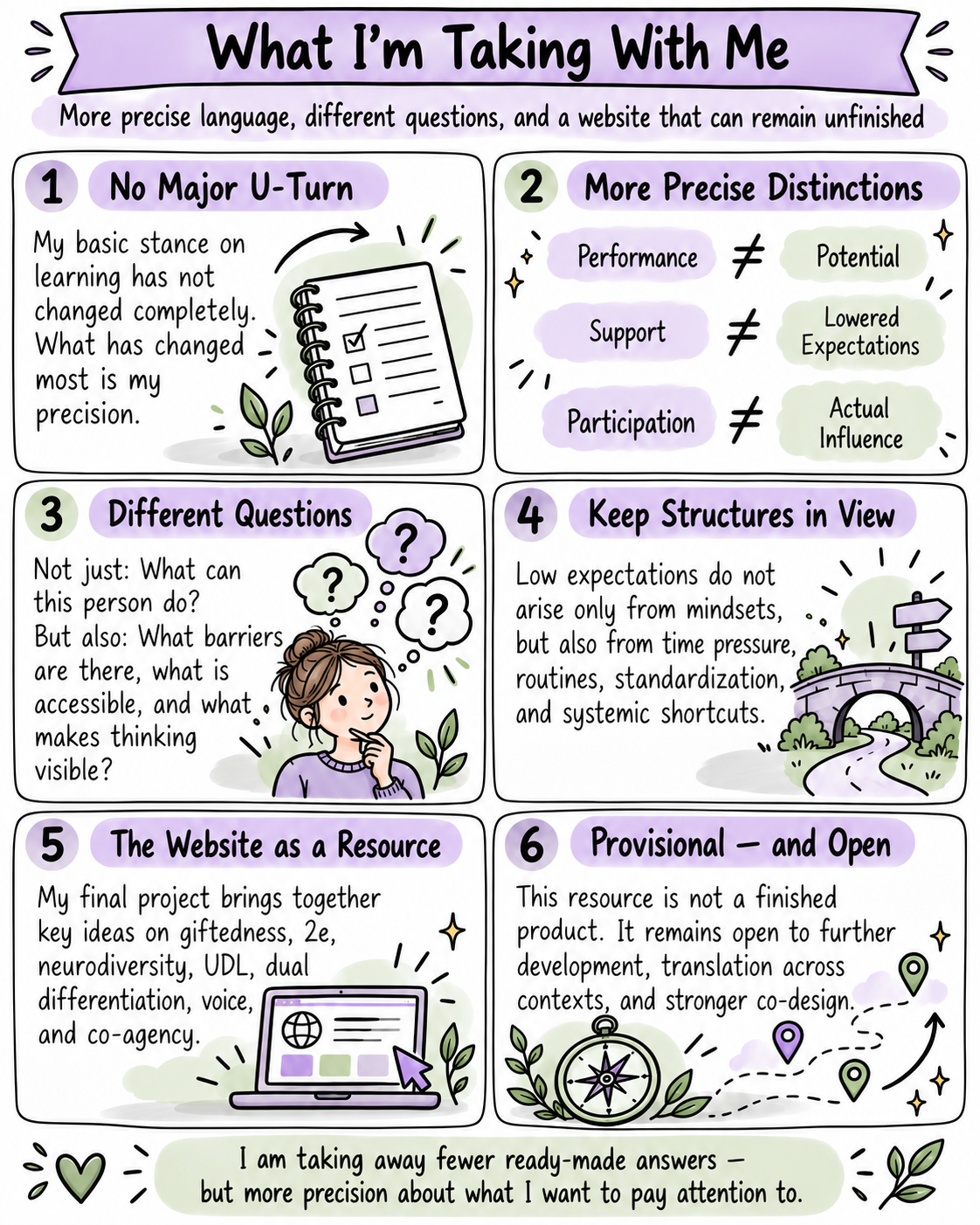
 Credits: PetiteProf79 | CC BY-SA 4.0 InternationalCourses are often described as though they should produce a clear before-and-after story. That is hardly ever an accurate account of courses I take. My basic understanding of learning did not change. I already considered learner variability, agency, belonging, and the role of the learning environment central to educational practice. What changed was my precision. I can now name certain problems more accurately, and I have concepts that allow me to distinguish between things I might previously have discussed together.
These distinctions include performance and potential, ability and current accessibility, support and reduced expectations, participation and actual influence. They may appear subtle. In practice, they change the questions we ask.
When a learner does not complete a task, I can ask whether they have the ability to do it. I can also ask whether the task is accessible, whether the goal makes sense to them, what barriers are present, whether underchallenge or overload plays a role, or whether the required form of expression is capable of making their thinking visible in the first place. The focus moves away from an apparently stable characteristic of the learner and toward the interaction among person, task, environment, and relationship.
Good intentions do not remove structural constraints
We also discussed why expectations for twice-exceptional learners are so often lowered. Personal biases and gaps in foundational knowledge certainly matter. I still find an exclusively individual explanation inadequate. Many people working in education want to support learners well and nevertheless make decisions that conflict with their own educational values.
Time pressure, large groups, standardized expectations, institutional routines, and the need to create categories quickly all encourage simplification. Under those conditions, shortcuts emerge. An observable difficulty receives a quick explanation; support follows a diagnosis; differentiation becomes a process in which some learners receive more and others receive less. This does not excuse deficit-oriented practice. It matters to my analysis because structural problems are unlikely to change if they are treated primarily as failures in individual educators’ attitudes.
Our work on equity expanded this further. Access to identification is not the same as access to opportunity. A formally equitable procedure can accomplish very little if learners have had radically different opportunities to develop and demonstrate their abilities before they ever enter that procedure. Language, family resources, disability, neurodivergence, cultural assumptions, and institutional expectations all influence whose potential is recognized and whose remains unnoticed. More equitable identification therefore involves multiple pathways, repeated opportunities, talent development, appropriate challenge, and environments where people can belong without first having to approximate an expected norm.
From my notes to a resource
These ideas became the basis for my final project. It began as a toolkit on giftedness, 2e, and neurodiversity and eventually expanded into a German- and English-language website with simplified-language versions and multiple routes into additional resources: Website
I did not want to create another checklist of traits. The site therefore tries to separate observation from interpretation, challenge stereotypical ideas about giftedness, and explain 2e as a complex and context-dependent profile. It brings together language, learning environments, UDL, dual differentiation, voice, and co-agency and connects them to reflection questions for professional practice.
The website is not a finished answer. Developing it made me more aware of how difficult it is to move ideas between linguistic and cultural contexts. Many of the concepts we worked with come from English-language discourse and do not transfer cleanly into German. Terms carry different histories and social meanings. This is one reason I want to leave the relationship between giftedness and neurodiversity open rather than settling it through a single definition.
Another limitation of the project has become clearer to me as well. A resource about neurodiversity-affirming practice can hardly remain credible in the long term without stronger co-design with people who bring a range of gifted, 2e, disabled, and neurodivergent lived experiences. Learner Voice is difficult to advocate convincingly while leaving those voices out of the process of developing the resource itself.
That feels like an appropriate place to end this course. I am leaving with fewer definitive answers than with greater precision about what I want to notice. Categories can be useful. Frameworks can support design. Their value depends on whether they help us see people more accurately, identify barriers, and expand what becomes possible—and on whether we remain willing to question the tools we are using.
Further Reading
- CAST (2024): Universal Design for Learning Guidelines 3.0. UDL Guidelines
- OECD: Learning Compass 2030. OECD
- Pfeiffer, Steven I. (2024): Identifying Gifted Students: A Practical Guide, 3rd ed. NAGC
- Hughes, Claire E., Debra A. Troxclair & Wendy A. Behrens (eds.) (2025): Twice-Exceptional Education: Connecting Gifted and Special Education. ERIC
Bildquellen
- Giftedness 3: PetiteProf79 | CC BY-SA 4.0 International
- Neurodiversity: PetiteProf79 | CC BY-SA 4.0 International