
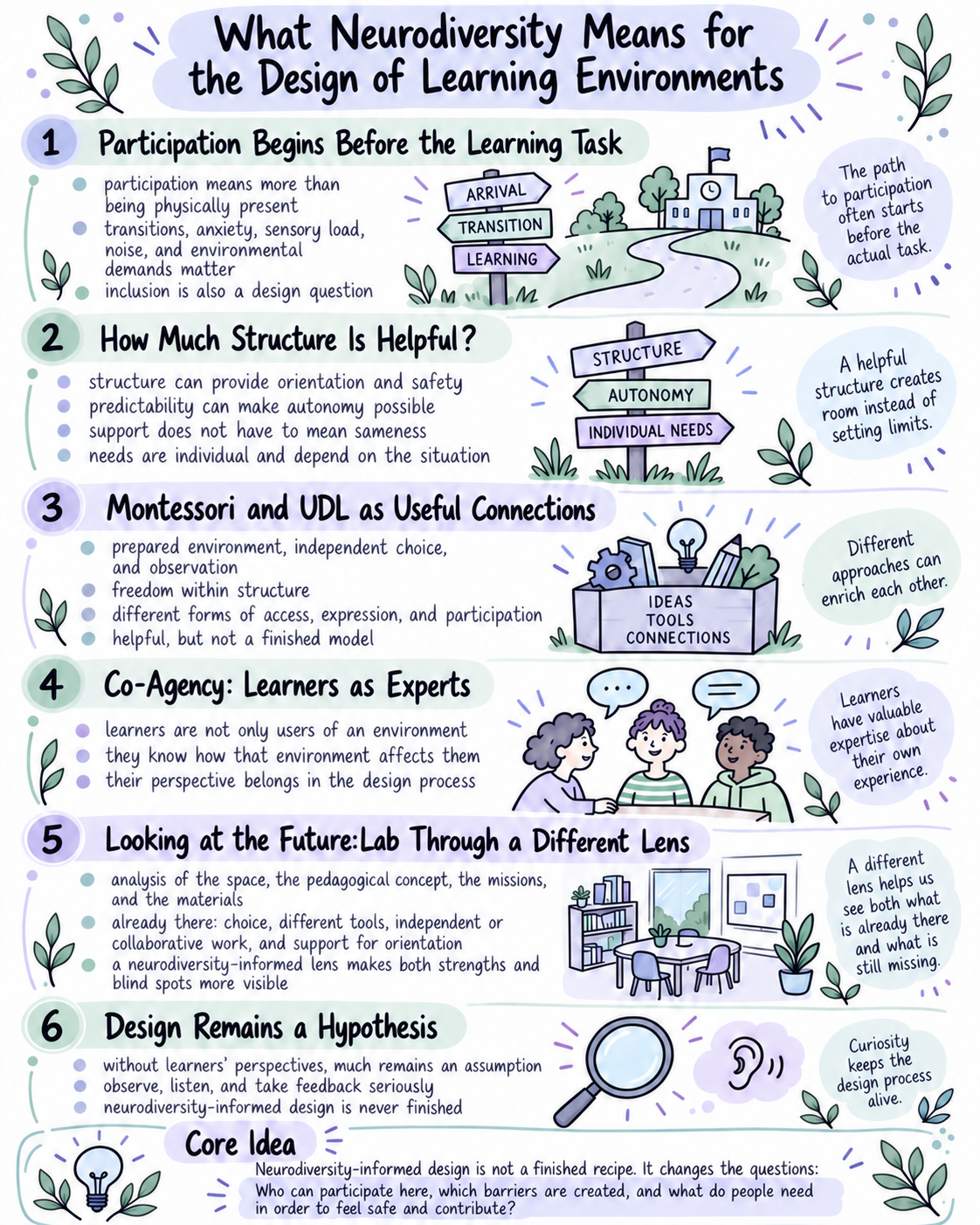
 Credits: PetiteProf79 | CC BY-SA 4.0 InternationalThe strongest connection to my own educational practice emerged during the course when we discussed learning environments. One idea from the longitudinal Australian study of autistic students stayed with me in particular: participation means much more than simply being physically present in a school or learning environment. Transitions, anxiety, sensory load, noise, and environmental demands all affect whether someone can actually participate.
At first, that may sound obvious. The more important question is where responsibility is located. If a room is noisy, routines are unpredictable, or communication happens in only one particular way, we can ask learners to develop strategies to cope with those conditions. We can also ask why the environment has been designed that way and whether all of its demands are actually necessary. That turns inclusion into a design question.
Many of these ideas were not new to my work. Choice, agency, multiple pathways, open-ended learning, and different ways of making thinking visible have been part of my educational approach for a long time. The course still sharpened my perspective. Providing options does not automatically mean that different ways of communicating, processing, regulating, or participating are genuinely treated as equally valid. A learning environment can look very open while still containing implicit expectations about how people are supposed to participate.
How much structure is helpful?
One question that kept coming up for me throughout the course concerned the relationship between autonomy and structure. Neurodivergent people obviously do not all need the same conditions. Still, predictability can be important for many people.
This can easily be misunderstood. A structured learning environment does not necessarily mean prescribing every step. Structure can provide orientation: What happens here? What options do I have? Where can I find support? Approximately how long will something take? What happens if I need a break? That kind of information can actually make autonomy possible.
This is one reason I found it interesting to revisit Montessori ideas. Some of these principles had already been part of my own work for years without my always explicitly identifying them as Montessori. The prepared environment, independent choice, observation, and the idea of “freedom within structure” offer useful connections to neurodiversity-informed design.
They do not provide a ready-made model, though. Choice itself can become overwhelming. Open-ended tasks can feel liberating and at the same time provide too little orientation. Structure can create safety and also become restrictive. Collaboration can be inspiring for one person and create significant social or sensory demands for another.
For that reason, the idea of designing one ideal learning environment seems increasingly unhelpful to me. Needs differ, and they may even change for the same person depending on the situation.
Universal design does not solve everything
Universal Design for Learning is useful in this context as long as it is not treated as a final solution. Anticipating different forms of access, expression, and participation from the beginning makes far more sense than introducing accommodations only after individual learners are already struggling. Still, every design decision includes assumptions about what people may need.
That has become an important point for me. A learning environment can include many options and still create barriers its designers never anticipated. Neurodiversity-informed design therefore needs to remain provisional. It has to stay open to review and change.
This is also where co-agency becomes important for me. Learners are not simply users of an environment that other people optimize for them. They hold knowledge about how that environment affects them. That knowledge belongs in the design process.
Looking at the Future:Lab Stuttgart through a different lens
These questions eventually became the starting point for my final course artifact. I revisited the Future:Lab Stuttgart, a mission-based learning environment that I was closely involved in designing and developing, through a neurodiversity-informed and intersectional lens. I looked at the physical space, the pedagogical concept, and a representative selection of missions and materials.
The analysis was interesting precisely because many of the things I was looking for were already there. Learners can make choices, use different materials and tools, work independently or collaboratively, and make their ideas visible in different ways. The environment includes support for orientation, the missions vary in structure, and there are multiple ways to approach a task.
At first, that felt reassuring. The more important insight, however, was elsewhere. Many of those elements had emerged from my broader educational philosophy. The course helped me articulate more clearly why they also matter from a neurodiversity-informed perspective. At the same time, it exposed places where good intentions still do not guarantee accessibility.
From this process, I developed a reflection structure that considers areas such as environment and regulation, orientation and autonomy, participation and collaboration, communication and support, and identity, representation, and intersectionality.
My final course artifact documents this analysis and the thinking that emerged from it: Link
Design remains a hypothesis
One limitation of this work is particularly important to me. I was able to analyze the learning environment, but during this phase I did not have direct access to the young people who will eventually use it. No checklist can replace that perspective.
I can try to anticipate different needs. I can review materials for barriers and create multiple ways of participating. Still, design initially remains a hypothesis about how other people might experience a space. Actual use reveals which assumptions hold.
For me, the next step would therefore not be another round of theoretical optimization. It would be to bring learners’ perspectives into the process: observe, listen, take their feedback seriously, and change things that may have looked reasonable from a design perspective but do not work as intended in practice.
That may be the most important consequence I am taking from the course for my own work. Neurodiversity-informed design is never finished. I also do not see it as another pedagogical model to place alongside the ones I already use. It changes the questions I ask.
Who can participate here, and how? Where does unnecessary strain emerge? Which forms of communication are assumed? Which choices are genuinely available? Who is missing from my own idea of how this environment will be used?
That also changes what design means. A learning environment is not a finished offer that should then work for as many people as possible. It remains negotiable. For me, that connects closely to what future-oriented education can mean: designing structures in ways that account for human diversity before someone has to fail within them for us to notice it.
Literature
- American Montessori Society. (n.d.). What is Montessori? The American Montessori Society
- Association Montessori Internationale. (n.d.). Montessori environments. Association Montessori Internationale
- (2024). Universal Design for Learning Guidelines version 3.0 [Graphic organizer]. CAST. UDL Guidelines
- (2019). OECD Future of Education and Skills 2030: OECD Learning Compass 2030 – Concept Note Series. OECD. Die dort entwickelte Vorstellung von Agency und Co-Agency passt direkt zu deinem entsprechenden Abschnitt. OECD
- Roberts, J. M. A., Adams, D., Heussler, H., Keen, D., Paynter, J., Trembath, D., Westerveld, M., & Williams, K. (2018). Protocol for a prospective longitudinal study investigating the participation and educational trajectories of Australian students with autism. BMJ Open, 8(1), e017082. doi: 10.1136/bmjopen-2017-017082. Monash University
- Simpson, K., Keen, D., Adams, D., Alston-Knox, C., & Roberts, J. (2018). Participation of children on the autism spectrum in home, school, and community. Child: Care, Health and Development, 44(1), 99–107. doi: 10.1111/cch.12483.
Bildquellen
- Neurodiversity 3: PetiteProf79 | CC BY-SA 4.0 International
- Neurodiversity: PetiteProf79 | CC BY-SA 4.0 International