
 Credits: PetiteProf79 | CC BY-SA 4.0 InternationalThe material on trauma was one of the most powerful parts of the course for me. What stayed with me most was how closely traumatic experiences can be connected to ordinary social and educational situations.
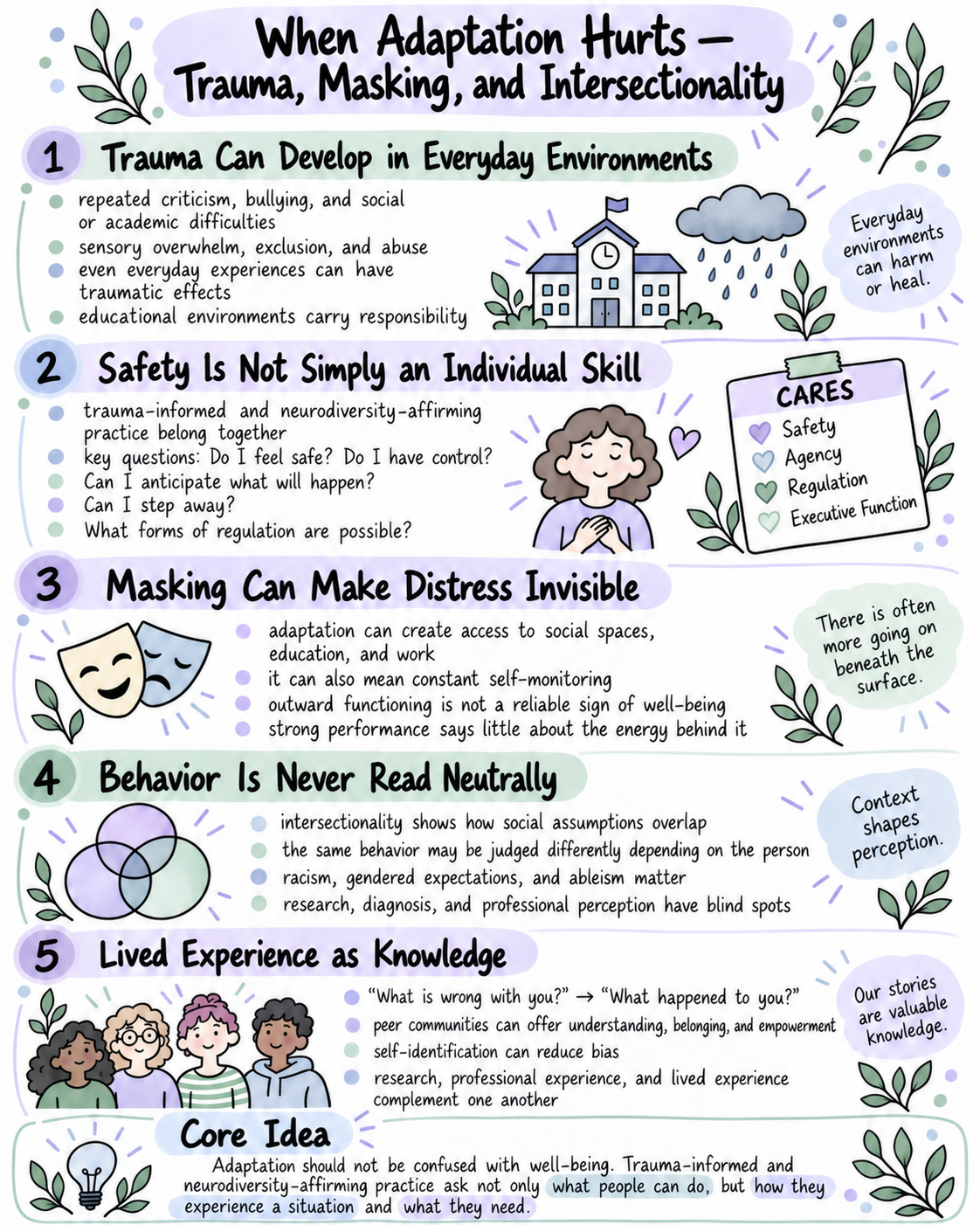
In the context of ADHD, Kerry J. Heckman discusses repeated criticism, bullying, academic and social struggles, being reprimanded by adults, and the long-term effects these experiences can have on self-esteem. Lauren Gravitz shows something similar in relation to autism. Exclusion, abuse, sensory overwhelm, and experiences that may appear relatively minor from a neurotypical perspective can still have a lasting traumatic impact.
This changed how I think about what we recognize as potentially traumatic. The impact of an experience is not determined only by how dramatic it looks from the outside. Experiences can repeat, accumulate, and gradually shape an expectation of being misunderstood, rejected, or overwhelmed again. It also places educational environments under scrutiny. If learners are repeatedly criticized for behavior connected to the way they regulate, pay attention, or communicate, if sensory overwhelm is interpreted as poor discipline, or if social difficulties are treated mainly as an individual skills problem, those experiences have consequences.
Karen Irvine’s work on access to mental health support added another dimension for me. Even when neurodivergent people seek help, their distress may be overlooked or misinterpreted. An existing diagnosis can lead professionals to explain new difficulties through that diagnosis alone. The people who need support may therefore encounter systems that once again fail to understand their experiences accurately.
Safety is not simply an individual skill
For that reason, trauma-informed and neurodiversity-affirming practice have become closely connected in my thinking. Both draw attention to the experience of a situation. Does it feel safe? How much control does a person have? Can they anticipate what is going to happen? Can they step away? What forms of regulation are available?
I found the CARES framework particularly useful because it connects several of these dimensions. Safety, agency, regulation, and executive functioning do not appear simply as skills a person either has or still needs to develop. An environment can support these processes, make them more difficult, or at times make them almost impossible. That may sound obvious, but it changes the questions we ask. When a person struggles in a particular environment, the first question no longer has to be which skill that person is missing. We can also ask what the situation is demanding and whether all of those demands are actually necessary.
Masking can make distress invisible
Masking added another layer to this. Adapting to expectations can be a useful strategy. It may make access to social spaces, education, or employment possible. At the same time, it can require someone to constantly monitor their own behavior and suppress parts of it in order to avoid negative reactions. Leah Reinardy’s experiences made the risks of equating outward functioning with well-being particularly clear to me. People can meet expectations very successfully while experiencing significant stress. In fact, someone who has learned to adapt especially well may be less likely to be recognized as a person who needs support.
This also changed the way I think about performance. Good results, independence, and expected behavior are not reliable indicators of how much energy someone needs to manage a situation. Educational systems, however, still rely heavily on observable behavior. A learner who works quietly, completes tasks, and attracts little attention can easily be assumed to be doing well. That is precisely where distress can remain invisible.
Behavior is never read neutrally
Intersectionality complicated this question further. Catina Burkett’s account made particularly visible how racialized, gendered, and ableist stereotypes can interact. Autistic behavior is not interpreted independently of who is displaying that behavior. Quietness may be read as arrogance, directness as aggression, withdrawal as rudeness. The same behavior can be interpreted very differently depending on the person.
This means that simply applying diagnostic criteria more “objectively” does not solve the underlying problem. Research, diagnosis, and professional perception have their own histories. Who was represented in research, which populations informed diagnostic descriptions, and which behaviors came to be considered typical still influence who is recognized and who is overlooked.
The historical and demographic context in Germany differs from that of the United States, but that does not make intersectionality less relevant. Behavior, language, migration history, religion, disability, and social position are not perceived independently here either. In a society that is becoming more diverse while political and social conflicts about belonging are becoming more visible, this sensitivity seems increasingly important to me.
Lived experience as knowledge
The Hearing Voices movement also stayed with me. I was especially struck by the shift from “What is wrong with you?” to “What happened to you?” The question changes the perspective. A person is no longer approached first as someone carrying a disorder that needs to be explained or corrected. Their experience becomes central. People meet others who have experienced something similar, find community, and develop ways of living with and understanding those experiences. A formal diagnosis does not necessarily have to be the price of being taken seriously.
This approach may also reduce bias. When professional categories alone determine which experiences are legitimate, institutional perspectives remain dominant. Peer communities create another route. People identify for themselves which experiences matter and have opportunities to make sense of them with others.
This does not make professional expertise unnecessary. What became clearer to me during the course is that we need different forms of knowledge. Research can reveal certain patterns. Professional experience contributes another perspective. Lived experience provides access to aspects of human experience that can only be observed from the outside to a limited degree. Perhaps one of the central challenges is to stop automatically arranging these forms of knowledge in a hierarchy. When we talk about neurodivergence, we are ultimately talking about lived human experience. The people whose lives are being discussed cannot remain a footnote.
Literature
- Burkett, C. (2020). ‘Autistic while black’: How autism amplifies stereotypes. Spectrum / The Transmitter. org
- Gravitz, L. (2018). At the intersection of autism and trauma. Spectrum / The Transmitter. org
- Heckman, K. J. (2020). ADHD and trauma: Untangling causes, symptoms & treatments. ADDitude. KERRY J HECKMAN, LICSW
- Irvine, K. (2019). Facing neurotypical normativity: An ethical call for therapeutic sensitivity to neurodiversity [Master’s capstone thesis, Lesley University]. Expressive Therapies Capstone Theses, 160. lesley.edu
- Manalili, M. A. R. (2021). Ableist ideologies stifle neurodiversity and hinder inclusive education. Ought: The Journal of Autistic Culture, 3(1), Article 6, 22–36. doi: 10.9707/2833-1508.1072. gvsu.edu
- Reinardy, L. (2022). Autistic masking: A dangerous survival mechanism [TEDx talk]. TED
- National Hearing Voices Network. (n.d.). Hearing Voices Groups. hearing-voices.org
Bildquellen
- Neurodiversity 2: PetiteProf79 | CC BY-SA 4.0 International
- Neurodiversity: PetiteProf79 | CC BY-SA 4.0 International