
In her article on Universal Design for Learning (UDL), Elizabeth Hartmann (2015) tells the story of Marcus, a teenager with a range of support needs whose mother is desperately trying to find a suitable school for him. The story takes place in the United States. A school for blind children is concerned about his cognitive disability. Another considers his physical disabilities too mild for him to benefit from its program. Others cannot imagine how Marcus could be included in their existing learning programs. Time and again, his mother, Hannah, encounters institutions that explain why her son does not fit. Eventually, she asks, “Where do kids like Marcus go?”
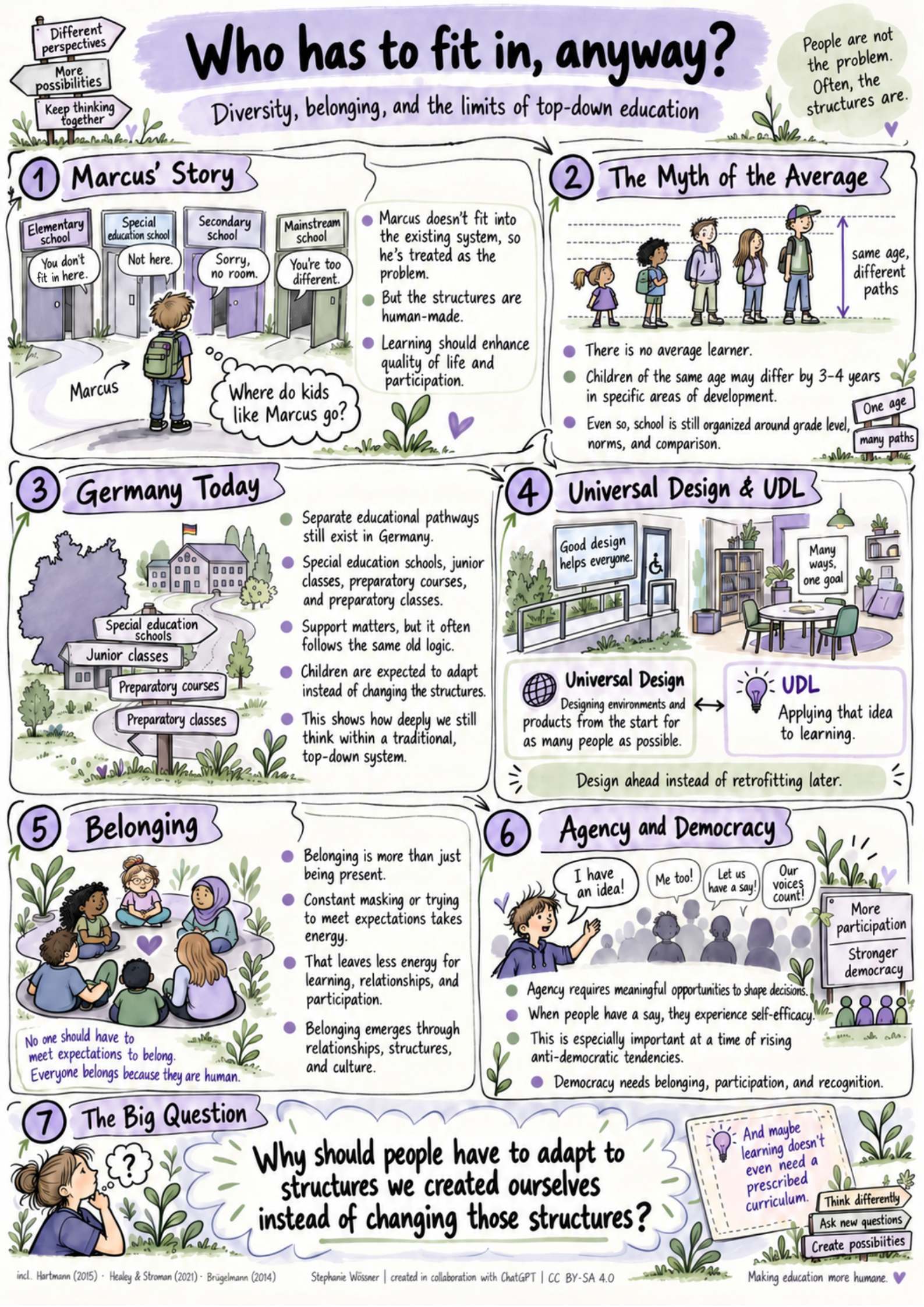 Credits: Stephanie Wössner | CC BY-SA 4.0 InternationalThis story made me angry. Here is a young person with his own interests, experiences, abilities, and ways of understanding the world, navigating it, learning, and helping to shape it. Yet the adults responsible for designing appropriate learning environments seem primarily concerned with the problems his presence might create for their existing approaches. They focus on his diagnoses, his perceived deficits, and the accommodations he would require. That Marcus already has knowledge and abilities, that he can learn and develop, and that other learners and educators might also benefit from his presence barely seems to matter. The adults’ assumptions about what is possible within their institutions become limitations that Marcus himself has little power to influence. And yet these limitations are partly the result of how they have designed their learning environments. So why is Marcus the one being treated as the problem?
This question has been on my mind for a long time. A podcast episode featuring Em Clark, which I listened to recently, prompted me to revisit how readily adults assume the authority to decide what children can do, what they need, and who they are supposed to become. In the episode, Clark discusses childism and her understanding of children as already whole human beings. Adults frequently view children in terms of what they supposedly lack and measure their development against expectations defined by others. Similar patterns can be found in how neurodivergent people are treated, regardless of their age. Yet every person is already someone, with their own experiences, perspectives, and ways of understanding and shaping the world. Development is part of being human, but it does not make a person any less whole or valuable while they are developing. Marcus’ story illustrates what happens when other people’s judgments determine which experiences a person is even allowed to have. There is a significant difference between someone underestimating another person’s abilities and that assessment determining which learning opportunities they can access and which possibilities for their future remain open to them.
Hartmann connects this perspective to the concept of the expert learner. She describes learners as people who can be purposeful, resourceful, and strategic in different ways, even when their abilities do not match conventional expectations. From this perspective, learning involves gaining experiences, exploring and making sense of the world, finding meaning, and becoming increasingly able to make one’s own decisions and help shape one’s surroundings. What I find particularly important is that Hartmann connects this understanding to quality of life and the possibility of living a fulfilling life. After all, why do we design education in the first place if we lose sight of what people need to live a good life? And who gets to decide what such a life should look like?
The Power of What Passes for Normal
Marcus’ story points to a more fundamental problem that my engagement with Universal Design has once again brought into focus. We know that there is no such thing as the average person, or the supposedly average learner around whom our education system has been designed. Yet much of the system continues to operate as though this fictional average actually existed. Expectations are established about what people should know and be able to do at a certain age, how quickly they should learn, how they are expected to demonstrate their abilities, and which behaviors are considered appropriate. Anyone who deviates from these expectations is seen as needing additional support, individual accommodations, or placement in a separate category. This logic is deeply embedded in school structures that are still shaped by industrial-era ideas of standardization, comparability, and control. Meanwhile, we are living through an era of fundamental change, and it is becoming increasingly clear how poorly such assumptions reflect the complexity of the world we inhabit.
A look at children’s development alone reveals how contradictory our reliance on age-based norms really is. Even children of the same age can differ considerably in their development. Educational researcher Hans Brügelmann has pointed out that developmental differences of three to four years can occur among children of the same age. These differences concern particular areas of development and competence, rather than a single overall developmental age for the child. A child might, for example, have highly developed language abilities while needing more time or support in other areas. Yet our education system remains largely organized around age-based grade levels and expectations about what should be achieved within a particular timeframe. Deviations from these expectations then become grounds for additional support, delayed school entry, or placement in different educational pathways. The fact that children develop differently is hardly a new discovery. The question is why our education system still so often treats this variability as a difficulty that needs to be managed.
Of course, social institutions need shared rules and some common points of reference. But why do we cling so firmly to norms that fail to adequately reflect human diversity? People do not develop along a single, uniform path. Their abilities, needs, and possibilities change with their experiences, their environments, and the demands they encounter. Something that presents a difficulty in one context may barely matter in another. Even people with similar neurological profiles or comparable support needs do not experience the world in the same way. Neurodiversity helps make some of these differences visible, although they cannot be reduced to neurological characteristics. When we also consider superdiversity and intersectionality, the diversity of individual lived experiences becomes even more apparent, along with the extent to which these experiences are shaped by social, cultural, historical, and societal conditions. Nevertheless, people are repeatedly judged by how well they fit into existing structures. I find it disrespectful that their differences are so often treated, first and foremost, as problems that need to be addressed.
What I find particularly contradictory is that legal provisions are intended to ensure access and participation while the structures to which access is granted frequently remain largely unchanged. Hartmann describes this problem in the context of the US education system and its legal requirements for learners with disabilities. Although these provisions are intended to guarantee access to the general education curriculum, their implementation can result in a process in which individual differences are first identified and then addressed through accommodations. Learners are categorized, their support needs are assessed, and existing learning opportunities are modified after the fact. The more fundamental question of how the curriculum itself is designed often goes unanswered. Legal frameworks differ from country to country, but the underlying contradiction is by no means limited to the United States.
Germany has been legally bound by the UN Convention on the Rights of Persons with Disabilities, including its commitment to inclusive education, since March 2009. Nevertheless, largely separate educational pathways continue to exist. In Baden-Württemberg, according to official figures from the state’s Ministry of Education, 57,385 children and young people attended one of 551 special education and counseling centers (Sonderpädagogische Bildungs- und Beratungszentren, SBBZ) during the 2025–26 school year. The previous year, that number had been 56,122, or 1,263 fewer. At the same time, according to a press release issued by the State Statistical Office on October 13, 2026, 10,332 learners with identified special educational needs participated in inclusive learning opportunities at mainstream schools, an increase of 8.4 percent over the previous year. In other words, the number of learners participating in inclusive education is increasing, but so is the number attending special education centers. These figures show, first of all, that both developments are happening simultaneously. The extensive separation within the education system remains in place.
The challenges are real, particularly given staffing shortages, insufficient multidisciplinary support, and often inadequate resources and conditions. But the difficulty of implementing inclusion within a system historically designed around selection and homogeneity says a great deal about that system. It should prompt us to question its underlying assumptions. Instead, education policy continues to respond to current challenges largely within familiar structures. Children are expected to be prepared for the demands of school, reach certain developmental milestones, and meet defined prerequisites before they can participate in the learning opportunities provided. The demands themselves are generally taken for granted. This reflects a traditional understanding of education in which learning goals, schedules, assessment criteria, and major decisions about learning are largely determined by others.
That is why I find current developments in education policy particularly striking. In Baden-Württemberg, so-called Juniorklassen (junior classes) are being introduced starting in the 2026–27 school year. Children identified as needing intensive support in their language, cognitive, motor, or social-emotional development can spend an additional year in a preparatory class before entering first grade. Although these classes are organizationally part of elementary schools, they precede the regular educational pathway. During the first two years of implementation, parents and legal guardians retain the decision about whether their children attend. Beginning in the 2028–29 school year, attendance is intended to become mandatory for children identified as having the relevant support needs. In July 2026, the German state of North Rhine-Westphalia passed legislation introducing school-based preparatory courses to support language development. Children whose German language skills are considered insufficient for participation in regular learning opportunities when they register for school will be required to attend a preparatory course. In addition, a decision can be made at the point of school entry to place a child in a three-year initial elementary school phase if the expected foundational learning prerequisites have not yet been met. In Baden-Württemberg, according to the Ministry of Education, 25,742 children and young people attended preparatory classes at general education schools during the 2025–26 school year.
Children develop language, mathematical, and other competencies under different circumstances. Some need targeted support, specific assistive tools, or temporarily smaller learning groups. Such options belong in learning environments designed to accommodate different people. Yet current education policies often begin with a different question: How can children be prepared to meet the demands of existing structures? What counts as necessary preparation, a need for additional support, or a developmental delay is largely determined by what the existing system expects at a particular point in time. The assumption that all children should develop certain competencies within a prescribed timeframe and then enter school with learning prerequisites that are as comparable as possible remains largely unchallenged. This is precisely where we can see how deeply current policies remain rooted in the assumptions of a traditional education system in which learning is directed by others. When those expectations are taken for granted, additional preparatory or support classes almost inevitably appear to be the obvious solution.
Whether this kind of organizational separation is actually the best response is far from clear. Support provided in separate groups may benefit individual learners while also affecting their sense of belonging, their social relationships, and their future educational pathways. There is also the question of whether additional resources would be better invested in these separate programs or in the long-term development of shared learning environments. Precisely because children’s development and futures are at stake, the consequences of these decisions need to be carefully examined. The first solution that seems plausible within the familiar logic of the system is not necessarily a sustainable one. It may even prevent more fundamental changes from being considered at all. After all, when additional measures are repeatedly needed to give people access to existing educational opportunities, that is also a sign that the underlying design of those opportunities needs to be examined.
This idea lies at the heart of Universal Design, an approach that originated in architecture and product design and is particularly associated with architect Ronald Mace and the Center for Universal Design at North Carolina State University. Products, buildings, and environments should be designed from the outset so that as many people as possible can use them without requiring special adaptations later on. This may sound obvious, yet it is far from common practice. The 2019 Tony Awards provided a striking example of how far reality falls short. Actress Ali Stroker became the first wheelchair user to win a Tony Award, but later could not join the other members of her cast onstage because there was no accessible route from the audience area to the stage. Situations like this reveal how readily designers of spaces and events continue to assume certain physical abilities. People who do not meet those assumptions are consequently excluded or left dependent on improvised solutions.
Universal Design for Learning takes this underlying idea into the context of learning and develops it into a distinct educational framework. CAST has developed guidelines that recognize learner variability and provide for different ways of accessing information, participating, expressing learning, and receiving support from the outset. This does not relieve educators of the responsibility to recognize individual needs and continue developing learning environments together with learners. But it changes the starting point: Learner variability is considered from the beginning of the design process rather than becoming relevant only when someone struggles with what is already in place.
Even an accessible learning environment leaves me with a more fundamental question: Why do we assume that learning requires an externally prescribed curriculum in the first place? Anyone who considers a mandatory curriculum necessary still has to ask who defines its goals and content, which knowledge is considered relevant, which forms of development are recognized, and how much influence learners have over these decisions. I question the very assumption that learning has to be tied to such a curriculum at all. UDL can help remove barriers and better accommodate human diversity. But the question of whether educational goals and learning pathways need to be determined by others to this extent goes further. It concerns our understanding of education, the possibilities for human self-determination, and the power relations within which decisions about learning are made.
Belonging Is Not an Individual Responsibility to Adapt
Kaleen Healey and Chloe Stroman explore how deeply these power relations shape people’s experiences of learning environments in their 2021 publication Structures for Belonging. Their research also focuses on the US education system. They understand belonging as something that emerges through the relationship between people and their environments and is strongly influenced by previous experiences, social positioning, and institutional structures. Whether learners feel welcome and experience themselves as valued members of a community depends on the signals they encounter in their environment and how they interpret those signals in light of their experiences. The same learning environment can therefore mean very different things to different people. Someone who sees themselves reflected in that environment, understands its unspoken rules, and feels recognized may never even have to think about whether they belong. Someone who has repeatedly experienced exclusion, whose identity is rarely represented, or whose behavior is constantly questioned may experience that very same environment quite differently. These differences are neither random nor simply a matter of individual perception. They also reflect societal power relations that privilege certain ways of living while devaluing others.
What matters particularly to me in this context is the relationship between belonging and learning. Someone who is constantly trying to figure out what is expected of them, how their behavior is perceived, or which parts of their identity would be safer to conceal has to devote emotional and cognitive resources to that process. Those resources are then less available for learning, developing personal interests, building relationships, or participating in shaping society. I think, for example, of neurodivergent people who have learned to set aside their own needs or suppress certain behaviors in order to avoid drawing attention to themselves. Or of children who repeatedly receive the message that they are somehow not functioning as they should, or who witness exclusion in the society around them. Perhaps, eventually, they manage to meet the expectations of their environment. But what has that adaptation cost them? What opportunities might they never even have discovered because so much of their energy was spent trying not to stand out? And what does it do to someone’s understanding of themselves when belonging repeatedly depends on meeting certain expectations, and obstacles remain even when they succeed?
These dynamics are by no means confined to schools or other educational institutions. In the workplace, too, it makes a considerable difference whether people feel they belong, whether their experiences and perspectives are recognized, and whether they can contribute without constantly worrying about being judged negatively or excluded. Someone who finds that their way of communicating, thinking, or working does not match an organization’s unspoken expectations faces similar questions. How much of themselves can they show? What adaptations are expected, and what consequences might follow if they do not comply? In hierarchical organizations, the ability to question existing rules or expectations is also distributed unequally. Here, too, leadership, organizational culture, relationships, and institutional structures shape people’s experiences of belonging. A study by Thissen et al. (2023) examines the significance of belonging in the workplace, including its relationship to health, recognition, and exclusion. Ultimately, the question of belonging concerns every space in which people live and work together.
Healey and Stroman show that belonging affects learning, engagement, and well-being in ways that can extend far beyond an immediate situation. Environments in which learners feel recognized and experience a sense of belonging create different opportunities for participation. At the same time, the authors make clear that belonging cannot simply be established through kind words or occasional community-building activities. It develops through relationships, but it is also shaped by institutional rules, the distribution of resources, societal narratives, and power relations. An environment in which certain people are systematically disadvantaged does not become inclusive simply because they are told they are welcome. This is precisely why we need to examine dominant culture and the assumptions that so often remain invisible to those who benefit from them. Whose experiences are considered normal? Whose language, behavior, and knowledge are recognized? Who is expected to explain themselves while others are simply assumed to belong? And who has the power to judge whether someone is competent, motivated, or behaving in a socially appropriate way?
Agency, Belonging, and Democracy
For me, the connection to agency is obvious. Self-determination is closely tied to the actual possibilities people have within a particular environment. Learners can be encouraged to take responsibility for their learning and make their own decisions. But if the fundamental conditions have already been established and are barely open to discussion, their self-determination remains limited. At the same time, agency cannot be understood as an individual capability that develops independently of societal conditions. People need genuine opportunities to influence decisions, contribute their perspectives, and participate in shaping their environments. Belonging also develops when people are able to make meaningful contributions and experience their knowledge and perspectives as valuable. This requires those who design learning environments and make institutional decisions to be willing to share power and question their own assumptions.
Against the backdrop of current antidemocratic developments, this takes on additional significance for me. The Friedrich-Ebert-Stiftung’s 2024–25 Mitte Study shows that the vast majority of people in Germany support democracy, while antidemocratic and dehumanizing attitudes continue to find acceptance in parts of society. In this context, we need to ask what kinds of experiences people actually have with equal human worth, recognition, and democratic participation. What do children and young people experience when their perspectives are barely considered, when decisions are made over their heads, and when belonging depends on how well they adapt? Democracy needs people who participate, take responsibility, engage with different perspectives, and help shape societal developments. Opportunities to do so also need to be part of everyday experience. Designing learning environments is therefore always connected to the question of what kinds of social relationships and ways of living together we make possible and practice. In this sense, belonging and agency have a democratic dimension that extends far beyond individual learning outcomes.
This brings me back to Marcus. His story might have unfolded differently if the educators and decision-makers involved had seen his presence as an opportunity to develop their learning environments further. His support needs would not have disappeared, but they would not have determined from the outset which opportunities were available to him. Perhaps the other learners would have gained new experiences, perhaps the educational approaches would have changed, and perhaps the adults themselves would have learned something about their own assumptions. Toward the end of her article, Hartmann essentially asks what would change if we stopped asking where children like Marcus could go and instead asked who was willing to learn from what Marcus knows. To me, that represents a fundamental shift in how we understand education and the relationship between people and societal institutions.
The Responsibility for Change
These questions extend far beyond schools. Societal institutions have developed over time, shaped by political decisions and cultural beliefs and continuously reinforced through everyday practices. Opportunities to change them are unequally distributed, as are the consequences of their shortcomings. Those who control resources, establish rules, and make institutional decisions therefore carry particular responsibility. At the same time, people contribute in different ways to reproducing these structures when they accept existing expectations without questioning them, judge others against those expectations, or treat differences as individual problems. At a time of fundamental change, when societal structures need to be reimagined anyway, I find it all the more contradictory that we continue to cling to ideas about normality, achievement, and adaptation whose exclusionary effects have long been recognized.
I know that societal transformation is complex and that people working within existing institutions cannot simply ignore the conditions under which they operate. Time, resources, legal requirements, and institutional expectations impose real constraints. I know this from my own experience. But these constraints do not explain why so much effort continues to go into finding new solutions within existing structures instead of questioning the assumptions on which those structures are based. Current education policy provides a good example. The problems are certainly recognized, and considerable efforts are being made to address them. Yet as long as the responses primarily focus on preparing children to meet the demands of the existing system, its fundamental orientation remains unquestioned. Additional support programs can bring improvements within that logic. But they do not automatically change the conditions that make such support necessary in the first place. Even the growing attention to inclusion, diversity, and individualized support has so far done little to change how deeply assumptions about supposed normality remain embedded in our institutions.
The question, then, is how more people can be encouraged to recognize these connections and act on what they understand. From a humanistic perspective, much of this seems self-evident to me. Every human being has value, regardless of how well they meet socially defined expectations. People develop, learn, form relationships, have different needs, and want to live their lives in ways that are meaningful to them. Yet much of how we organize society continues to be shaped by assumptions that treat certain ways of living as natural and others as deviations from the norm.
The structures that shape how we learn and live together are neither natural nor unchangeable. They have been created through social processes, and responsibility for shaping them remains a societal task. Current debates about education policy in particular reveal how important it is to question solutions that seem obvious at first glance. After all, when an existing structure repeatedly excludes people, simply creating additional pathways through which they might somehow manage to fit cannot be a lasting solution. Why is it so difficult to question the assumptions underlying these structures themselves? And why is it still so readily accepted that individuals are expected to adapt, while the institutions demanding that adaptation are so rarely called into question?
Further Reading
- Brügelmann, H. (2014). Der „Verschiedenheit der Köpfe“ gerecht werden – eine Aufgabe erst seit Einführung der Inklusion? Lehren & Lernen, 40(8/9), 62–65. Fachportal Pädagogik.
- CAST. (2024). Universal Design for Learning Guidelines, Version 3.0.
- Center for Universal Design. (1997). The principles of universal design. North Carolina State University.
- Friedrich-Ebert-Stiftung. (2025). Mitte-Studie 2024/25: Die angespannte Mitte.
- Hartmann, E. S. (2015). Universal design for learning (UDL) and learners with severe support needs. International Journal of Whole Schooling, 11(1), 54–67.
- Healey, K., & Stroman, C. (2021). Structures for belonging: A synthesis of research on belonging-supportive learning environments. Student Experience Research Network.
- Ministerium für Kultus, Jugend und Sport Baden-Württemberg. (2026). Zahlen zur Schule und FAQ zur Bildungsreform.
- Statistisches Landesamt Baden-Württemberg. (2026). Inklusion in baden-württembergischen Schulen: Zuwachs um 8,4 %.
-
Thissen, L., Biermann-Teuscher, D., Horstman, K., & Meershoek, A. (2023). (Un)belonging at work: An overlooked ingredient of workplace health. Health Promotion International, 38(3).
Bildquellen
- Who has to fit in: Stephanie Wössner | CC BY-SA 4.0 International
- Neurodiversity: PetiteProf79 | CC BY-SA 4.0 International