
There are texts and conversations after which you do not suddenly see everything differently, but something still shifts because they offer a new frame for convictions that were already there. That was my experience listening to the episode The Already Whole Child from That Early Childhood Nerd, in which Heather Bernt-Santy speaks with Em Clark about her article The Already-Whole Child: Reconceptualizing Care and Sanctuary through Childism. Much of what they discuss felt close to ideas that have shaped my own educational work for years: agency and co-agency, children’s rights and equity, learning as a relational process, playfulness, learning for life, and learning environments that do not simply move people through predetermined routines as efficiently as possible, but actually open up room for participation and shaping. My more intensive engagement with neurodiversity over the last months has sharpened that view even further.
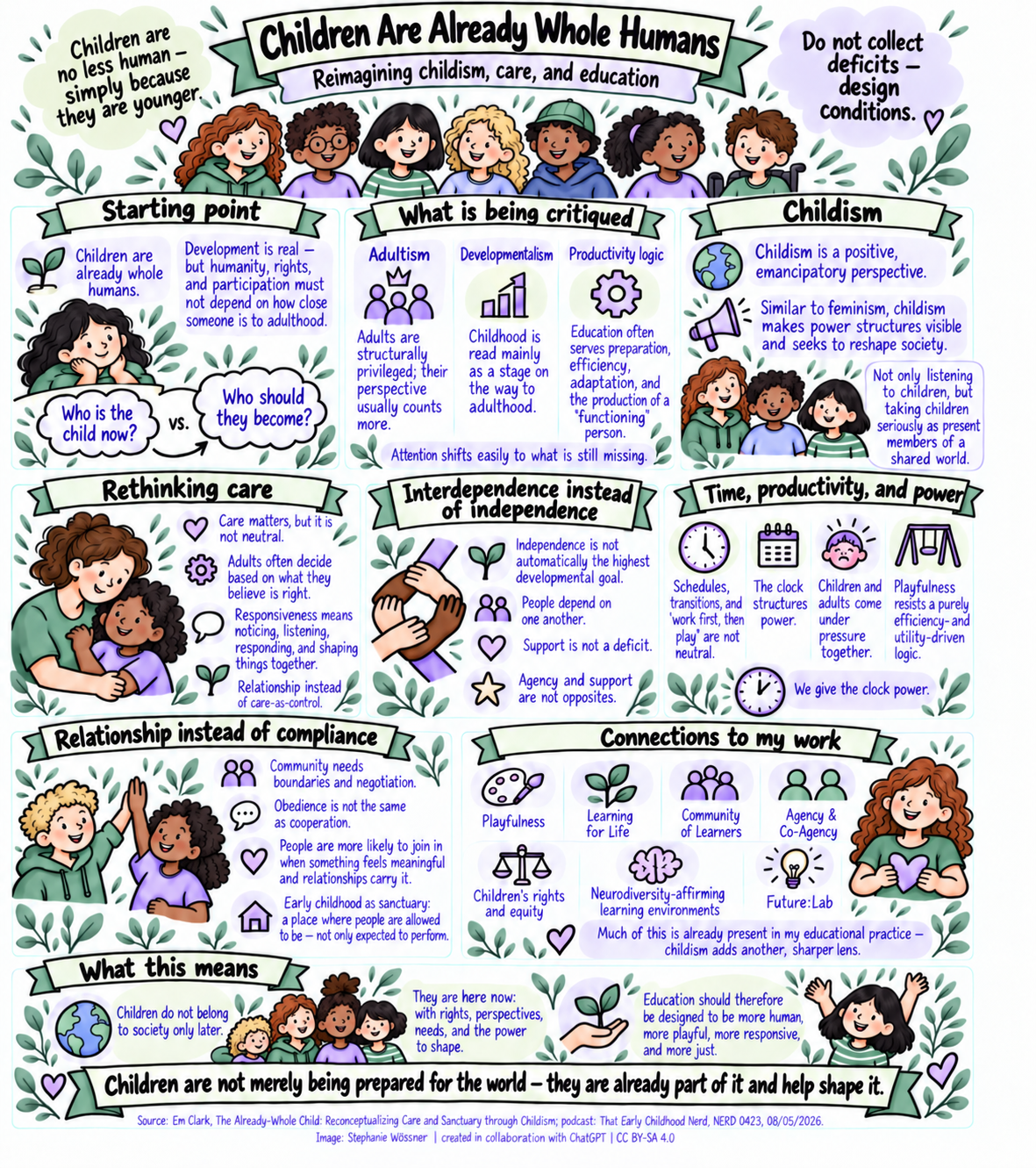 Credits: Stephanie Wössner | CC BY-SA 4.0 InternationalAnd yet, while listening, I kept thinking: she is approaching this more radically than I have so far. Not necessarily because the practical consequences for education would be completely different. Rather, Clark starts from a place from which I myself have looked at education less often. I often approach these questions through learning, learning environments, agency, and shared future-making. Childism begins by looking at the social position of children as children. That makes questions visible that cannot simply be reduced to pedagogy: Why is adulthood so automatically treated as the endpoint? Why do adults, by default, decide how much power children get? Why is independence valued more highly than interdependence? And how much of what we describe as support, care, or preparation rests on an image of the child as not yet fully complete?
Clark’s opening question is therefore deliberately unsettling: what would early childhood education mean if we truly understood young children as already whole—as already whole and fully human persons? Her article describes how adultist, developmentalist, and neoliberal logics position children as beings-in-progress, as people whose value and rights are closely tied to how far they have moved toward a normative version of adulthood.
When adulthood becomes the norm
None of this means denying that children develop. Human beings change throughout their entire lives. I learn differently at 47 than I did at 17, but that does not mean I was less of a person at 17. That distinction is exactly what makes the concept of developmentalism so useful. Development becomes problematic when it turns into a hierarchy in which adulthood becomes the measure of how competent, rational, autonomous, or socially relevant someone already is.
In everyday life, that logic is difficult to recognize because it sounds so familiar. Children are expected to become school-ready, independent, responsible. They are supposed to regulate their emotions, sit still, complete tasks, and prepare for later life. Much of this comes from understandable and often caring motives. Still, it creates a gaze that focuses strongly on what is not there yet. The more we think about what someone is supposed to become, the harder it can become to notice who that person already is.
This connects with a critique of education that has been important to me for a long time. In my series on the future of learning, I have deliberately not framed learning as the production of competencies for a later labor market, but as part of human and social development, relationships, and future-making. Learning has value in the present, not only when it can later be put to economic or social use. Clark sharpens this argument. If childhood is structurally understood as preparation, then learning is not the only thing that becomes functionalized. The child is read through the lens of the future adult. In that sense, even the seemingly harmless phrase “first work, then play” suddenly belongs to a much larger logic. First comes what is productive; play comes afterward. First duty, then pleasure. Being outdoors, moving, exploring playfully, or simply enjoying oneself must be earned. The fact that many adults know this logic from their own childhood and still apply it to themselves—or reject it only partially—does not make it more neutral, only more familiar.
From adultism to childism
Adultism has been an important concept for me for some time. In my article Wenn Erwachsene immer Recht haben – warum wir Adultismus endlich hinter uns lassen müssen, I described it as the structural privileging of adults: adults supposedly know more, are allowed to decide more, and their perspective carries more weight, while children and young people live within structures that adults have designed for them. This shows up in families as much as in education or political participation.
What I take more strongly from Clark’s perspective is childism as a positive concept. It is not used in the same way everywhere, but Clark draws on the tradition around John Wall, in which childism is understood as a critical and emancipatory perspective. The comparison with feminism is especially helpful for me here. Feminism is not primarily the name of the discrimination of women; it makes a power order visible and opens up the possibility of shaping social relations differently. In that sense, adultism names the structural prioritization of adults, while childism asks what society might look like if children’s experiences and humanity were not evaluated against an adult norm.
Clark describes childism accordingly as a lens through which systemic adultism can be deconstructed and social norms reconstructed from the lived experiences of children. That is more than a call to listen to children more often. Childism shifts the perspective from the question of how adults can better do justice to children to the question of how we shape a shared world in which children are already members with their own perspective, their own rights, and their own power to shape.
This is also where I now see an interesting connection to agency and co-agency. In my talks, I often work with the OECD Learning Compass 2030 and the Sun Model of Co-Agency. Agency refers to the possibility of setting goals, making decisions, and acting effectively; co-agency makes visible that such possibilities arise relationally and that adults and young people may share very different degrees of power. This has always mattered to me because participation does not automatically mean real co-creation. A youth hearing after which adults still decide alone, or a learning task that offers three preselected options, can count as participation and still leave very little actual shaping power.
Childism goes one step further back: why does power lie with adults in the first place and then get shared by them? That question does not make agency and co-agency less relevant to me. It adds a layer I had not made quite so explicit before. Even a well-intentioned system of participation can still function within an adultist order if adults ultimately define which decisions children are allowed to make and when their perspective counts as sufficiently “mature.”
Children’s rights, care, and interdependence
This also gives the UN Convention on the Rights of the Child a somewhat different emphasis. I have referred to it for a long time when speaking about equity and participation. The fact that the United States is still the only UN member state not to have ratified the convention is striking, but of course that does not automatically explain how well children’s rights are realized in those states that have ratified it. Formal rights and lived reality are two different things. Germany, too, and the German school system in particular, do not automatically follow through on the idea that young people should be involved in decisions that concern them.
What Clark sharpens is the logic behind this: children’s rights are not advance rights granted in view of future adulthood. Participation rights do not need to be justified by saying that children thereby develop democratic competencies for later. They matter because children are human beings and members of society now.
This is also why I find the World Child Forum so compelling. Until now, I have mainly used it as a strong example of understanding young people not as a target group but as actors. The initiative The Nobel Peace Prize Initiative made this thought particularly visible once again: not a single extraordinary child who earns social relevance through exceptional performance, but children as a group and as present-day social actors. That fits remarkably well with Clark’s question of how differently we might conceptualize the world if we consistently understood children as fully human—or, better, if we designed the world from that assumption.
Another aspect of the podcast that stayed with me was the idea that society makes an enormous number of decisions simply because adults believe that children need those things. That is, after all, part of responsibility and care. Clark does not reject care. Rather, she draws on care ethics and asks what happens when care is defined one-sidedly.
There is an important distinction here. Adults can know a great deal about children and still decide past the actual child in front of them. Developmental models, pedagogical concepts, checklists, observation tools, and professional experience can all be helpful. They can also lead us to already know what we expect to see. In an authentic relationship, the situation is different: there, the other person must be able to answer back. Care becomes a mutual process in which one side does not fully define what the other needs.
Clark therefore places much greater emphasis on responsiveness. Not: I know what children need. But: I notice how this particular person responds to a situation, and I allow that knowledge to shape what happens next. For me, this connects directly with my work on neurodiversity. In What neurodiversity means for the design of learning environments, I wrote that learners are not simply users of an environment that others optimize for them. They themselves hold knowledge about how that environment affects them, and that knowledge belongs in the design process.
This is also where the Future:Lab comes in, without needing a separate excursus. Spaces, materials, technology, missions, and roles can create conditions in which exploration, multiple pathways, and shaping become more likely. But even a carefully designed space remains provisional. The people who use it change it through their decisions, needs, and ideas. A responsive learning environment is therefore never finished. Clark’s point that control can prevent us from seeing what children already know or can do captures this tension very well. If we are constantly checking whether a child is reaching an expected state, we will inevitably notice less of what emerges beyond that expectation.
Clark’s critique of independence as an ideal is especially compatible with my neurodiversity-informed perspective. Many developmental models describe progress in terms of children needing less help, organizing themselves, and acting independently. Of course it can be empowering to be able to do something on your own. It becomes problematic when independence is treated as a measure of human completeness.
Clark contrasts this with interdependence. Human beings depend on one another—not only small children, not only disabled or neurodivergent people, not only those officially identified as having support needs. Adults, too, live through relationships, use infrastructures, draw on the knowledge of others, need care and support, and sometimes cannot do under certain conditions what they can do easily under others. Clark’s combination of childism and care ethics therefore explicitly challenges the idea that independence is a higher state of human existence.
For me, this is more than a semantic shift. Once interdependence becomes the starting point, the way we think about support changes as well. Needing support no longer means that something is missing from a person’s wholeness. Help and agency no longer automatically stand in opposition. Co-regulation is not an unfortunate stop on the way to full self-regulation. And a person no longer needs to prove that they require as little support as possible in order to count as competent.
These thoughts connect directly with what I have learned in recent months about regulation. In What my nervous system is teaching me about learning and learning environments, it became increasingly clear to me that capacities can be available in state-dependent ways. A person may be fundamentally able to do something and still have no access to it in a given situation. This is not a side issue. As soon as independence is treated as the ideal, support is in danger of being read as deficit, even though it may simply be a normal condition of human agency.
Time, playfulness, productivity, and compliance
At several points, the podcast creates an almost unsettling reversal of perspective. We often expect from children a form of self-control and adaptation that adults themselves would hardly sustain. Sitting still for long periods, staying attentive even when something is not engaging, fitting eating, movement, or bathroom needs into predefined time slots, stopping an activity immediately because the schedule demands it, regulating emotions in a socially acceptable way while remaining polite—adults, too, become irritated when they are hungry, exhausted, or overwhelmed. In meetings, we stand up, get coffee, look out the window, move around, or lose concentration. Comparable reactions in children quickly become pedagogically relevant.
This does not mean children should always get what they want. Clark does not say that, and this distinction matters. Community does not function without boundaries, negotiation, and mutual consideration. The question is rather why adult needs and institutional routines so often appear as objective necessities, while children’s needs appear as something to be managed.
Perhaps some situations that adults describe as “tantrums” or problematic behavior are easier to understand once we also see this cultural conflict. That does not explain every escalation, and it certainly does not reduce every meltdown to a single cause. But it changes the question: is the problem located entirely in the child who does not adapt, or are different needs and power positions colliding here?
This is where Clark’s focus on time was especially helpful to me. Time is so omnipresent in education that it has almost become invisible. Learning blocks begin and end, transitions happen at set moments, breaks are fixed, and rooms must be changed. The clock appears as a neutral external force: we have to move on now because that is simply what time demands.
Clark describes clock-driven pacing instead as part of the power structure of educational spaces. Her counter-concept, responsive pacing, does not mean abolishing all time structures. Shared spaces need coordination. But we can recognize the clock for what it is: a human-made structure whose demands can be weighed against concentration, relationships, bodily needs, and the different needs of those involved. Clark describes the conscious interruption of such routines as a redistribution of power, not as indulgence.
This also affects adults. In the podcast, Clark speaks about the pressure on educators and care professionals who are expected to keep all these time structures functioning. Adults and children alike are worn down by systems whose routines continue even when everyone can feel that they are no longer serving anyone well. That is an important point, because otherwise childism can easily be misunderstood as a conflict between children and adults. Many adults within institutions themselves have far less shaping power than their role in relation to children might suggest.
This is where playfulness comes back in for me. In my educational work, it has long meant more than playful methods. Playfulness makes exploration, openness, detours, and the testing of possibilities possible before the outcome is fixed. In The future of learning is not digital, it’s human (in German only) and the related blog series, I intentionally connected relationships, play, and self-efficacy with future skills and human-centered education.
Clark gives this perspective an additional political sharpness. If the unspoken goal of education is to prepare people for efficiency, adaptation, and productivity, then compliance easily becomes a virtue. Being punctual, completing tasks, setting one’s own needs aside, accepting instructions, and functioning as smoothly as possible—all of this fits neatly with the image of the future compliant worker. The industrial-age mindset remains intact even when we cover it with more modern language.
That does not mean responsibility, reliability, or shared rules are unimportant. But human beings are not built to be efficient all the time, and education should not reduce them to that. The idea that joy or play is unproductive runs deep. That is precisely why it matters to ask what happens when we stop treating playfulness as a reward after the “real” work and instead recognize it as a legitimate way of engaging with the world.
At this point, many of the threads that seemed separate begin to come together. Children are strongly relationally oriented. Human beings in general are. And yet institutions often treat relationship as a soft supplement to the supposedly real tasks: learning, achievement, competency development, organization. Clark turns this order around. In an authentic relationship, fewer standardized instruments are needed to notice when something is wrong, because perception and responsiveness are already part of the relationship.
This does not mean declaring professional observation, research, or structure unnecessary. It means refusing to put them in the place of relationship. When people understand why something matters, when they recognize a shared purpose, and when their perspective can shape the situation, they will do much of what living together requires. That is something different from compliance. Cooperation does not emerge because one person decides and the other obeys; it grows in a process of shared orientation.
This is also why I like the term community of learners. I do not mean a harmonious space without differences in power. Adults and children do not carry the same responsibility, have the same experience, or occupy perfectly symmetrical roles in every situation. But a community of learners assumes that all participants can learn, contribute knowledge, and take part in shaping the shared space. Adults are not the finished people guiding unfinished people toward a later endpoint.
Norms, sanctuary, and humanizing learning environments
Clark’s analysis also does not stop with age. Adultism intersects with other power relations. Her article points out that control, surveillance, and normative expectations affect marginalized children differently, including Black, Brown, Indigenous, and neurodivergent children.
This connects directly with my more recent work on neurodiversity and intersectionality. Developmental models and diagnostic assumptions did not emerge in a vacuum. When research, educational theory, or images of “normal” development are based mainly on certain groups, those experiences quickly become the implicit standard for everyone else. This affects gender, social class, cultural background, and neurology, among other dimensions.
In When adaptation hurts: trauma, masking and intersectionality, I wrote about why the same behavior can be interpreted differently depending on who shows it, and why supposedly neutral norms always have a history. Childism adds another layer to this: age itself is a power category. That does not mean reducing every other difference to it. From an intersectional perspective, it becomes particularly interesting to ask how expectations of children intersect with ideas about neurology, gender, background, disability, or social position. The “right child,” moving through an expected developmental pathway, is never a neutral image.
Clark gathers all these ideas together in the concept of a sanctuary. Her article was published in an issue of the International Critical Childhood Policy Studies Journal devoted to reimagining early childhood education under the theme “Turning to Hope, Making Sanctuaries.” She does not use the term simply to mean a cozy or safe place. It refers to a humanizing alternative to compliance-oriented systems, one that considers relational, temporal, and material conditions together. In the podcast, this became a particularly powerful thought for me: Early childhood could be a sanctuary – you can be instead of performing. That does not mean development, challenge, or responsibility disappear. A sanctuary does not freeze people in their present state. Precisely because people are already whole, they are also allowed to keep growing. Development does not need to be earned, and it does not first legitimize someone’s humanity.
Here I see a clear connection to my own understanding of learning environments. A good learning space is not a place where people are expected to deliver a predetermined performance as smoothly as possible. It opens multiple forms of participation, movement, regulation, exploration, and shaping. And it allows people not to appear constantly productive.
Clark sometimes uses language that can provoke resistance. To speak of dehumanization is strong. No caring parent, teacher, or educator likes hearing that their own practice may be entangled in structures that dehumanize children. This is where I see a connection to the Future:Project’s Wheel of Transformation. When a familiar order suddenly becomes visible as an order, resistance often comes first. We are not necessarily defending bad intentions; we are defending our existing understanding of what is normal, reasonable, and caring.
Developmentalism is a good example. Preparing children for life sounds entirely positive at first. It can even create a kind of educational savior complex: we must give children what they need so that they can succeed later, and we must protect them. Only when we question that underlying assumption does it become visible that we may be reproducing a world to which children are meant to adapt, rather than asking with them what kind of world we want to shape together.
That is one reason I find Clark’s forcefulness convincing. It prevents the critique from being softened too quickly by good intentions. At the same time, I do not read her as morally condemning individual adults. A system can be strange, contradictory, or even dehumanizing without the people within it being evil. Adults themselves have grown up under expectations, have learned to place pleasure behind productivity, to accept authority, and to equate “because I am bigger” with more rights. Anyone who has survived such a childhood can easily come to believe that it cannot have been that bad. That is precisely how cultural patterns reproduce themselves.
And these patterns are by no means exclusively American. Much in the podcast sounds very familiar in Germany as well. We also have educational voices here that quickly frame participation as a loss of control or pit children’s rights against parental rights. The cultural and institutional contexts differ, but the underlying question of power between adults and children remains.
Another lens for my own work
That is why I do not take from Clark an entirely new pedagogy. That would also misrepresent my own work so far. Playfulness, learning for life, agency and co-agency, children’s rights, equity, community of learners, open learning environments, and the conviction that learning must not be reduced to the production of competencies for later usefulness were already there. Much of this also appears in my talks, where I explicitly place questions of humanity, responsibility, participation, and design at the center.
What childism offers me is another lens. Until now, I have often approached these questions through education, learning, transformation, and design. Clark pushes me to begin more strongly with the social position of children themselves. As a result, some of the things I already considered important are reframed: playfulness also becomes a critique of productivity logic, co-agency becomes a question of structural power, care becomes a negotiation between human beings, flexible time structures become a power issue, and neurodiversity becomes yet another reason to question supposedly neutral developmental norms.
The combination of all these perspectives does not lead me to a pedagogy in which adults carry no responsibility or children always decide. It leads me to a more demanding question: How do we shape conditions together in which children and adults can grow, without tying humanity to age, independence, productivity, or adaptability?
Perhaps that is also the point at which already whole begins to point beyond early childhood education for me. Human beings need care, relationships, and other people throughout their entire lives. We continue developing without having been incomplete beforehand. We can take responsibility without becoming fully independent. We can meet expectations without making compliance the goal of education. And we can set limits with children without concluding that their perspective matters less.
If we take that seriously, the question of what education is for begins to change. Children do not first have to be prepared for a world to which they will one day belong. They already belong to this world. And they should have the opportunity to shape it with us.
Further reading
Clark, Em (2025): The Already-Whole Child: Reconceptualizing Care and Sanctuary through Childism. International Critical Childhood Policy Studies Journal, 12(2), pp. 96–109. Article
That Early Childhood Nerd (2026): NERD 0423 – The Already Whole Child with Em Clark, podcast episode, August 5, 2026. Spotify
Biswas, Tanu & Wall, John (2023): Childist theory in the humanities and social sciences. Children & Society, 37(4), pp. 1001–1004. DOI
Wall, John (2023): Childism: Transforming Critical Theory in Response to Children. In: Sarada Balagopalan, John Wall & Karen Wells (eds.), The Bloomsbury Handbook of Theories in Childhood Studies, pp. 208–222. Bloomsbury Academic. Overview | Resources
Noddings, Nel (2012): The caring relation in teaching. Oxford Review of Education, 38(6), pp. 771–781. DOI
OECD (2019): OECD Learning Compass 2030. Concept note
United Nations (1989): Convention on the Rights of the Child. Text
World Child Forum (2026): The Nobel Peace Prize Initiative: What if all the children of this world received the next Nobel Peace Prize? Link
Bildquellen
- Children are human: Stephanie Wössner | CC BY-SA 4.0 International
- Neurodiversity: PetiteProf79 | CC BY-SA 4.0 International